


Original Coverage & Source Attribution: fourweekmba.com
AWS introduced the Physical AI Toolchain on AWS in a blog post dated 7 October 2026, and Amazon’s post of 8 October 2026 describes it as an open-source stack for building machines that perceive, reason and act in the real world. Amazon says it is built on AWS using NVIDIA’s physical AI stack, for industrial automation, autonomous mobility and humanoid robotics.
The code sits in a public GitHub repository, aws-samples/sample-the-physical-ai-toolchain-on-aws, which the GitHub API lists under the Apache License 2.0.
Business Pill · DATA FLYWHEEL
A short explainer of the data flywheel: usage produces data that improves the product, which brings more usage. It teaches the general idea only and says nothing about any company in this story.
The key insight: As we read it, AWS is giving away the integration work rather than the compute. The repository is listed under Apache 2.0, and the blog says the pipeline it packages deploys on AWS managed services, from SageMaker training to IoT Greengrass at the edge.
What AWS Built
The AWS blog calls the toolchain “a publicly available collection of reference architectures, Infrastructure as Code, and deployment automation” for the Physical AI development lifecycle. It says the toolchain is robot-agnostic and task-agnostic: teams bring their own URDF robot description, teleoperation data and task definition.
Amazon’s post lists five pillars: synthetic data generation, model training, simulation and validation, edge deployment, and continuous improvement, where operational data from deployed machines flows back to generate new training data.
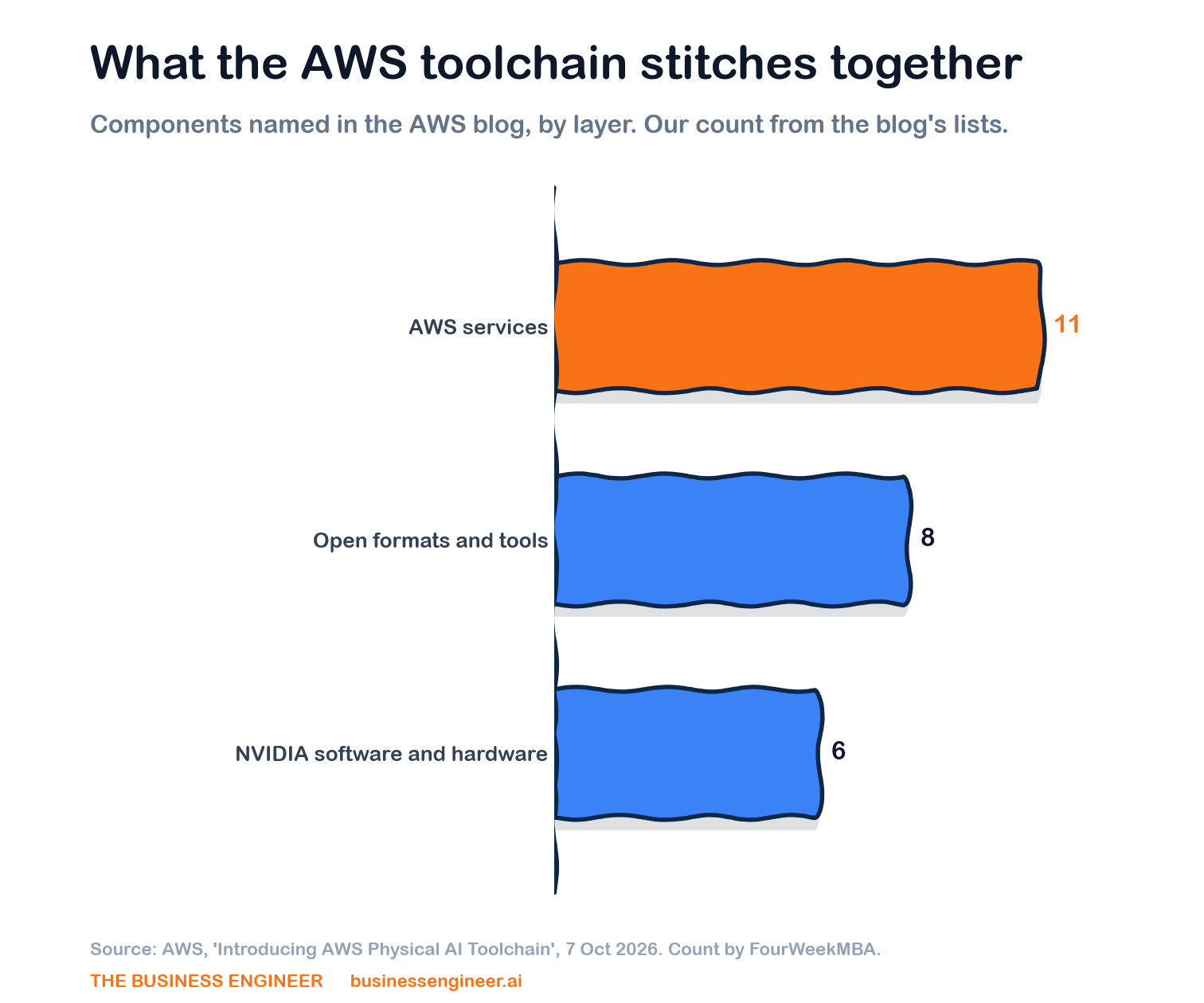
On the AWS side, Amazon names Amazon SageMaker for model training, Amazon EC2 GPU instances for simulation, AWS IoT Greengrass for edge deployment and Amazon Bedrock AgentCore for orchestration. The blog adds AWS Batch, Amazon EKS, Amazon S3 and Amazon FSx for Lustre.
The NVIDIA Layer and the Open Formats
The blog says the toolchain integrates NVIDIA’s robotics software: Isaac GR00T for vision-language-action training, Isaac Sim for physics simulation, Isaac Lab for reinforcement learning, Cosmos for synthetic data generation and OSMO for workflow orchestration, with Jetson and RTX hardware as the edge targets.
Beyond NVIDIA, the blog lists open formats and tools. Raw recordings arrive in Zarr and are standardised to the LeRobot format; training uses PyTorch and Hugging Face. Reinforcement learning tasks are defined in Gymnasium, robots are described in URDF, models export to ONNX for edge inference and hand off to ROS 2 for on-robot control.
Each component is an independent Terraform module, according to the blog, so teams can adopt one stage at a time or deploy the full pipeline. At the base sits what AWS calls the Strands Agentic Layer, built on the Strands Agents SDK, which the blog says takes intent in natural language and decides which components to invoke.
Named Customers and Figures
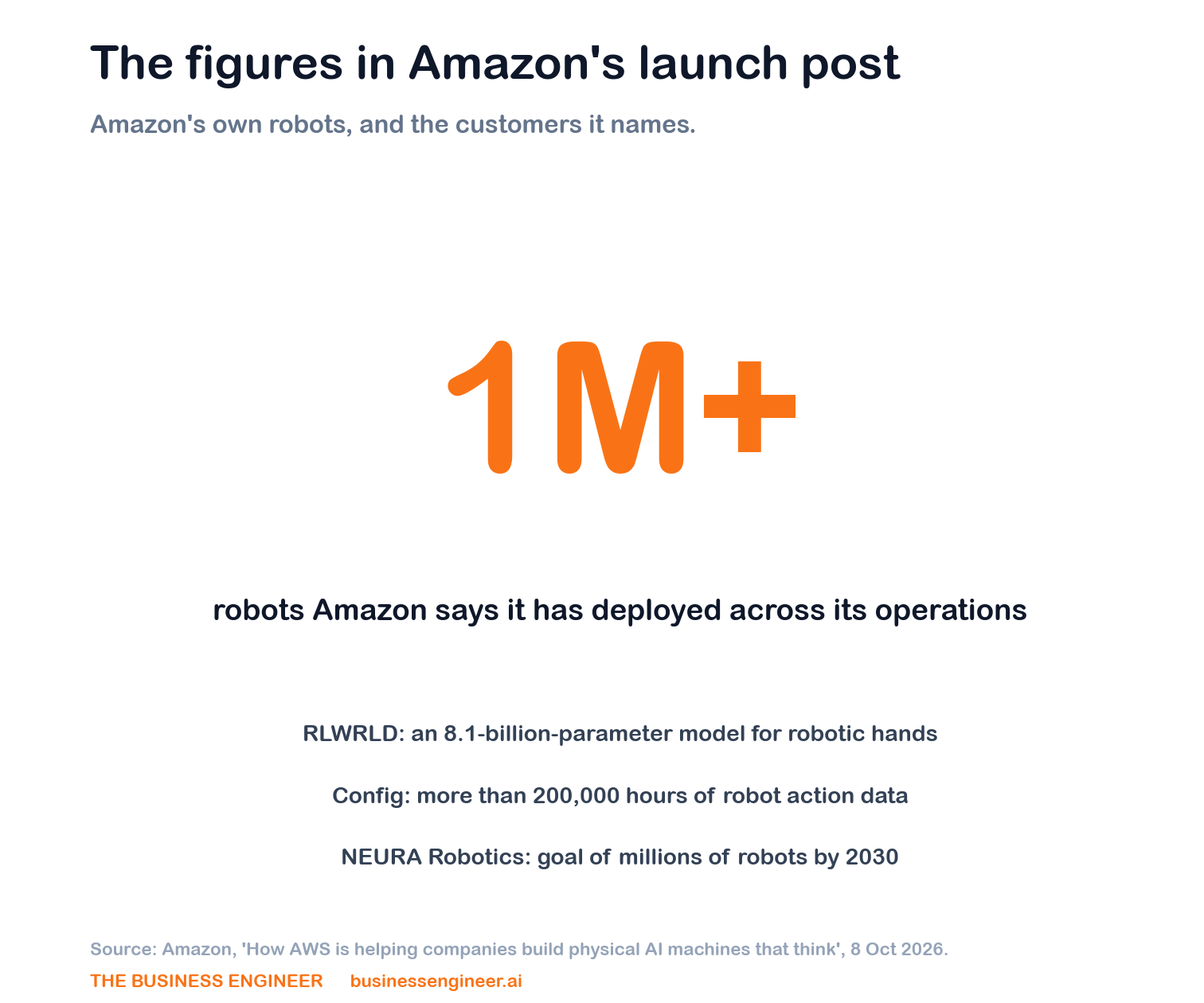
Amazon’s post names three companies building physical AI on AWS. It says NEURA Robotics is developing cognitive humanoid robots with the goal of bringing millions of intelligent robots to market by 2030.
The post says RLWRLD is building an 8.1-billion-parameter foundation model for dexterous robotic hands, and that Config has built a data pipeline capturing more than 200,000 hours of robot action data.
Amazon also says it has deployed more than 1 million robots across its own operations network, and that the toolchain draws on those learnings. Amazon cites a Global Startup Trends Report saying one in seven startups globally is now building physical AI, with 72% of builders calling cloud computing essential.
What the Executives Said
“We built the Physical AI Toolchain on AWS because customers told us that too much of their engineering effort was going to infrastructure instead of innovation,” said Uwem Ukpong, vice president, AWS Industries, in Amazon’s post.
David Reger, founder and CEO of NEURA Robotics, said: “The Physical AI Toolchain on AWS helps us accelerate exactly that cycle.” Amit Goel of NVIDIA said that “Building physical AI requires a seamless integration of three computing platforms”, naming training, simulation and deployment.
How Teams Get Started
The blog says the repository includes a workshop with a working example for each module. The GR00T training module, for instance, ships with 27 supplied UR3 pick-and-place teleoperation episodes.
Prerequisites listed in the blog are an AWS account with GPU quota approved for SageMaker and EC2, an NVIDIA NGC API key and a Hugging Face token, plus an instruction to follow the tear-down steps to avoid incurring costs.
AWS says teams can move from evaluation to their own data in hours rather than weeks of custom integration. Amazon’s post says the toolchain helps manufacturers launch physical AI capabilities in weeks rather than the years it would take starting from scratch.
For context on the term, see our explainer on physical AI; for the chip side, see our report on GlobalFoundries’ Dresden build.
The Structural Read
The open part is the plumbing. The AWS blog describes reference architectures, Infrastructure as Code and deployment automation, and says the toolchain provides infrastructure patterns and architectural guidance, not finished robot behaviors.
NVIDIA supplies the robotics layer. The blog names GR00T, Isaac Sim, Isaac Lab, Cosmos and OSMO as the domain layers, with AWS providing what it calls the execution substrate.
The data stays portable. The blog says the toolchain keeps data and models in open, portable formats such as LeRobot and ONNX, and that each Terraform module can be adopted on its own.
Uwem Ukpong, vice president, AWS Industries, 8 October 2026
“We built the Physical AI Toolchain on AWS because customers told us that too much of their engineering effort was going to infrastructure instead of innovation. We want to flip that.”
Three Implications
START WITH ONE MODULE The AWS blog recommends starting with the one component that removes the current bottleneck, or deploying Foundation and OSMO first when starting from scratch.
GPU QUOTA COMES FIRST The blog lists an AWS account with GPU quota approved for both SageMaker and EC2 as the first prerequisite, followed by an NVIDIA NGC API key and a Hugging Face token.
THE LOOP RUNS BACK FROM THE FIELD Amazon’s post says operational data from deployed machines flows back to generate new training data, which it calls continuous improvement.
The Business Engineer Lens
This story maps onto the Business Engineer framework The Open vs Closed Meta-Framework.
The framework’s pattern: “Close the SCARCE layer (keep proprietary) + Open the ABUNDANT layer (commoditize)”.
As we read it, the toolchain opens the integration layer, the reference architectures and Terraform modules, while the GPU compute, storage and edge services it deploys are AWS services and the robotics models and simulators are NVIDIA’s.
What Is Not Established
The speed claims, weeks rather than years and hours rather than weeks, are Amazon’s and AWS’s own statements, not independent measurements. NEURA Robotics’ CEO is quoted on the toolchain; for RLWRLD and Config, the posts we read describe them as building on AWS and do not say whether they use the toolchain itself. We did not contact Amazon, AWS or NVIDIA.
Business Engineer Framework
The Open vs Closed Meta-Framework
A Business Engineer framework on which layer of a technology stack to open and which to keep closed.
The Bottom Line
The Physical AI Toolchain on AWS is a public, Apache-2.0 repository of reference architectures and Terraform modules that runs NVIDIA’s Isaac, GR00T, Cosmos and OSMO software on AWS services, from synthetic data through edge deployment. Amazon presents it alongside named customers and its own fleet of more than 1 million robots.
94,000+ executives read Business Engineer for the AI strategy frameworks cited by ChatGPT, Claude, and Perplexity.
A note on sourcing. We read Amazon’s post of 8 October 2026 and the AWS blog post of 7 October 2026 in full, and checked the repository licence through the GitHub API. We did not contact Amazon, AWS or NVIDIA. Nothing here is a forecast, and nothing here is financial or investment advice.