



Original Coverage & Source Attribution: aktualita.co
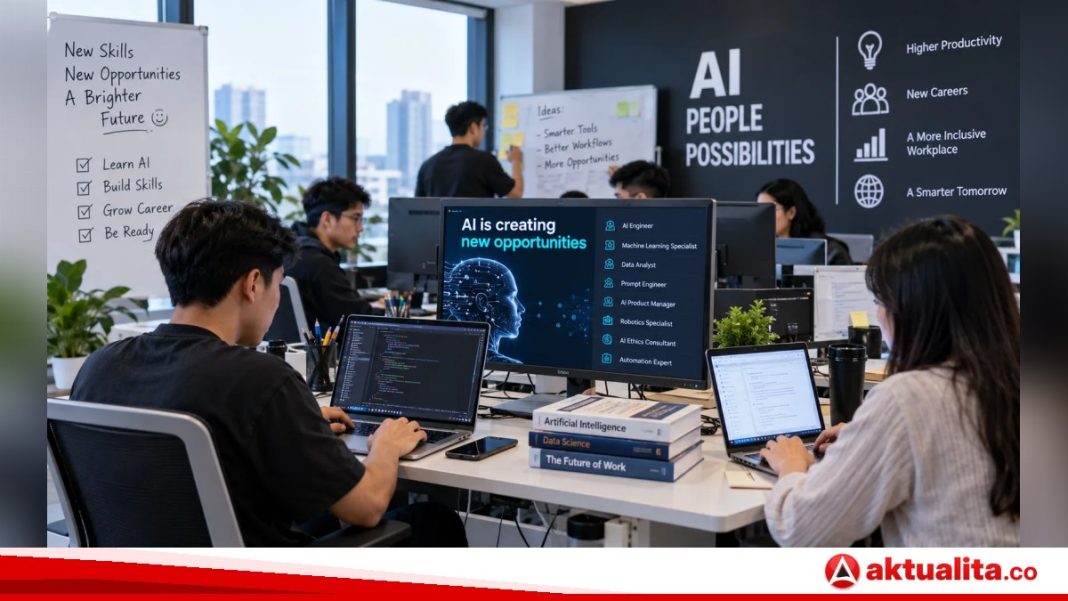
NEW YORK, Aktualita.co — Artificial intelligence is changing the American labor market, creating opportunities in technology, cybersecurity, data analysis, and business operations while raising new questions about the future of traditional office work.
As companies increasingly integrate AI-powered tools into daily operations, the demand for employees who understand how to develop, supervise, and apply these technologies is expected to remain significant.
However, the transformation is not limited to software developers and engineers.
Professionals in finance, marketing, healthcare, education, and administration are also encountering AI systems that change how everyday tasks are completed.
For workers planning their careers in 2026, understanding these developments may be as important as learning any single software application.
Which AI-Related Jobs Are Growing?
Federal employment projections indicate strong long-term demand for several occupations closely connected to artificial intelligence and digital technology.
The Bureau of Labor Statistics projects substantial employment growth in data science and information security, reflecting the increasing importance of information analysis and digital infrastructure.
Among the occupations expected to benefit from technological development are:
| Career | Main Responsibilities |
|---|---|
| Data Scientist | Analyze complex information and build predictive models |
| Machine Learning Engineer | Develop and deploy machine learning systems |
| AI Software Developer | Build applications incorporating AI capabilities |
| Cybersecurity Analyst | Protect systems and investigate digital threats |
| AI Product Manager | Coordinate technology development and business needs |
| Automation Specialist | Improve workflows using automated tools |
| AI Governance Specialist | Evaluate risks, oversight and responsible technology use |
Some of these are established occupational categories, while others are emerging job titles used by individual employers.
The availability and responsibilities of these positions vary across industries.
Data Scientists Remain in High Demand
Data science is among the fields expected to experience significant employment growth.
The Bureau of Labor Statistics projects employment of data scientists to increase approximately 35 percent between 2025 and 2035.
That growth is substantially faster than the overall average across occupations.
The agency also projects around 24,800 job openings for data scientists annually, on average, during the period.
Companies increasingly depend on data analysis to improve operations, understand customer behavior, manage risks, and develop new products.
AI has expanded the range of tools available to data scientists, but employers still need people who can interpret results and evaluate whether automated conclusions are reliable.
Technical knowledge alone is not sufficient.
Strong analytical reasoning, communication skills, and an understanding of business problems remain valuable.
Cybersecurity Becomes More Important
As organizations rely on connected technology and AI systems, digital security remains a major concern.
Cybersecurity professionals help identify vulnerabilities, respond to incidents, protect sensitive information, and maintain secure networks.
AI can assist with threat detection and security monitoring, but it can also introduce new vulnerabilities.
For example, organizations may need to address unauthorized access to AI services, sensitive information entered into external applications, or manipulated outputs generated by automated systems.
This creates demand for employees capable of combining conventional security knowledge with an understanding of emerging AI-related risks.
Will AI Replace Traditional Office Jobs?
The impact of AI on employment is likely to vary significantly by occupation and task.
Some administrative activities, such as routine document preparation, data entry, scheduling, and standardized reporting, can increasingly be supported by automated systems.
However, that does not mean every position involving those activities will disappear.
Many jobs combine routine work with judgment, relationship management, complex decision-making, and responsibilities that remain difficult to automate reliably.
An administrative professional, for example, may use AI to prepare a draft report while remaining responsible for checking its accuracy and communicating with colleagues.
Similarly, financial analysts may use automated tools to process information while relying on professional judgment to interpret results.
The more immediate challenge for many workers may be adapting to changing job requirements rather than moving into entirely new professions.
Which Skills Should Workers Learn in 2026?
Employees seeking to improve their prospects in an AI-influenced labor market should consider developing both technical and professional capabilities.
Digital literacy is becoming increasingly important across industries.
Workers can benefit from learning how AI systems produce outputs, understanding their limitations, and recognizing situations where automated results require verification.
Other valuable skills include data analysis, spreadsheet proficiency, basic programming, cybersecurity awareness, and workflow automation.
Communication, critical thinking, and problem-solving are also important because businesses need employees who can translate technical information into practical decisions.
For professionals without a technology background, learning to use AI responsibly within an existing field may offer a more realistic career path than attempting to become a specialist immediately.
Do You Need a Computer Science Degree?
Not every job involving AI requires a computer science degree.
Highly technical positions in machine learning research or advanced software engineering often require extensive mathematical and programming knowledge.
Other roles, including technology coordination, business analysis, product operations, and AI-supported content management, may be accessible through different educational backgrounds.
Employers typically assess a combination of qualifications, experience, technical competencies, and demonstrated ability.
Certificates and short courses can help introduce new tools, but completing a course does not guarantee employment.
Practical projects showing how a candidate solved a real problem may provide stronger evidence of capability.
How to Prepare for an AI-Driven Career
A practical starting point is to examine how AI is being adopted within a particular industry.
Employees can identify repetitive tasks that might be improved through automation, while also considering privacy, accuracy, and regulatory requirements.
Building a small portfolio of completed projects may help demonstrate useful skills.
For example, a marketing professional might create a data-driven campaign analysis, while an administrative employee might develop an improved reporting workflow.
Job seekers should also examine actual vacancy requirements instead of relying solely on general predictions about future careers.
The labor market changes quickly, and employer expectations can differ substantially between companies.
The Future of Work Is About Adaptation
Artificial intelligence presents both opportunities and challenges for American workers.
The technology is likely to change existing occupations while contributing to the development of new ones.
Some tasks may become faster or less labor-intensive, while demand may increase for professionals who can design, evaluate, maintain, and supervise intelligent systems.
For workers in 2026, the central question is not simply whether AI will eliminate jobs.
It is how employees can build the knowledge, adaptability, and judgment needed to remain valuable as technology evolves.