




Original Coverage & Source Attribution: koreatechdesk.com
The introduction worked. The customer took the meeting, another investor agreed to listen, and the VC had delivered exactly the access it promised. Months later, however, there was still no contract and no new funding. Nothing necessarily went wrong with the introduction, actually. Because the harder question is what an investor can reasonably be expected to deliver after opening the door, and when the outcome becomes the responsibility of the startup founder.
Technical Success Still Leaves the Founder With a Business to Build
The boundary begins before an investor provides any post-investment support. A technology can work exactly as intended while the company around it remains commercially unproven.
Jinsuk Lee, an institutional LP at Korea Venture Investment Corporation (KVIC) who previously worked in corporate venture capital and direct venture investing, describes the problem through three levels of judgment. His earlier career as a software engineer gives him another perspective on the gap between proving a technology and building an investable company.
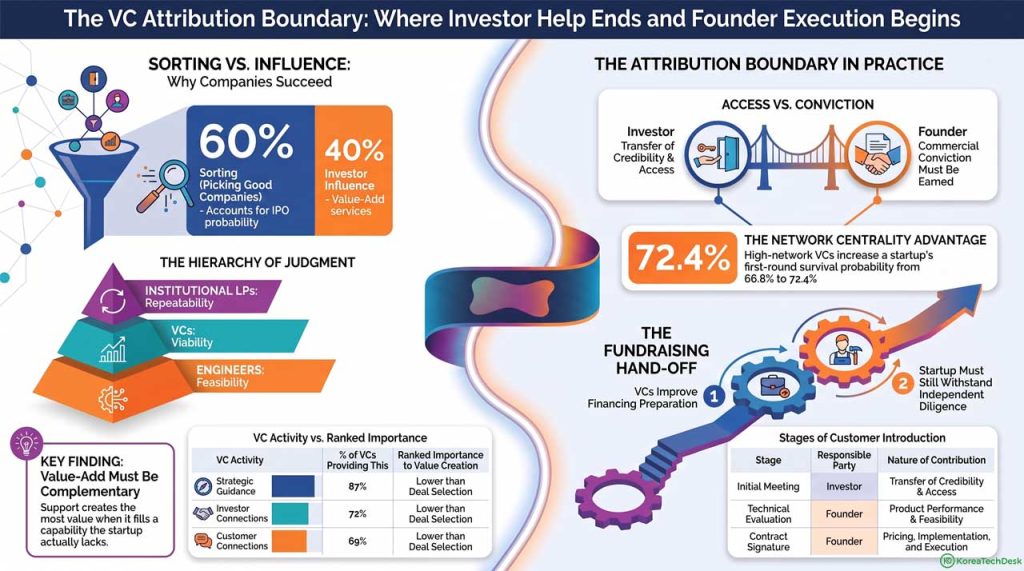
“Engineers focus on feasibility. Venture capitalists focus on viability. Institutional LPs focus on repeatability,”
Lee told KoreaTechDesk during an exclusive written interview on Korea’s startup and venture capital challenges.
For Lee, technical accomplishment is necessary in many deep-tech companies, but it does not establish commercial readiness on its own. Customer adoption, timing, execution, organizational capability, and the ability to create sustainable economic value still determine what can be built around that technology.
The U.S. Department of Energy’s Adoption Readiness Level framework reflects the same problem. It treats technical readiness as only part of commercialization and separately evaluates market acceptance, value proposition, resources, supply-chain conditions, regulation, and other barriers that can prevent technically successful products from reaching commercial scale.
That keeps responsibility for viability firmly inside the company. Investors can influence the conditions around execution, but they cannot replace it.
VC Value-Add Is Real, but Activity Is Not the Same as Outcome
Venture firms rarely market themselves as providers of capital alone. Strategic guidance, recruiting support, corporate introductions, investor access, and operating advice have become common parts of the value proposition offered to founders.
Research supports the idea that these activities are substantial. Paul Gompers, William Gornall, Steven Kaplan, and Ilya Strebulaev surveyed 885 institutional venture capitalists across 681 firms. After investing, 87% reported providing strategic guidance, 72% connected portfolio companies with investors, 69% provided customer connections, and 65% offered operational guidance.
Yet the same research found that VCs rated deal selection as more important to value creation than post-investment value-add. That creates a measurement problem that is often hidden when a successful portfolio company is presented as evidence of investor support.
A startup succeeding after taking capital from a respected VC does not automatically reveal how much of that success the investor caused.
Portfolio Success Cannot Show How Much the Investor Changed
Morten Sørensen examined this attribution problem by separating two forces behind the stronger performance associated with experienced venture investors.
One was influence, meaning the investor helped improve the company after investing. The other was sorting, meaning experienced investors were better positioned to identify and secure stronger companies in the first place.
In Sørensen’s study of U.S. venture investments, sorting accounted for roughly 60% of the improvement in IPO probability associated with highly experienced investors, while investor influence accounted for about 40%. The findings show why stronger portfolio outcomes cannot be attributed to post-investment support alone: experienced VCs may create value after investing, but they may also outperform because they are better positioned to identify and secure promising companies in the first place.
That does not reduce post-investment support to a branding exercise. Research by Shai Bernstein, Xavier Giroud, and Richard Townsend found evidence that greater VC involvement can improve portfolio company outcomes.
Their Journal of Finance study used the introduction of new airline routes that reduced travel time between VCs and companies they had already funded. The increased proximity was associated with greater innovation and a higher probability of successful exit. Nearly 90% of surveyed VCs also reported that direct flights increased their interaction with portfolio management and improved their understanding of company activities.
Investor involvement can therefore create measurable value without making the investor responsible for the company’s eventual success. The harder task is identifying which part of that outcome the VC actually helped produce.

The Best Investor Help Fills a Capability the Startup Actually Lacks
A more useful definition of VC value-add starts with complementarity.
Research published in Organization Science in 2025 examined how high-tech startups matched with accelerators and primarily financial seed investors. Simone Santamaria and Stefano Breschi found that accelerator support produced stronger subsequent funding benefits for technically capable founding teams that lacked business knowledge. The incremental effect was much weaker when the founding team already possessed substantial business capabilities.
The research points to a broader principle for founders: external support creates more value when it complements capabilities already inside the company rather than duplicating them.
A first-time technical founder entering enterprise sales, for example, may gain substantial leverage from an investor who understands procurement and can connect the company with relevant buyers. A repeat founder with an experienced commercial team may need something entirely different, such as regulatory expertise, international hiring networks, or support preparing for the next financing round.
This makes the amount of investor involvement a poor measure of its usefulness. What matters more is the fit between the capability an investor brings and the capability the startup still needs to build.
Customer Introductions Expose the VC Attribution Boundary
Customer introductions make the problem especially visible.
An investor may know the right executive, secure the meeting, provide useful context, and improve the founder’s credibility enough to begin a serious conversation. Those contributions can be meaningful.
The buyer still has to evaluate the startup independently. Product performance, pricing, procurement requirements, implementation risk, security, internal budgets, timing, and management execution can all determine what happens next.
Access can be transferred. Commercial conviction has to be earned.
This creates what can be understood as a VC attribution boundary. The closer an outcome sits to something the investor directly controls, the easier it is to evaluate the investor’s contribution. Attribution becomes weaker as the result depends increasingly on company execution and independent decisions by customers, employees, other investors, or the market.
A customer introduction shows that the investor created access. If the buyer moves into technical evaluation, the opportunity has progressed, but the startup is already being judged on its own merits. By the time that process becomes a long-term contract, product performance, pricing, procurement, implementation, and the company’s execution have played much larger roles.
For founders evaluating a potential investor, the useful question is therefore not simply how many customer introductions the VC can make.
Ask what usually happens after those introductions: how often the right decision-makers engage, how far conversations tend to progress, and what role the investor continues to play once the startup enters evaluation. That makes it easier to separate a real, valuable network from a long list of introductions that rarely move beyond the first meeting.
Follow-On Funding Gives VC Networks a Cleaner Test
Fundraising support sits closer to venture capital’s core capabilities.
VCs spend their careers evaluating companies, building relationships with other investors, observing financing markets, forming syndicates, and seeing how later-stage investors evaluate businesses. That makes investor access one of the areas where a venture firm can possess a genuine comparative advantage over the startup itself.
Research by Yael Hochberg, Alexander Ljungqvist, and Yang Lu provides foundational evidence that these networks can have economic value. Their study covered 3,469 U.S. venture funds and found that companies backed by better-networked VCs were more likely to survive into subsequent financing rounds and reach successful exits. In one measure, a one-standard-deviation increase in the lead investor’s network centrality increased first-round survival probability from 66.8% to 72.4%.
The findings show how investor networks can become an economic resource rather than simply a relationship advantage. Better-connected VCs can widen access to potential financing partners and syndicates, giving portfolio companies more opportunities to secure the capital needed for their next stage of growth.
Korea is also building more formal infrastructure around this type of support. In April 2026, the Ministry of SMEs and Startups’ Scale-up TIPS expansion increased participating operators from 24 to 83 and strengthened investment-linkage mechanisms intended to support continued growth and follow-on financing.
Even here, however, an introduction to another investor is not equivalent to raising the next round. The startup still has to withstand independent diligence, justify its valuation, demonstrate progress, and persuade another investment committee.
The investor’s contribution becomes easier to evaluate when founders examine the intermediate result: Did the VC identify appropriate investors, improve financing preparation, open credible conversations, support diligence, or help assemble a syndicate?
Those are more defensible value-add claims than taking credit for the financing itself.
Founders Should Diligence the Help, Not the Slogan
The usual fundraising question asks what an investor can do beyond writing a check. Founders can learn more by asking where that claimed capability has produced an observable result.
A VC promising customer access should be able to explain how it identifies relevant buyers and what typically happens after the introduction. An investor offering fundraising support should be able to describe how it prepares companies for the next round and which part of that process it actually participates in.
Founders should also pay attention to the areas where an investor deliberately does not intervene.
An investor who claims expertise across sales, hiring, product, operations, international expansion, pricing, recruiting, corporate partnerships, and financing may sound unusually supportive. It can also be difficult to tell where the firm possesses genuine comparative advantage.
Strong portfolio support requires judgment about when intervention creates leverage and when management should remain responsible for solving the problem itself.
The Most Useful Investor Does Not Need to Run the Company
Venture capital becomes valuable precisely because founders and investors contribute different capabilities.
Lee’s feasibility, viability, and repeatability hierarchy captures that division of responsibility. The investor can challenge assumptions, widen access, provide context, connect scarce resources, and help management see risks earlier. The founder still carries the harder obligation of turning those advantages into a functioning business.
A useful investor therefore does not need to claim ownership of every portfolio-company success.
Their contribution becomes more credible when founders can see exactly where it changed the company’s opportunity set, where management took over, and where the final result depended on execution that no introduction or board discussion could substitute.
For Korean startups choosing investors at home and abroad, that may be a more demanding test of VC value-add than asking which firm promises the largest support platform. The better question is which investor possesses a capability the company truly needs and understands the point where helping the founder must give way to letting the founder build.
Key Takeaway
- VC value-add should be separated from startup outcomes. A successful portfolio company does not by itself show how much of the result came from investor selection, post-investment support, or founder execution.
- Jinsuk Lee separates feasibility, viability, and repeatability. Engineers test whether technology works, VCs examine commercial viability, and institutional LPs consider whether investment judgment can be repeated.
- Investor involvement can create measurable value. Academic research has linked greater VC engagement with higher innovation and successful-exit probabilities, but investor influence is only one contributor to company performance.
- Complementary support is more useful than maximum involvement. Investor resources create greater value when they fill capabilities a startup does not already possess.
- Customer introductions should be evaluated through a VC attribution boundary. Investors can create access, but customer conviction, procurement progress, delivery, and commercial performance still depend heavily on the company.
- Follow-on financing sits closer to venture capital’s comparative advantage. VC networks can improve access to subsequent capital, while another investor’s final decision still requires independent evaluation.
- Korean startup founders should diligence specific investor capabilities. The useful question is not how much help a VC promises, but what scarce capability it adds, what intermediate outcomes it can demonstrate, and where its role ends.
– Stay Ahead in Korea’s Startup Scene –
Get real-time insights, funding updates, and policy shifts shaping Korea’s innovation ecosystem.
Follow KoreaTechDesk on LinkedIn, X (Twitter), Threads, Bluesky, Telegram, Facebook, and WhatsApp Channel.
Looking to connect with verified Korean companies building globally?
Explore curated company profiles and request direct introductions through beSUCCESS Connect.