Original Coverage & Source Attribution: cityjournal.substack.com
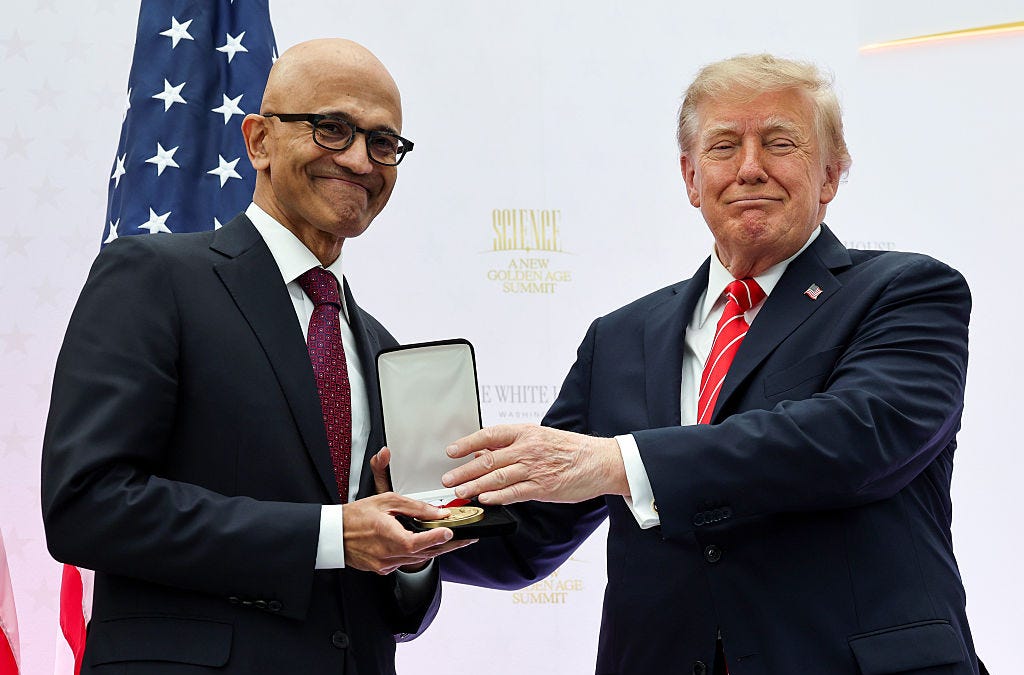
Last week, the Trump administration announced a crackdown on the issuance of employment-based visas to eight companies and ten universities, with Vice President J.D. Vance accusing them of hiring “indentured servants.” The targets included not just long-suspect Indian third-party placement firms—which should be banned—but also the trillion-dollar software company Microsoft. The ban came, oddly, on the same day President Trump awarded Microsoft CEO Satya Natella the National Medal of Science.
The administration is right to root out fraud. But the attack on Microsoft, as well as the software company Adobe, doesn’t do that. Instead, it may make American workers and consumers worse off without sufficiently going after fraud.
Permanent Labor Certification (PERM) is the process by which companies sponsor foreign employees for U.S. permanent residency. The process applies almost exclusively to college-educated workers, particularly those with an American advanced degree. Employers must try to recruit a qualified American worker for the role beforehand through an arcane process defined in the 1990s that usually takes one to two years to complete.
For Indian-born immigrants, that process stretches to decades. Due to annual green card limits and per-country caps, demand from qualified Indian applicants far exceeds supply. That has left hundreds of thousands of Indians as temporary workers for decades on end.
The system is vulnerable to abuse, and certain companies take advantage of the current loopholes in the H-1B skilled immigration visa. There are about a dozen India-based “body shop” firms whose U.S. workforces are overwhelmingly composed of H-1B workers. Vance’s announcement targeted some of these suspected bad actors, including Cognizant Infosys, Tata Consultancy Services, Wipro, HCL Technologies, and Capgemini.
Each year, these companies file large numbers of H-1B petitions almost exclusively for Indian nationals, scooping up many of the slots allocated by lottery. They can do this despite paying salaries far below other H-1B employers. But these firms rarely sponsor for permanent residence anymore, making the PERM ban a futile measure; the Indian body shops prefer to keep workers in H-1B status without option to permanent residence.
The Department of Labor is also targeting Microsoft and Adobe. These firms use the H-1B program and PERM process to sponsor immigrants who contribute to the American economy and to their American coworkers.
To justify the targeting, Vance claimed that Microsoft fired 6,000 Americans and replaced them with 6,500 foreign workers. But Microsoft employs approximately 121,000 people in the United States. It fires and hires thousands of workers every year just as a matter of churn.
Moreover, of the 6,258 H-1B applications it filed in fiscal year 2025, Microsoft claims 80 percent were simply to extend or change the status of existing employees—not for additional workers. Government data show the company sponsored only 1,394 new H-1B workers who didn’t previously have that visa. Adobe, on the other hand, filed for 777 H-1B visas, of which only 184 people did not already have H-1B status.
The numbers show why restricting PERM does little to address the abuse by Indian tech firms. The targeted Indian body shops collectively receive more than twice as many new H-1B workers as Microsoft in fiscal year 2025, while getting just 63 PERMs certified—only 5 percent as many as Microsoft. And while 58 percent of Microsoft’s PERMs are for Indian workers, nearly 99 percent of the Indian firms’ PERMs are. It is obvious who is abusing the system.
The attack on Microsoft and Adobe is, unfortunately, part of the administration’s broader approach to high-skilled immigration. Its policies may expand the “indentured servitude” they claim exists, not reduce it.
For example, U.S. Customs and Immigration Services recently proposed a rule eliminating the 60-day grace period for H-1B workers to switch employers if they are fired or quit. That gives employers even more bargaining power over H-1B employees, giving unethical actors the ability to threaten their foreign workers—and therefore making those workers more attractive than Americans. Similarly, cutting off PERM certifications keeps workers in H-1B status longer, again reducing their bargaining power.
Then there is the administration’s $100,000 fee on H-1B applications. That policy initially affected only workers abroad and, thus, mainly Indian immigrants employed by the “body shop” firms. But it is now being increased to $103,265 and expanded to cover international students as well. These are the same students Trump himself said he wanted to “automatically” give green cards upon graduation.
These actions, all targeted at high-skilled immigrants, come as the U.S. budget deficit and national debt have once again reached a record high. On the same day as Vance’s announcement, the CBO confirmed that the 2026 federal deficit has reached $2 trillion. My own analysis finds that ending the H-1B visa program would cost American taxpayers $200 billion over the next decade, further ballooning the debt while simultaneously shrinking the economy.
There are problems with the H-1B visa program. These are mostly the result of the program’s lottery structure, which creates the opportunity for fraud, among other issues. But we shouldn’t solve these problems by targeting firms, like Adobe and Microsoft, that bring valuable immigrants to America.
Instead, we should fix the system at its core. For example, Congress could replace the lottery with a system that hands out the 85,000 available annual H-1B visas to the highest paid positions, rather than relying on the flawed and gameable weighted-ranking system in the new H-1B lottery. That wouldn’t just end all gaming and fraudulent use of the program. It would also strengthen the economy and save taxpayers $140 billion over the next decade.
This is obvious when you look at past H-1B recipients: people like Microsoft’s Satya Nadella, Nvidia’s Jensen Huang, or Tesla’s Elon Musk. These people did not replace workers—they created opportunities for Americans, and so do others at a smaller scale. With smart reforms, the H-1B system can be improved to select more people like them.
Ronald Reagan concluded his presidency warning that if the door was ever closed to new Americans, our leadership in the world would be lost. He was making not only a cultural argument, but also an argument about what drives innovation and growth. Hostility to high-skilled immigrants—especially when they are culturally compatible—comes from a zero-sum mindset. That’s not what makes America great. It’s shooting ourselves in the foot.