Original Coverage & Source Attribution: hackread.com
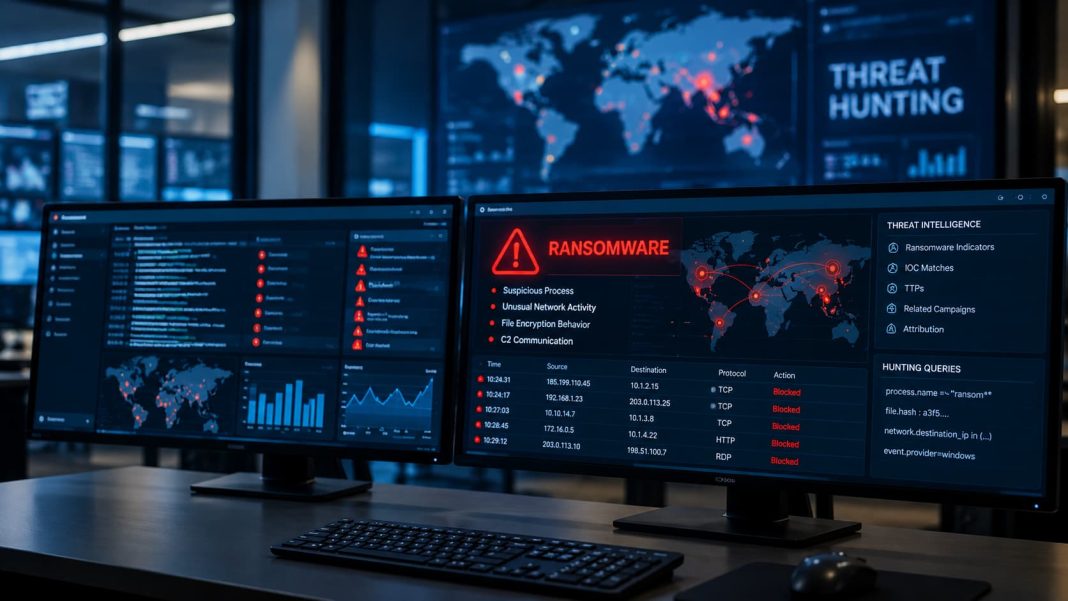
Ransomware defense cannot rely on alerts alone. For MSSPs in particular, the ability to proactively hunt for attacker infrastructure and emerging campaigns can mean finding threats before they become major incidents.
Threat intelligence feeds give security teams a way to make threat hunting more continuous and scalable. By feeding fresh, actionable intelligence into the solutions analysts already use, they can turn external threat activity into concrete hunting opportunities across customer environments.
The Role of Threat Hunting in Modern MSSP Security
Threat hunting gives MSSPs a proactive way to identify suspicious activity that may not trigger existing detections.
Customers expect their security provider to identify threats before they result in disruption, data loss, or costly incident response. That means an MSSP team needs to do more than respond to alerts generated by individual customer environments. It has to understand what attackers are doing outside those environments and use that intelligence to look for relevant activity inside them.
Ransomware makes this especially important. By the time encryption is detected, an attacker may have already gained access, established persistence, moved laterally, or stolen sensitive data.
Recent research into IronChain illustrates how quickly ransomware can turn into a broader business continuity problem. The September 2026 build analyzed in ANY.RUN’s Interactive Sandbox combined destructive file handling with SYSTEM-level persistence and multiple kernel drivers, creating several points that defenders could investigate before or during an incident.
The research also found that the malware’s encryption design may leave affected files without a reliable recovery path, increasing the potential impact of an attack.
Proactive hunting allows security teams to search for earlier signs of compromise. The challenge is scale. An MSSP may be responsible for dozens or hundreds of environments, each generating large amounts of telemetry. Asking analysts to manually collect indicators, research campaigns, build queries, and validate findings for every customer quickly becomes expensive and difficult to sustain.
Threat intelligence helps address this challenge by giving security teams the insight they need to identify emerging threats and focus their hunting efforts.
Turning Threat Intelligence Feeds into a Hunting Engine
Threat intelligence feeds should not simply add more indicators to an MSSP’s database. Their value comes from helping analysts identify what to hunt for, where to look, and which findings deserve attention.
ANY.RUN’s Threat Intelligence Feeds (TI Feeds) provide continuously updated malicious IPs, domains, and URLs enriched with sandbox analysis. Their quality is supported by millions of sandbox investigations, with contributions from more than 700,000 analysts and activity from over 16,000 organizations.
That scale gives MSSPs a broader pool of threat intelligence to support hunting across customer environments.
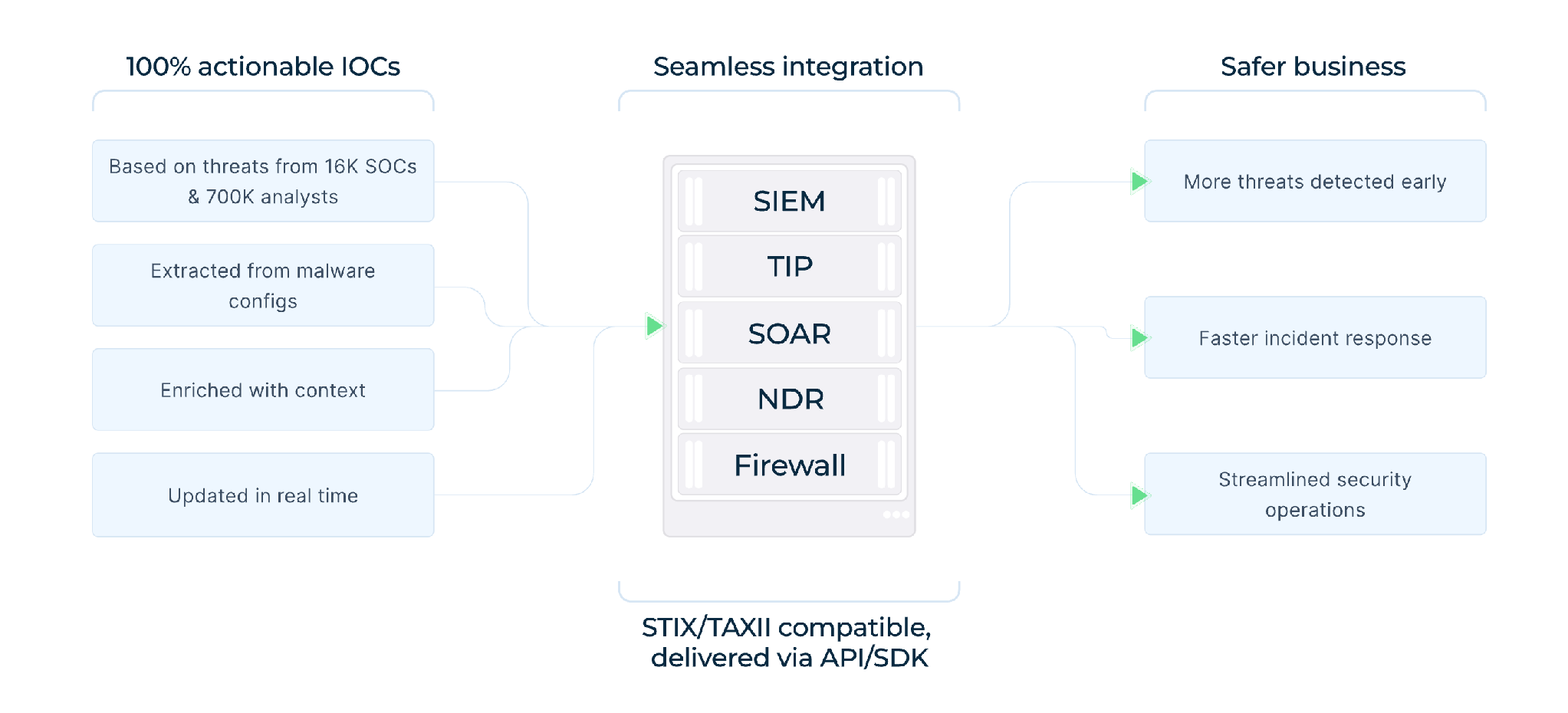
Feeds can be integrated into SIEM, EDR, XDR, SOAR, firewalls, and other security technologies. Through connectors, API/SDK, and STIX/TAXII, intelligence can flow into the systems where analysts are already investigating customer environments.
Consider a ransomware group that starts using new command-and-control infrastructure. Without external intelligence, an MSSP may only investigate that infrastructure after an internal alert or customer incident brings it to their attention.
With an intelligence-driven hunting model, the indicators can become hunting leads first. Analysts can search customer telemetry for connections to the infrastructure, investigate related activity, and determine whether other environments show signs of the same campaign.
Get 99% unique, high-confidence IOCs to strengthen your threat detection.
IronChain provides a practical example of why this approach matters. A newly observed build can introduce fresh hashes, dropped components, persistence mechanisms, and other behavioral artifacts. Instead of treating the malware sample as an isolated incident, an MSSP can use those findings to search across customer environments for related activity, such as unexpected drivers, privileged scheduled tasks, or other indicators associated with the same threat.
The question shifts from “Did we detect an attack?” to “Where could this attack already be present?” That distinction is particularly valuable for MSSPs because a single piece of intelligence can inform hunts across multiple customer environments.
Making Threat Hunting More Scalable
The value of threat intelligence should ultimately be measured by its impact on processes within a security team, not by the number of indicators in a feed.
High-quality intelligence can reduce the manual work involved in collecting, validating, and maintaining IOCs. That gives analysts more time to investigate meaningful activity instead of spending their time preparing the data needed to investigate it.
MSSP teams that use ANY.RUN’s solutions report a 50% reduction in IOC extraction time, 94% of users reporting faster triage, and up to 3x better SOC performance.
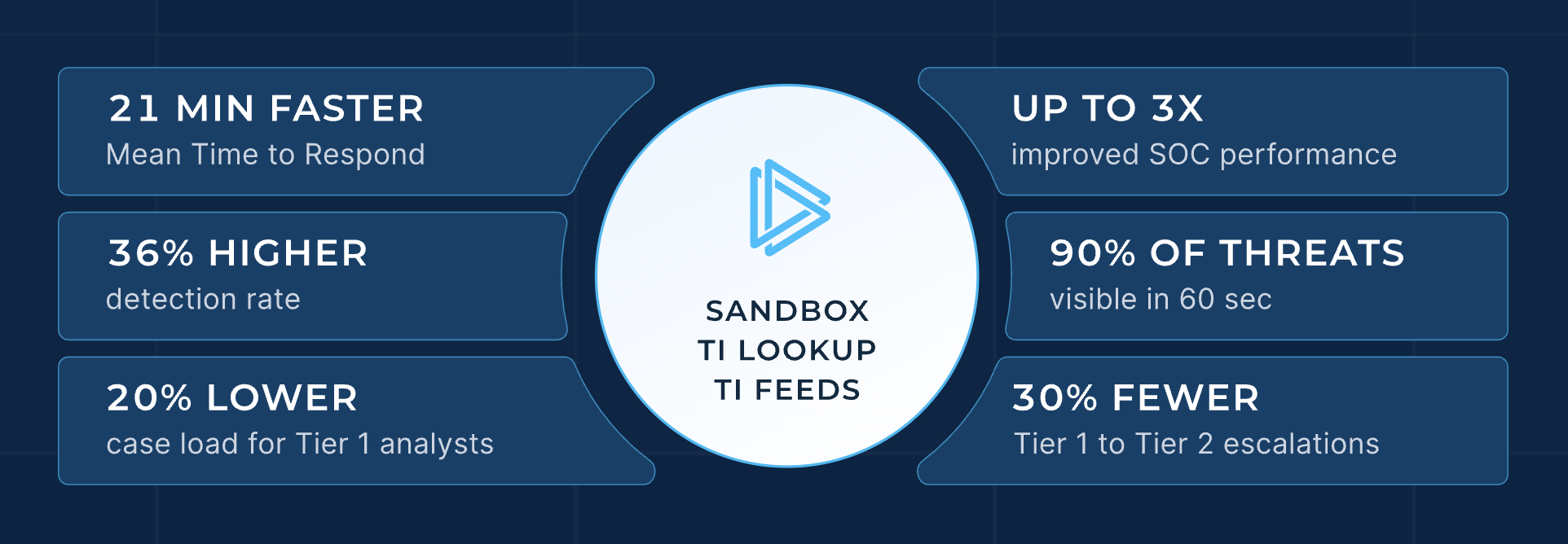
For team leaders, these outcomes matter more than the sheer volume of indicators a feed delivers. Faster investigations and lower analyst workload can translate into greater customer coverage without requiring a proportional increase in headcount.
That creates a direct connection between threat intelligence and the economics of delivering managed security services.
Feeds Provide the Scale, Context Makes Them Useful
An indicator rarely tells everything an MSSP team needs to know. If a customer’s endpoint connects to an IP listed in a threat intelligence feed, the analyst still needs to establish why the connection matters. What malware used the infrastructure? Is the IP associated with other domains or files? What behaviors have been observed? Is the activity part of a known campaign?
An integrated intelligence ecosystem can provide much more value than a standalone feed.
For example, ANY.RUN’s Threat Intelligence Lookup (TI Lookup) allows analysts to investigate indicators and pivot through related threat data, including IPs, domains, URLs, hashes, files, processes, signatures, YARA rules, and TTPs.
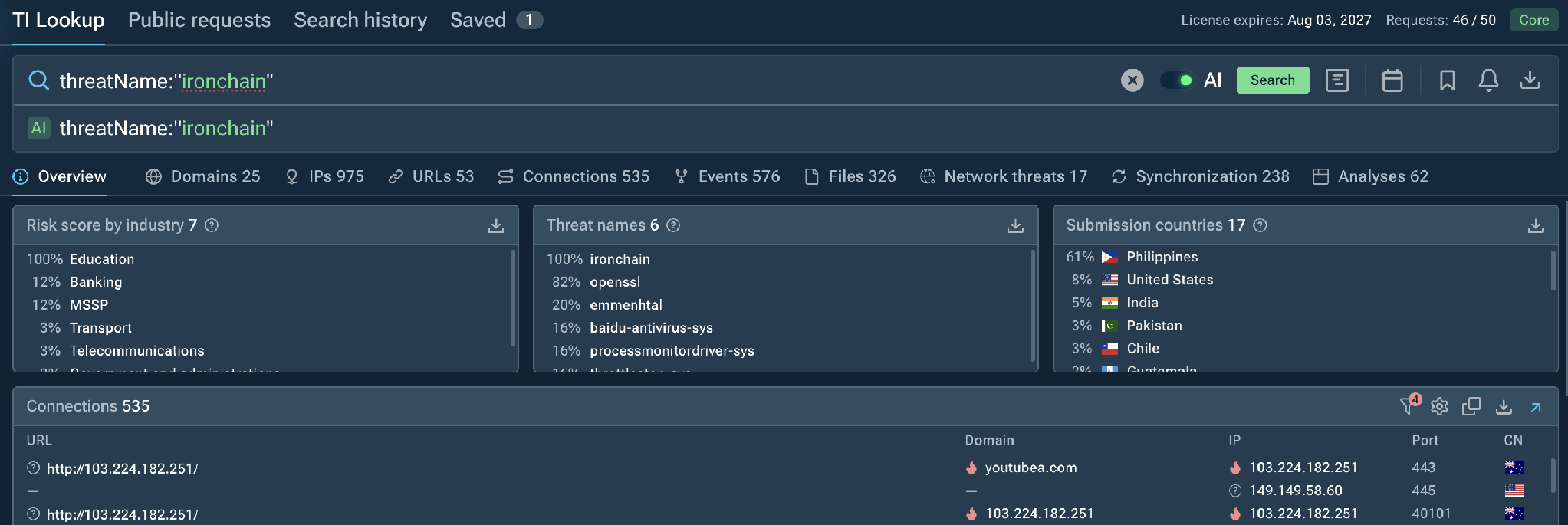
Threat hunters can use a feed match to launch a deeper investigation into the associated activity. Instead of treating an IP address as an isolated artifact, they can investigate its relationships with malware, infrastructure, behaviors, and previous sandbox activity. That context can reveal additional indicators and hunting opportunities that would otherwise be easy to miss.
ANY.RUN’s Threat Intelligence Reports (TI Reports) add another layer of context by connecting individual indicators to broader campaigns, threat actors, and attack techniques.
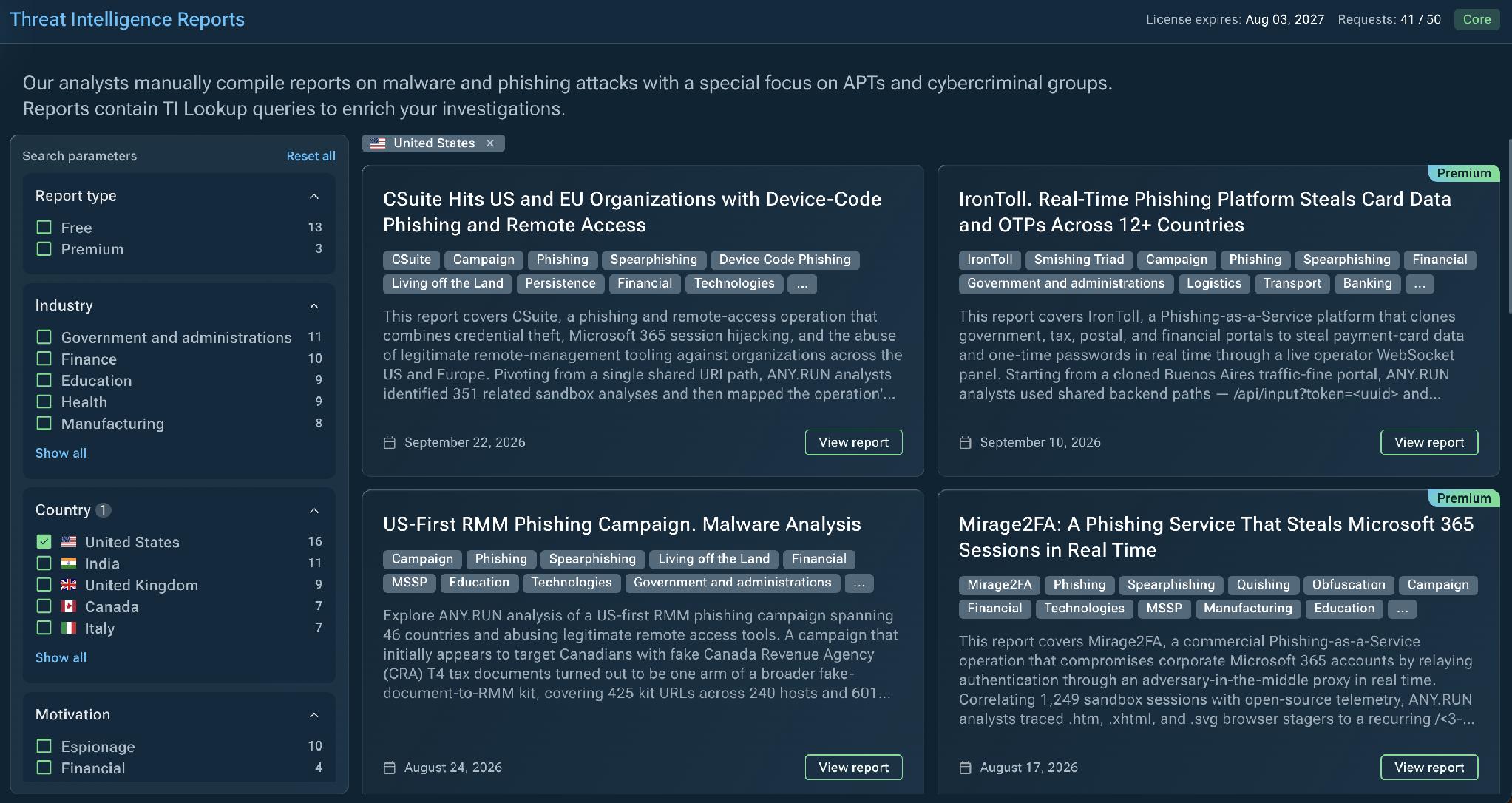
This helps MSSPs understand the bigger picture behind a feed match and identify new hunting opportunities before related activity appears across customer environments.
Detect up to 58% more threats with intelligence built for faster, broader coverage.
Using Interactive Sandbox Analysis to Accelerate Investigations
Threat hunting often raises questions that an IOC alone can’t answer.
An MSSP may discover a suspicious file in a customer environment or encounter an unfamiliar payload connected to an emerging campaign. Understanding what that file actually does can determine whether the finding represents a genuine threat and what the analyst should hunt for next.
ANY.RUN’s Interactive Sandbox provides an environment for analyzing suspicious files and URLs and observing their behavior. In 90% of cases, threats become visible within 60 seconds of analysis, helping organizations achieve a reported 36% increase in threat detection.
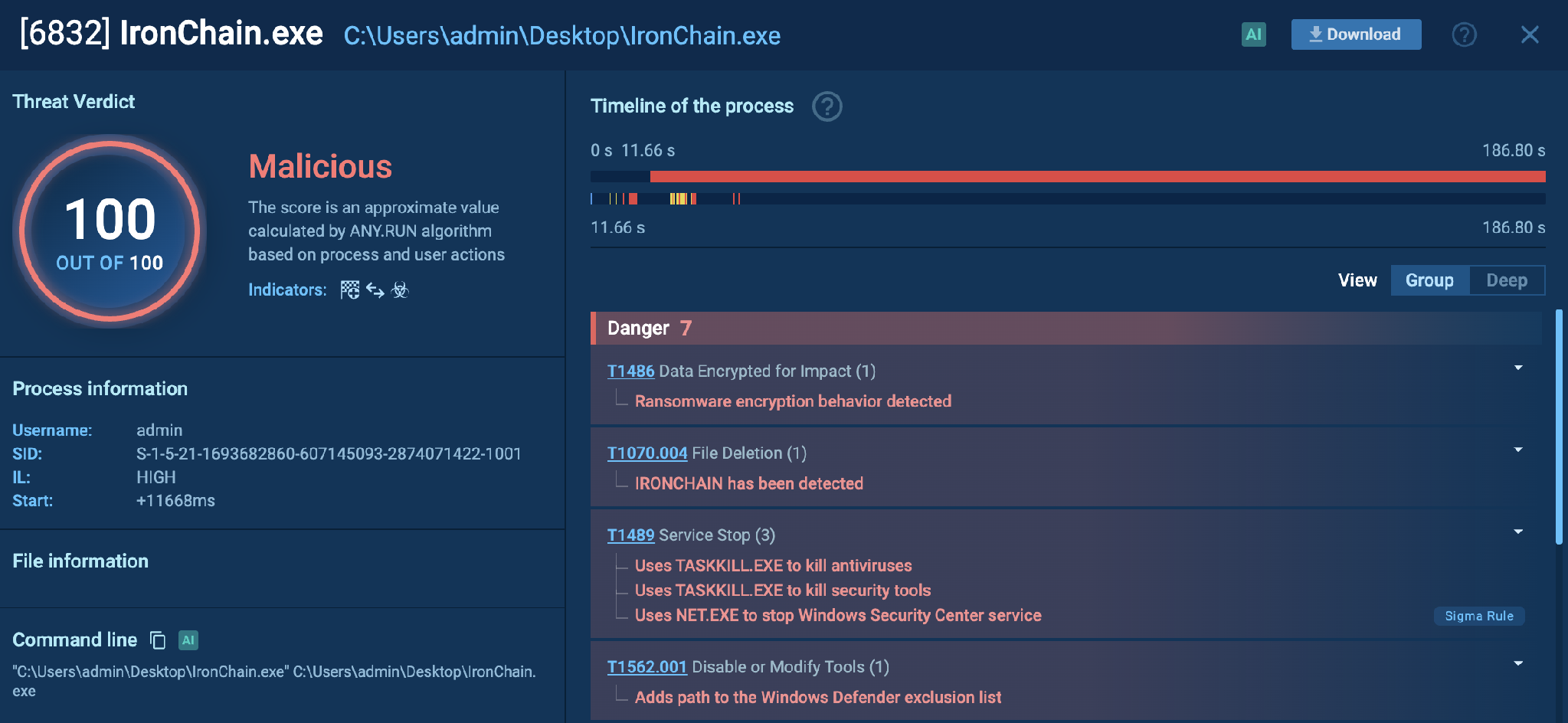
The IronChain investigation shows how behavioral analysis can add useful context to a ransomware sample. The public sandbox session exposed the process tree, network activity, dropped files, and system changes, while the broader analysis connected those observations with persistence, driver activity, and attempts to impair security controls.
Sandboxing also helps turn technical analysis into information that analysts can act on more quickly. Tier 1 Reports summarize malware behavior in an analyst-friendly format, while AI Summary condenses execution activity into key findings and attack stages. AI Recommendations can then point analysts toward additional artifacts, indicators, and behaviors worth investigating.
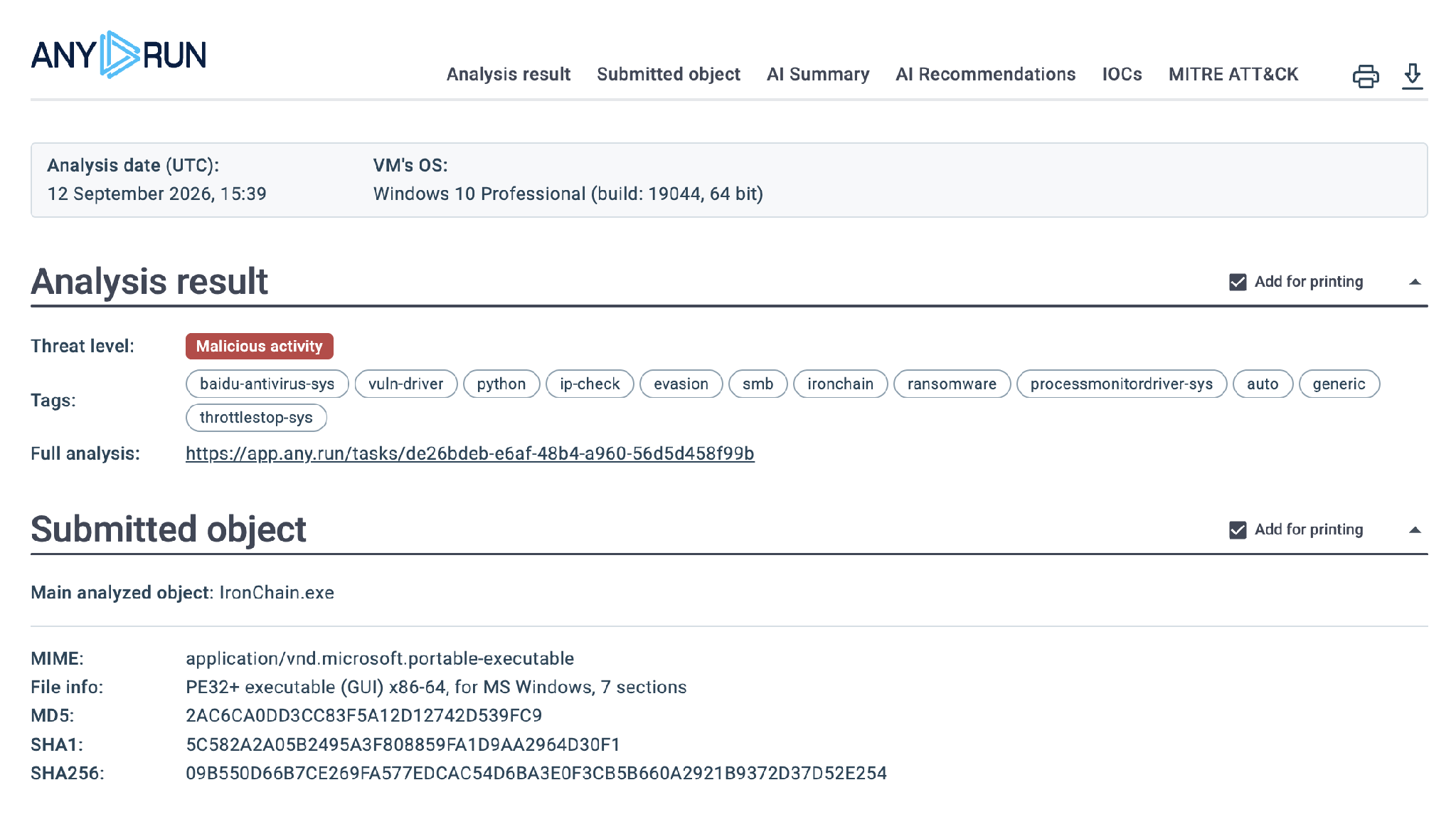
This can reduce the analyst time required to move from a suspicious artifact to a useful hunting hypothesis.
More importantly, sandbox analysis can feed the broader intelligence workflow. A newly observed malware sample can reveal infrastructure and behaviors that become new hunting leads, creating a continuous feedback loop between investigation and threat intelligence.
The Business Value of Intelligence-Driven Hunting
For CISOs and SOC leaders, the business case for threat intelligence should come down to a few practical questions. Does it help the team find threats earlier? Does it reduce investigation time? Can analysts cover more environments without increasing workload at the same rate? Does it improve the quality of customer outcomes?
Those questions are particularly important in an MSSP environment, where operational efficiency directly affects the ability to scale.
An intelligence-driven hunting program can help reduce manual IOC collection, improve investigation prioritization, and give analysts more context when they encounter suspicious activity. The result can be faster threat discovery, shorter response times, and better use of scarce security expertise.
The customer-facing value is equally important. An MSSP that can demonstrate proactive hunting based on current threat intelligence can offer something beyond reactive monitoring: evidence that its security team is actively looking for threats relevant to the customer’s environment.
That can become a meaningful differentiator in a crowded managed security market.
Cut 21 minutes from MTTR and accelerate threat response across every client.
Speed Up MSSP Response
Conclusion
The value of threat intelligence comes from how effectively it can be turned into proactive security action. Threat intelligence feeds provide a continuous flow of actionable indicators, while investigation, analysis, and threat research add the context analysts need to understand threats and prioritize hunting efforts.
This connected approach can help MSSPs scale proactive hunting, enabling SOC teams to identify threats earlier, respond faster, and use analyst resources more effectively across customer environments.
Ransomware will keep evolving, but MSSPs that turn fresh intelligence into targeted, continuous hunting can strengthen defenses while delivering greater value to customers.