Original Coverage & Source Attribution: www.novinite.com
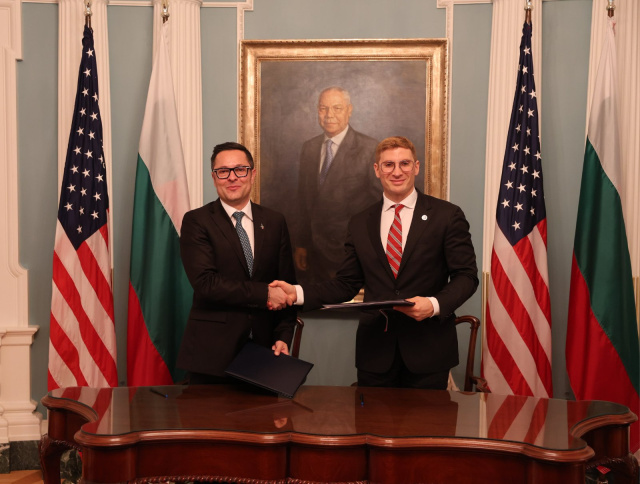
Bulgarian Deputy Prime Minister and Minister of Economy, Investments, and Industry Alexander Pulev discussed security, defense cooperation, and expanding economic ties in high-tech sectors with US State Department officials during a visit to Washington, where he also signed a joint declaration on cooperation in artificial intelligence.
Pulev met with Fleet White, US Deputy Assistant Secretary of State for Political-Military Affairs, and Jacob Helberg, US Deputy Under Secretary of State for Economic Growth, Energy, and the Environment. The talks covered opportunities to strengthen cooperation in security, the defense industry, artificial intelligence, space technologies, and strategic investments.
“Bulgaria is a reliable NATO ally and is firmly committed to developing its strategic partnership with the US. In the current international climate, security in the Black Sea region requires constant coordination and joint action among allies,” Pulev said.
His meeting with White focused on implementing the F-16 Block 70 fighter jet program, developing joint industrial cooperation projects with a US company, and expanding bilateral ties in space and satellite technologies.
In his talks with Helberg, Pulev addressed ways to broaden the economic partnership between Bulgaria and the US, attract American investment in strategic sectors, and advance artificial intelligence and high-tech industries.
The two officials signed a Joint Declaration between Bulgaria and the US on partnership opportunities in artificial intelligence. The agreement highlights innovation, resilient supply chains, secure digital infrastructure, and investment as areas for cooperation. The US-led international declaration brings together 54 nations and establishes a shared framework for developing artificial intelligence infrastructure.
“Bulgaria is no longer on the periphery; it is at the heart of high-tech development in Europe. We have a strong political will to expand our economic relations with the US in the spheres of high technology and high-value-added manufacturing,” Pulev said.
The deputy prime minister outlined the capabilities of Bulgaria‘s IT ecosystem, its engineering talent and research and development activities, as well as progress in artificial intelligence. He also highlighted the country’s potential to contribute actively to the development of Europe’s artificial intelligence infrastructure.
Pulev said Bulgaria could become a key participant in supply chains for industries focused on future technologies. He pointed to technology companies operating in electronics, high-tech, aerospace, and defense, noting that many of them work with American partners.
He also identified the Institute for Computer Science, Artificial Intelligence and Technology (INSAIT) as a particular advantage for Bulgaria. The institute attracts Bulgarian and international scientists and strengthens the country’s research capacity in artificial intelligence.
“Our goal is to translate interest in Bulgaria into concrete investments, technology transfers, and joint manufacturing. We have the potential to forge partnerships that generate high added value,” Pulev said.
The deputy prime minister identified electric vehicle and battery manufacturing, data centers and artificial intelligence infrastructure, space technologies, and cybersecurity as priority areas for stronger economic cooperation.
“We are building the largest space center in Europe. In Dobroslavtsi, we are developing satellite solutions to support the National Center for Monitoring, Coordination, and Management using space-based data. The project represents a strategic step toward establishing Bulgaria as a leading hub for space technologies and innovation in Europe, with the potential to foster high-tech manufacturing, attract investment, and create new opportunities for Bulgarian industry,” Pulev said.
(function(d, s, id) {
var js, fjs = d.getElementsByTagName(s)[0];
if (d.getElementById(id)) return;
js = d.createElement(s); js.id = id;
js.src=”https://connect.facebook.net/en_US/sdk.js#xfbml=1&version=v3.1″;
fjs.parentNode.insertBefore(js, fjs);
}(document, ‘script’, ‘facebook-jssdk’));