Original Coverage & Source Attribution: opiniojuris.org
10 Nov 6th Annual Symposium on Pop Culture and International Law: Sharks with Frickin’ Laser Beams Attached to Their Heads – Weaponization of Internationally Protected Animals under IHL
[Mia Colliard is a Legal Researcher and LL.B. Candidate at the University of Fribourg, CH.]
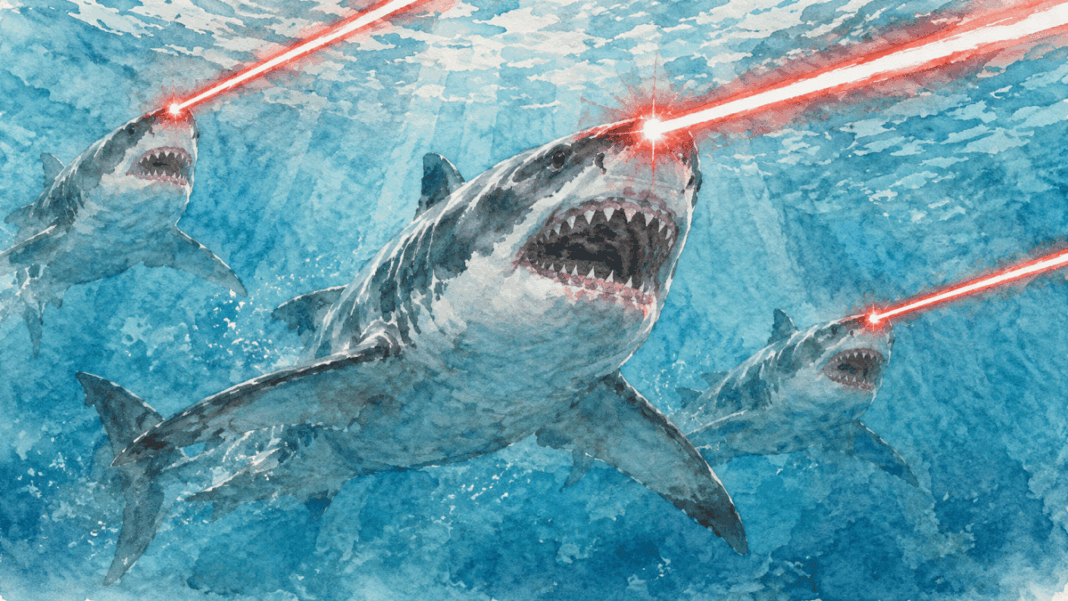
In Austin Powers: International Man of Mystery (1997) we make the acquaintance of charmingly incompetent supervillain Dr. Evil. After emerging from a 30-year-long cryogenic sleep, Dr. Evil attempts to take over the world once more. Fortunately, plans do not go accordingly, and once he has captured Austin Powers, it is eventually revealed that the sharks with freakin’ laser beams attached to their heads could not be supplied.
However, this poses an interesting question regarding what would’ve happened if they had been, and what exact “red tape” mentioned by Number Two (Dr. Evil’s, well… second in command) would’ve had to be cleared in a modern context. This comes through four questions. The question of the sharks’ weaponization, their status, the protections extended to endangered species, the environmental obligations linked to the sharks’ potential targeting and finally, which international responsibilities may be engaged.
For this analysis, it is assumed that Dr. Evil leads a non-State armed group engaged in a non-international armed conflict (NIAC) against State armed forces. The armed group cannot become a party to the relevant environmental treaties. Its conduct is nevertheless governed by the applicable rules of IHL, which include customary international law, and the relevant treaty provisions governing NIACs.
What Status May be Extended to Sharks?
The development of Animal Welfare Law internationally, for example through the European Union, indicates a general willingness to recognize animals as having interests worthy of protection beyond the scope formerly associated with them. For example, Article 13 TFUE requires the Union and its Member States to pay full regard to animal welfare requirements when formulating and implementing certain policies. Their position under International Humanitarian Law (IHL) remains considerably less developed. While animals do receive protection largely indirectly, through the rules which govern civilian objects, the natural environment and specially protected objects, it is not enough to protect animals as sentient beings, able to experience pain, suffering and distress.
In the hypothetical scenario where Dr. Evil might use sharks in a conflict with international bodies, the first question would be to consider which status could be attributed to the animals. Could they be considered as combatants ? Article 43(2) of Additional Protocol I (AP I) defines combatants as members of the armed forces of a Party to an armed conflict. Peters and de Hemptinne further explain that animals cannot meaningfully distinguish between combatants and persons hors de combat, or bear responsibility for violations of the rules governing the conduct of hostilities. Thus, they should not bear the status of combatants. Such a status would open them to additional harm as combatants may, at any time, be targeted during their belonging to armed forces.
Sharks should instead be treated, for the purposes of the conduct of hostilities, as objects. If trained for military purposes, similarly to military dogs, they might be understood as equipment. This does not mean they would necessarily constitute military objectives. In fact, the customary rule reflected in Art. 52(2) AP I and ICRC Customary IHL Rule 8 asserts that an object may only be a military objective where, by its nature, location, purpose or use, it makes an effective contribution to military action and its total or partial destruction, capture or neutralization offers a definite military advantage.
Where the sharks are used for military purposes and their targeting offers a definite military advantage, they admittedly may be targeted by opposing forces. As wild animals however, their position must be examined with specific care, considering whether its military use alone would be sufficient to make it a military objective. The distinction bears particular importance in Dr. Evil’s shark case, as, if the shark is merely a carrier for the laser, the laser system itself could constitute a military objective whereas the animal’s destruction would have to be assessed separately following the rules on attacks and incidental harm . On the other hand, if the shark had been deliberately deployed and trained to approach and attack enemy forces, its use could constitute an effective contribution to military action, and its neutralization offer a definite military advantage, it could become a legitimate military target.
What of Additional Protections Extended to Protected Species of Sharks?
Dr. Evil’s request for sharks did not specify which species of sharks he sought. This omission matters, as certain species of shark benefit from additional conservation regimes. For example, the scalloped hammerhead is classified as a critically endangered species on the IUCN Red List, is listed under Appendix II of CITES and is also listed under Appendix II of the Convention on Migratory Species (CMS). This situation would entail a greater attention to the potential consequences of their targeting as opposed to, for example, the use of mutated, ill-tempered sea bass.
While none of those instruments create an automatic immunity from attack, they still bear some relevancy to the question at hand. This is particularly true of the status of the shark species utilized during the conduct of hostilities. The endangered status of a shark, its population size and the ecological consequences of its destruction would serve the assessment of foreseeable environmental harm by another State. There is, however, no hard obligation not to target weaponized protected species. Rather, the obligation regarding their targeting lies in the application of the principles of distinction, proportionality and precaution, which the ICRC recognizes as applying to NIACs and IACs alike.
What Environmental Obligations Govern the Targeting of the Sharks?
The ICRC’s Customary IHL Rule 43 provides that no part of the natural environment may be attacked unless sit qualifies as a military objective, that destruction of the environment is prohibited unless required by imperative military necessity; and that attacks expected to cause excessive incidental environmental damage are prohibited. The ICRC considers this rule to be applicable both to IACs and NIACs.
Rule 44 and Rule 45 provide additional guidance in the assessment of the targeting of Dr. Evil’s sharks in a NIAC. Under Rule 44, which arguably applies to NIACs as well, the parties must show due regard for the protection and preservation of the natural environment and take all feasible precautions to avoid or at least minimize incidental environmental damage. This obligation must be understood in light of the requirement to take into account environmental considerations when assessing the necessity and proportionality of military operations, as the International Court of Justice recognized in its Nuclear Weapons Advisory Opinion (para. 30) . It further stated, on environmental law, that it must still be considered in the context of the implementation of the principes and rules of the law of armed conflicts (para. 32). This principle demands that parties take the proper precautions to prevent irreversible damage. In this case, if Dr. Evil had procured an important number of scalloped hammerhead sharks, their scarcity and impact on their environment would certainly require additional care by the opposing party in their targeting.
As for Rule 45, it prohibits the methods and means of warfare expected to cause widespread, long-term and severe damage to the natural environment. Though its customary application to NIACs is arguable. There is a particular interest to be had here, as should this provision apply, whichever State would find itself on the other side of Dr. Evil’s sharks may be strictly prohibited from killing them.
The effect on the environment should be “long-term”, in the case of a shark’s endangered species, should their destruction touch a rather substantial portion of the group, it is likely that it would affect the species as a whole and its ecosystem for the foreseeable future. It could be argued to constitute severe damage as well. According to the IUCN Red List, their global population has seen a 76.9 to 97.3%. If Dr. Evil had at his disposition a substantial number of scalloped hammerheads to utilize, the threshold could be crossed. However, the endangered status alone is not likely to establish serious or significant ecosystem disruption. The killing of a restricted number of scalloped hammerheads, in a specific location, would be unlikely to meet this threshold. While these arguments may weigh against the destruction of the sharks, their capture and the subsequent neutralization of the lasers attached to their heads is unlikely to be prohibited.
The distinction between the targeted animal and its incidental environmental damage is necessary. If a weaponized shark were to be lawfully targeted, its intended destruction must be examined under the existing rules of IHL and the military advantage it would present. This, however, does not mean that where environmental harm is reasonably foreseeable, it shall take precedence over human suffering.
Which International Responsibilities May be Engaged?
In a NIAC, relevant customary rules on distinction, proportionality, precautions and environmental protection would be central to establish the legality of States’ conduct. In the situation set by the Austin Powers series, the two most likely State contenders to take part in the NIAC would be the United Kingdom and/or the United States. Considering the UK is party to AP II, it may apply to the United Kingdom if its higher threshold for application is met.
As mentioned earlier, the International Court of Justice, in paragraph 30 of its Nuclear Weapons case has clarified that environmental treaties are not necessarily suspended during an armed conflict, but rather that their applicability depended on the nature of the obligations and the treaty’s purpose. Thus, indicating both States should duly consider the environmental importance and protections extended to the sharks and detailed above.
The US’ position on customary environmental protections must also be considered. While they do accept important elements of environmental protection under customary IHL, the US contests the broad formulation of ICRC Rule 43 insofar as it considers all parts of the natural environment as a civilian object. Rather, they believe that the natural environment receives the protections afforded to civilian objects so long as they constitute a civilian object (ILC Draft Commentary p. 79). Though it might be relevant to their willingness to destroy sharks as military objectives, it does not strip the animals of the ordinary rules protecting civilian objects and the prohibition of excessive incidental harm.
Conclusion
In conclusion, I do believe that in a situation where Dr. Evil’s sharks may be used against the armed forces of another State Party, their targeting wouldn’t necessarily create a particular risk to the environment. In Austin Powers in Goldmember (2002), Dr. Evil’s son, Scott, ultimately provides his father with two sharks with frickin’ laser beams attached to their freakin’ heads. Given the very limited number of animals involved, their deployment against armed forces would be unlikely to cause any lasting damage to the environment. The conclusion would be different if, for example, a substantial number of sharks could be captured, equipped and systematically deployed.
Nevertheless, the hypothetical exposes a significant gap in international humanitarian law, one which has started to be explored by scholars in recent years but has not yet received substantial support by the international community. And while existing rules do somewhat protect animals indirectly as objects, elements of the environment and even to some extent, members of a protected species, it still does not recognize animals as full subjects in armed conflicts. This legal grey zone is particularly concerning in NIACs, where other environmental treaties’ obligations’ do not apply to the non-state Party. Moreover, the current environmental crisis, as well as the negative effect armed conflicts have on the fauna and protected species raises urgent red flags regarding the preservation of our environment, which our planet and future depend on.
Topics
Featured, General, International Humanitarian Law, Public International Law, Symposia, Themes