Original Coverage & Source Attribution: houseofsaud.com
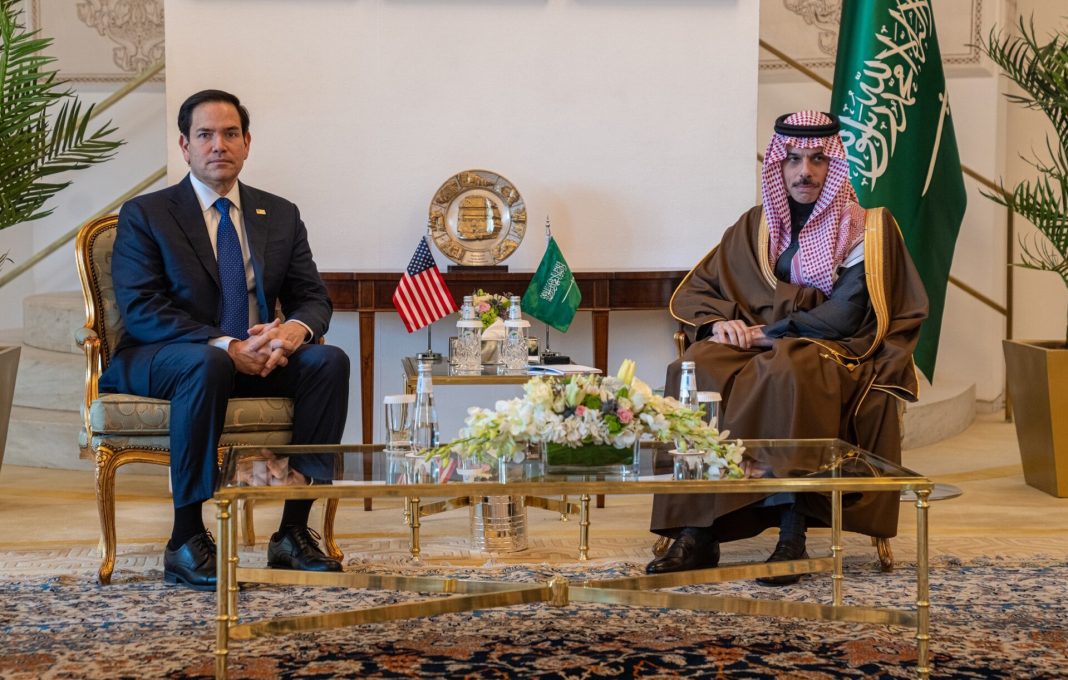
Saudi Foreign Minister Prince Faisal met Rubio at the G20 in Atlanta on Oct 30, discussing Iran and Yemen as Trump said Tehran wants to talk before Nov 3.
ATLANTA — Saudi Foreign Minister Prince Faisal bin Farhan met US Secretary of State Marco Rubio on Friday at the G20 Foreign Ministers’ Meeting, where the two discussed Iran, Yemen and Sudan as Washington signalled that Tehran “wants to talk” and the countdown to the November 3 moratorium on US strikes entered its final three days.
The bilateral, the second between the two officials in just over a month, came on a day when President Donald Trump told reporters Iran wanted a deal and that the war would end “very soon,” while Qatar sent mediators back to Tehran for a fresh attempt even after Iran rejected its latest draft proposal. For Riyadh, the meeting in Atlanta offered one of the last face-to-face opportunities to shape the post-midterm calculus before the strike moratorium expires.
What Did Faisal and Rubio Discuss in Atlanta?
The State Department said Rubio and Prince Faisal discussed bilateral cooperation on regional matters including “developments in Iran, Sudan, and Yemen,” according to a readout published on October 31. Rubio said the two officials discussed “ways our countries can continue working together on regional challenges, including the situations in Iran, Sudan, and Yemen,” according to the State Department statement reported by The National and Dunya News.
The House of Saud Daily Briefing
Saudi Arabia’s news in 3 minutes, every morning. Free. See today’s issue
✓ You’re in. Your first briefing arrives tomorrow morning.
The readout did not specify what Rubio asked of Saudi Arabia or what Prince Faisal requested from Washington. No Saudi readout of the bilateral meeting was available as of Saturday morning.
The Atlanta meeting was the second between the two men in just over a month. Prince Faisal met Rubio at the State Department in Washington on September 28 as fighting between the Saudi-led coalition and the Houthis intensified in Yemen, according to The National. At that earlier meeting, the war in Yemen and the broader Iran conflict dominated the agenda.
Rubio’s public framing of the US-Saudi relationship has been consistent. On October 5 he said “Saudi Arabia has a right to defend itself and the United States has a defence and security agreement with Saudi Arabia and we intend to live by it,” according to The National.
Rubio Signs Expo 2030 Participation Agreement
Alongside the security discussions, Rubio signed the US participation agreement for Expo 2030 Riyadh, designating the United States as an “Official Participant” in the event, according to the State Department and Dunya News. The signing was intended to “showcase American innovation” and strengthen the US-Saudi partnership, the State Department said.
The Expo 2030 deal was one of the few tangible deliverables from the Atlanta bilateral. It follows a broader pattern of Washington pairing security assurances with commercial engagement, including the 123 civil nuclear agreement signed by Energy Secretary Chris Wright and Saudi Energy Minister Prince Abdulaziz bin Salman in July, according to Spectrum News and AP.
What Has Saudi Arabia Asked Trump to Do After November 3?
Saudi officials, after visiting Tehran for multilateral talks on October 26, asked the White House to hold off on rushing into further military action and to give regional mediation more time, according to Axios, as cited by Samaa and Daily Beirut on October 29 and 30. The officials cited Iran’s fear of US-Israeli strikes after the midterms as a reason to keep the diplomatic track alive.
This was not a new request. Crown Prince Mohammed bin Salman called Trump in early August to voice concern about fresh strikes on Iran, according to Axios and Bloomberg. Saudi officials repeated the ask in late October, relaying the Crown Prince’s concern about rushed military action and urging Trump to “prioritize dialogue,” Axios reported.
The pattern suggests Riyadh’s core position has not moved: Saudi Arabia wants the war to end through negotiation, not escalation. The kingdom is absorbing near-daily Houthi missile and drone strikes — including attacks on oil infrastructure and airports — and has no interest in a wider US-Iran war that could draw heavier Iranian retaliation onto Saudi territory.
What is not clear is whether Prince Faisal delivered a specific proposal in Atlanta — a timetable for extending the moratorium, conditions for a ceasefire, or an offer to mediate — or whether the message was simply a reiteration of existing Saudi preferences. The State Department readout gave no indication either way.
Trump Says Iran Wants to Talk
Hours before the Faisal-Rubio meeting in Atlanta, Trump told reporters at the White House that Iran “wants to talk,” that the war was “going to end very soon,” and that the US is “not pressed for time,” according to the Times of Israel liveblog, Fox News and PBS NewsHour, all on October 30. He described the conflict as “not a typical war.”
The comments marked a shift in tone from Trump’s October 8 announcement that the US “will not be attacking Iran at any time prior to the midterm elections” on November 3, according to The National. That earlier statement was widely read as signalling the opposite: that strikes would resume after the midterms. Trump’s October 30 language suggested he was at least leaving room for a diplomatic off-ramp.
Vice President JD Vance reportedly sent a letter to Tehran in an effort to revive negotiations, according to the Wall Street Journal on October 28. Trump downplayed it.
Iran confirmed receipt of Trump’s signalling without issuing a formal public response as of Friday evening, according to CBS News live updates. Two unnamed diplomats told the Associated Press on October 28 that Trump had not made a final decision on post-moratorium military action.
Reports from the New York Times on October 21 said the US and Israel had drawn up plans for a “short but intensive” operation targeting Iran’s energy infrastructure, nuclear facilities and missile and drone arsenal. Trump had not approved the plans.
Why Did Iran Reject Qatar’s Draft Proposal?
Iran rejected Qatar’s latest draft as containing “unacceptable ideas that did not amount to an offer,” an Iranian official told Reuters, as reported by Middle East Eye. Despite the rejection, Qatari mediators returned to Tehran on Friday — the same day as the Atlanta bilateral — for a fresh push, according to Reuters via Shafaqna.
The rejection underlined a fundamental gap. Iran’s core demands — an end to the war, the lifting of the US counter-blockade of Iran, payment of wartime compensation and no compromise on its nuclear programme — remain unchanged. Foreign Minister Abbas Araghchi submitted a seven-day roadmap via Qatar at UN sidelines on September 25, under which the Strait of Hormuz would reopen in return for the US lifting its blockade, sanctions waivers and about $12 billion in frozen assets, according to Al Jazeera.
The Wall Street Journal reported that Trump rejected Araghchi’s proposal and expected renewed bombing after the midterms, according to Hurriyet. Qatar has continued to shuttle between Washington and Tehran despite the impasse, but each successive draft has been rejected by one side or the other.
For Saudi Arabia, the Qatar track is both useful and insufficient. It keeps a diplomatic channel open, which Riyadh has urged, but it has not produced a ceasefire or halted Houthi attacks, which Iran has declined to restrain. The revised US draft that Qatar brought to Tehran on Friday may represent a last attempt before the moratorium expires.
What Did the G20 Produce on Iran?
Nothing collective. The Atlanta G20 Foreign Ministers’ Meeting, held October 30–31, produced no joint communiqué. Rubio cancelled the traditional group photo after European diplomats objected to Russian Foreign Minister Sergei Lavrov’s presence, according to Asharq Al-Awsat and the Korea Times. Rubio was expected to issue a chair’s summary instead.
Polish Foreign Minister Radosław Sikorski framed the objection: “We have wars going on, and we have participants in those wars around the table,” according to Asharq Al-Awsat on October 31.
The Iran war dominated the meeting. Asharq Al-Awsat reported that US officials present told Middle East allies to prepare for possible renewed strikes on Iran after the November 3 midterms. Rubio described the moment as a “moment of choosing,” according to The National on October 30. Germany’s Foreign Office said most G20 nations shared the view that Iran “must come to the negotiating table,” The National reported.
Without a communiqué, bilateral meetings were the primary venue for substantive diplomacy. Prince Faisal met Lavrov on the sidelines, discussing Yemen insecurity and risks to shipping through the Strait of Hormuz and the Bab al-Mandab, according to Asharq Al-Awsat. He separately met Canadian Foreign Minister Anita Anand; both sides condemned Houthi attacks on Saudi Arabia, Asharq Al-Awsat reported.
Rubio also met Turkish Foreign Minister Hakan Fidan on the G20 sidelines. Fidan was expected to urge US-Iran dialogue and raise attacks on Gulf shipping and energy infrastructure, according to Indrastra and The National. Turkey’s parliamentary Foreign Affairs Committee approved the Makkah joint defence pact ratification bill on October 27, though a full assembly vote has not yet been scheduled.
Background: From Moratorium to Countdown
Trump announced the moratorium on October 8, saying he would not attack Iran before the midterm elections on November 3, according to The National. The Hormuz blockade remained in “full force,” he said.
In the weeks since, several developments have shaped the diplomatic landscape leading into Atlanta:
- The US ordered nonessential diplomatic staff and families to leave Saudi Arabia on October 21, a move widely interpreted as pre-positioning for possible military action, according to CNBC and the BBC.
- Saudi Arabia, Iran, Turkey and Pakistan held a multilateral meeting in Tehran on October 26, producing a joint communiqué but no ceasefire.
- The Houthis escalated attacks on Saudi Arabia, including strikes on oil facilities, airports and military sites, while the Saudi-led coalition intercepted multiple missiles and drones.
- Hormuz shipping continued to face mine strikes and IRGC interference, keeping oil prices elevated and adding economic urgency to diplomatic efforts.
- Prince Faisal told the UN General Assembly in September that the international community had been “absent” in confronting threats to peace and security, according to The National.
The Atlanta bilateral came at the intersection of all these threads. With three days left before the moratorium expires, Saudi Arabia’s message to Washington — shaped by its own exposure to Iranian proxies and its desire to avoid a broader war — remained what it has been since August: give diplomacy more time.
Whether Rubio carried any new commitment back to Trump, or whether the meeting simply confirmed existing positions, will become clear only when the moratorium deadline passes on November 3.
Frequently Asked Questions
Has Prince Faisal met Rubio before the Atlanta G20?
Prince Faisal met Rubio at the State Department in Washington on September 28, according to The National. Before that, Rubio called Saudi Arabia an “important strategic partner” during a trip to Manila on July 23, according to Asharq Al-Awsat. The two officials have had at least two direct meetings since late September.
What is the Expo 2030 participation agreement that Rubio signed?
The agreement designates the United States as an “Official Participant” in Expo 2030, which Riyadh is scheduled to host. It is a standard bilateral instrument that commits the US to maintaining a national pavilion and is separate from any security or defence agreements. The signing was announced by the State Department on October 31.
What happens if the November 3 moratorium expires without extension?
The moratorium’s expiry would remove Trump’s self-imposed constraint on military action against Iran. The New York Times reported on October 21 that US and Israeli planners had drawn up options for strikes on Iranian energy infrastructure, nuclear facilities and missile arsenals, though Trump had not approved them. An extension, a diplomatic breakthrough, or a decision to simply let the deadline pass without action are all possible outcomes.
Is Iran engaging with Trump’s “wants to talk” statement?
Iran confirmed receipt of Trump’s October 30 signalling but issued no formal public response as of Friday evening, according to CBS News live updates. Iran’s foreign ministry spokesman Esmaeil Baqaei has not commented publicly on the Atlanta G20 proceedings. Iran has historically demanded preconditions — including sanctions relief and an end to the counter-blockade — before entering direct talks with the United States.
Did the G20 produce any collective statement on the Iran crisis?
No. The Atlanta G20 Foreign Ministers’ Meeting failed to produce a joint communiqué after Rubio cancelled the group photo over objections to Lavrov’s presence, according to Asharq Al-Awsat. Rubio planned to issue a chair’s summary instead. Germany said most G20 nations agreed Iran should negotiate, but no formal collective position was adopted.
The House of Saud Daily Briefing
Saudi Arabia’s news in 3 minutes, every morning. Free. See today’s issue
✓ You’re in. Your first briefing arrives tomorrow morning.
Most Read Today
Most Read This Month