Original Coverage & Source Attribution: government.economictimes.indiatimes.com
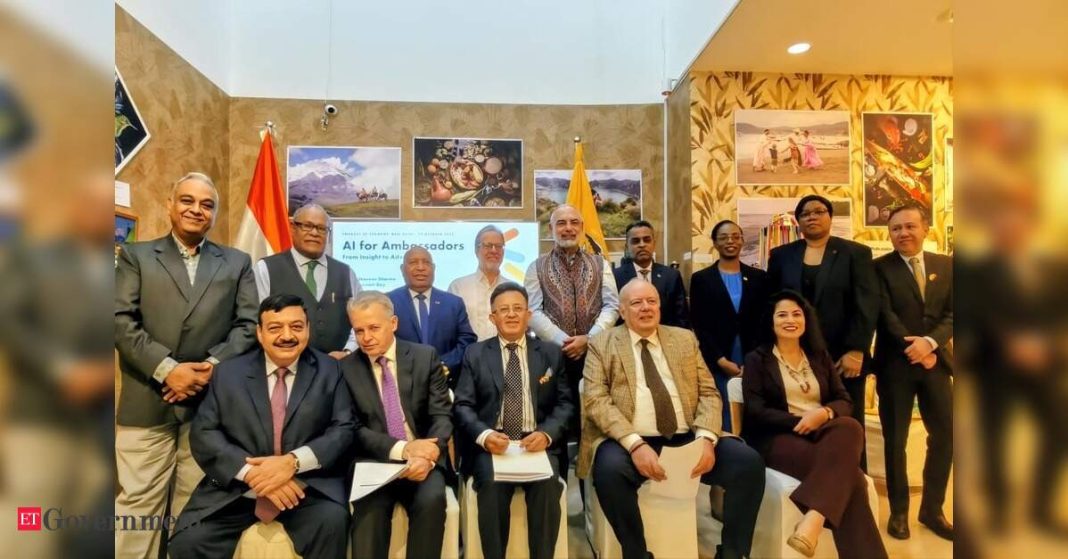
Artificial intelligence is increasingly becoming an important tool in the professional lives of diplomats and ambassadors, offering new possibilities for analysing geopolitical developments, preparing policy briefs, managing official engagements and advancing national interests.Highlighting the growing relevance of AI in contemporary diplomacy, Fernando Xavier Bucheli Vargas, Ambassador of Ecuador to India, opened a special session at the Embassy of Ecuador in New Delhi on October 29, bringing together senior representatives of the diplomatic community to examine the practical applications of emerging technologies in diplomatic work.The session, titled “AI for Ambassadors – From Insight to Advantage,” was organised by the Embassy of Ecuador as an initiative to familiarise senior diplomats with the potential of artificial intelligence in their professional responsibilities. The event was attended by 16 diplomats, including 13 Heads of Mission, representing 14 countries.The programme focused on how AI-powered tools could help embassies and high commissions improve the efficiency of their operations, strengthen their understanding of political and economic developments, and support more informed diplomatic decision-making.The technical presentations were delivered by Naveen Sharma, Chairman of Anaika Global, and Poonam Dey, an AI practitioner with academic qualifications in computer science and psychology. Sharma, who specialises in geopolitics, is also the author of Prompt to Political Power — Political Leader’s AI Mastery Manual, a book examining the application of artificial intelligence in political leadership.Rather than concentrating on the theoretical dimensions of AI, the presentations demonstrated its practical applications in the daily functioning of diplomatic missions. The speakers illustrated how AI-based systems could assist ambassadors and their teams in managing information, identifying developments relevant to their countries and preparing for high-level engagements.One demonstration showed how an embassy could use automated systems to generate regular briefings tailored to its diplomatic and economic priorities. Such systems could monitor publicly available information, identify developments affecting bilateral relations, assess their significance from the host country’s perspective and suggest areas requiring diplomatic attention.The approach could be particularly useful for diplomatic missions operating with limited personnel, where officials must simultaneously monitor political developments, economic policies, trade opportunities, security issues and bilateral engagements.Another demonstration examined the role of AI in preparing for ministerial and other high-level official visits. The proposed applications included compiling background dossiers from identifiable sources, analysing negotiating positions, preparing multilingual communications and establishing mechanisms to monitor commitments made during bilateral discussions.The speakers also discussed the possibility of developing integrated AI-assisted systems that connect an embassy’s long-term diplomatic objectives with its daily activities, including meetings, official visits, policy reporting and follow-up actions. Such systems could enable diplomatic missions to move beyond routine information collection towards more structured and proactive engagement.At the same time, the presentations emphasised that artificial intelligence should function as a decision-support mechanism rather than a substitute for diplomatic judgement. Political sensitivity, negotiation, relationship-building and accountability would remain the responsibilities of ambassadors and their teams. Appropriate safeguards would also be necessary to protect confidential communications and sensitive diplomatic information.The session generated considerable interest among the participating diplomats, several of whom expressed interest in further programmes examining the practical applications of AI in diplomatic work.The 14 countries represented at the event were Ecuador, Colombia, the Dominican Republic, El Salvador, Guyana, Jamaica, Papua New Guinea, Paraguay, the Solomon Islands, Sri Lanka, Suriname, Timor-Leste, Trinidad and Tobago, and Uruguay.The initiative comes at a time when artificial intelligence is beginning to influence not only economic activity and public administration but also the methods through which governments conduct international relations. For diplomatic missions, the potential applications extend from political and economic intelligence to trade promotion, consular services, public diplomacy and the coordination of bilateral initiatives.By convening ambassadors and senior diplomats for a focused discussion on these applications, the Embassy of Ecuador provided a platform for examining how emerging technologies could be integrated into diplomatic practice while preserving the central role of human judgement in international relations.