Original Coverage & Source Attribution: e.vnexpress.net
The figures, from the IMF’s October World Economic Outlook, put Vietnam’s nominal output per person 8.9% above last year’s level and nearly double what it was a decade earlier.
Vietnam trailed Indonesia by about $250 last year, IMF estimates show, and the fund’s April outlook had still projected Indonesia staying ahead in 2026.
The new projections would make Vietnam fifth among ASEAN members, behind Singapore, Brunei, Malaysia and Thailand. The IMF expects it to keep its lead over Indonesia in 2027, at $5,659 against $5,550.
Indonesia remains Southeast Asia’s largest economy by far. With nearly three times Vietnam’s population of just over 100 million, its GDP is projected at $1.48 trillion this year, against Vietnam’s $542 billion.
Nikkei Asia linked the shift to Vietnam’s growing role in high-tech manufacturing of semiconductors and electronics, noting that Taiwan’s Foxconn is expanding production there. South Korea’s Samsung Electronics makes smartphones and other electronics for export at its northern Vietnamese factories.
Vietnam’s economy grew 9.95% in the third quarter, its fastest pace in four years.
|
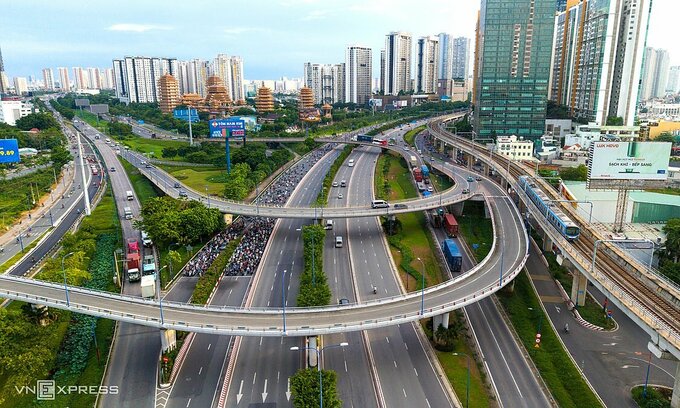
A multi-level interchange in Ho Chi Minh City. Photo by VnExpress |
The government’s public investment push is also supporting growth, Mai Fujita, a senior research fellow at Japan’s Institute of Developing Economies, told Nikkei Asia.
Vietnam plans to spend VND1.014 quadrillion ($39.3 billion) on public investment this year, with roads, airports and other infrastructure under construction nationwide.
Indonesia’s growth, by contrast, has hovered around 5%. The IMF forecasts 5.1% for the country this year, against 8.4% for Vietnam.
Vietnam is targeting growth of at least 10% this year and aims to lift GDP per capita to about $8,500 by 2030, roughly Thailand’s level today.
Fujita said Vietnam also needs to pursue long-term growth by developing human resources and technology, alongside the infrastructure spending that lifts growth in the short term.