



Original Coverage & Source Attribution: www.fool.com
Nvidia (NVDA -0.33%) became the first company to cross the $5 trillion market cap threshold last year, powered by its position at the center of the artificial intelligence (AI) infrastructure boom. It fell under that line, but is near $6 trillion in market cap now. Nvidia sells the GPUs, networking equipment, and software that hyperscalers and developers need to build powerful models.
Apple (AAPL +0.21%) briefly followed Nvidia into $5 trillion territory before slipping back below that milestone. Interestingly, Apple’s AI opportunity looks different from Nvidia’s. The company doesn’t need to dominate AI infrastructure because its enormous installed base of devices gives Apple something resembling a tollbooth through which developers can distribute AI-powered services.
There’s another company sitting somewhere between these two models: Alphabet (GOOGL +0.42%) (GOOG +0.38%). Google owns AI infrastructure, develops frontier models, operates one of the world’s largest cloud platforms, distributes AI to billions of users, and monetizes the technology across several businesses. That’s why I think Alphabet can handily become the next $5 trillion company — and potentially get there before the end of 2028.
How Alphabet quietly built an AI empire
What makes Alphabet unusual is how it controls so many layers of the AI stack. Starting with infrastructure, Google spent years developing its own custom silicon, called Tensor Processing Units (TPUs). Historically, these chips powered Google’s internal workloads and those of cloud customers. However, Alphabet is now beginning to expand the opportunity by making TPUs available to select customers for deployment inside their own data centers.
Alphabet is showing how AI isn’t just confined to chatbots. Moving up the stack is Google Cloud and Gemini. The Gemini consumer app has 950 million monthly active users, while Gemini Enterprise is already being used by nearly 90% of the Fortune 100.
Moreover, the company is incorporating AI into search and advertising, where better recommendations and targeting translate directly into high-margin revenue. Meanwhile, Waymo is using AI to operate autonomous vehicles and has already scaled to hundreds of thousands of paid rides per week.

Today’s Change
(0.42%) $1.48
Current Price
$351.98
Key Data Points
Market Cap
Day’s Range
$350.31 – $356.83
52wk Range
$235.84 – $408.61
Volume
6.5M
Avg Vol
26.9M
Gross Margin
60.94%
Dividend Yield
0.25%
How AI can change Alphabet
During the second quarter, Google Cloud revenue soared 82% year over year to $24.8 billion. Even more impressive, the platform’s backlog reached $514 billion. That backlog provides Alphabet with something growth investors love: visibility.
Meanwhile, Gemini is proving that Google belongs in the same conversation as frontier models. Gemini models process roughly 22 billion API tokens per minute. As usage expands across Gemini Enterprise, Workspace, Search, and Google’s consumer products, Alphabet has numerous opportunities to monetize AI research.
Waymo provides another potential growth engine. While robotaxis aren’t material to Alphabet’s financial results yet, autonomous transportation could become a major commercial market — and Alphabet already owns one of the most mature platforms.
The bigger theme here is that Alphabet doesn’t need each of its AI initiatives to become a blockbuster. Search can monetize AI through advertising while Gemini sells software and subscriptions. Cloud stands to benefit from accelerating infrastructure spend while TPUs monetize underlying hardware. Lastly, Waymo gives Alphabet an opportunity to commercialize AI in the physical world. Very few companies have this many shots on goal.
How Alphabet can reach a $5 trillion valuation
Alphabet is currently worth $4.2 trillion. Reaching a $5 trillion valuation requires its market capitalization to increase by only about 19%. Wall Street’s consensus estimates currently call for Alphabet to notch roughly $11.81 in earnings per share (EPS) this year, and expand that to $15 in 2027 and nearly $18 by 2028. Alphabet stock currently trades at a forward price-to-earnings (P/E) ratio of 23.
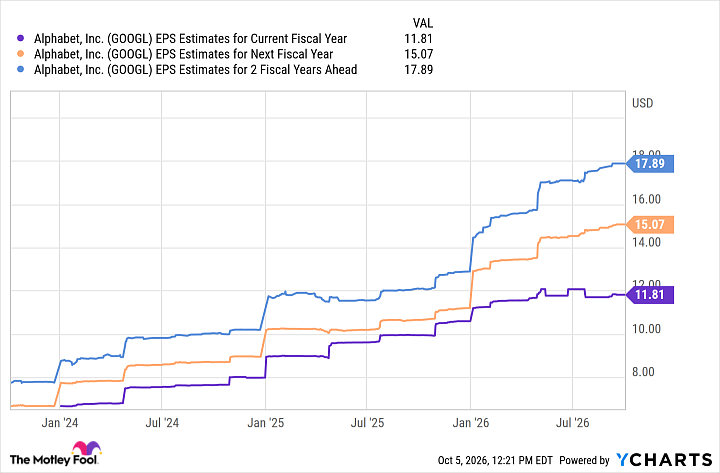
GOOGL EPS Estimates for Current Fiscal Year data by YCharts
Here’s the interesting part: Multiplying the consensus 2028 earnings estimate of $18 per share by Alphabet’s forward P/E of 23 produces a future share price of $414. This is about 20% higher than Alphabet’s current stock price and would propel the company just above a market cap of $5 trillion. This means Alphabet could reach $5 trillion by 2028 without requiring multiple expansion.
Of course, there are some important risks to note. Alphabet is spending enormous amounts of money building AI infrastructure. Competition from OpenAI, Anthropic, Microsoft, and Amazon remains fierce.
I think the competitive landscape is what makes Alphabet stock such a compelling long-term investment, though. Alphabet doesn’t need Waymo to dominate transportation, Gemini to destroy ChatGPT, or TPUs to replace Nvidia’s GPUs for this overall thesis to work out.
In the long run, Alphabet simply needs its vertically integrated AI businesses to keep compounding earnings. If the forecast above is any indication, analysts seem overwhelmingly bullish on Alphabet’s ability to continue monetizing and profiting from its AI ambitions. And that makes sense.