Original Coverage & Source Attribution: astanatimes.com
ASTANA – Kazakhstan’s planned large-scale construction and infrastructure investment program could sustain economic growth but also add to inflationary pressures, particularly if productivity gains do not match increased public spending, according to the International Monetary Fund (IMF).
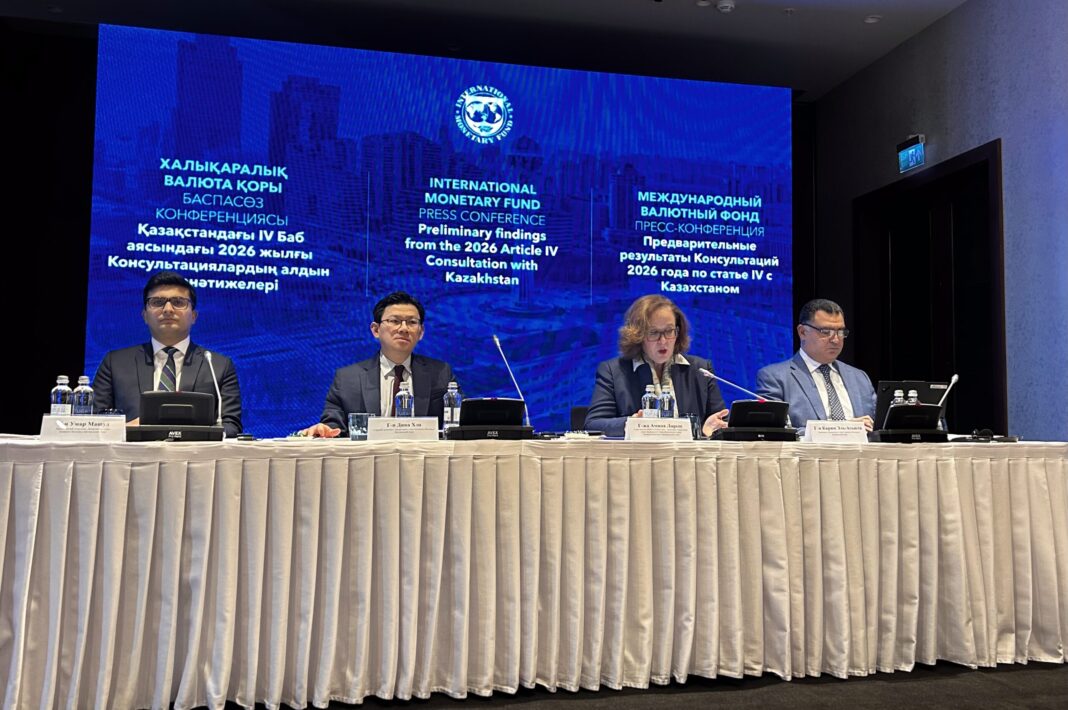
IMF Mission presented preliminary findings on Nov. 17 from the fund’s Article IV consultation, projecting economic growth of 4.6% in 2026 and 4.8% in 2027. Photo credit: The Astana Times
At a press briefing on Nov. 17, Amina Lahreche, chief of the IMF mission to Kazakhstan, presented preliminary findings from the fund’s Article IV consultation, projecting economic growth of 4.6% in 2026 and 4.8% in 2027. The IMF expects inflation to remain elevated despite recent progress. It declined to 9.2% in October, but the fund projects it will reach 9.6% by the end of 2026 and 8.4% by the end of 2027, gradually converging toward the National Bank of Kazakhstan’s 5% target by 2029.
Lahreche attributed persistent price pressures to strong domestic demand, increases in regulated prices and elevated inflation expectations. She said a tighter and better-coordinated policy mix would be necessary to bring inflation down while supporting sustainable growth.
Construction spending could fuel inflation
Lahreche said that further disruptions of the CPC remain part of the IMF’s risk assessment rather than its baseline forecast. Photo credit: The Astana Times
The IMF’s projections account for the government’s planned withdrawal of approximately 6.5 trillion tenge ($14.3 billion) from the National Fund through 2029 to finance infrastructure and construction projects. The government has also proposed declaring 2027 the Year of Nationwide Large-Scale Construction as part of a broader push to modernize infrastructure and stimulate economic activity. Asked how the planned spending could affect inflation, Lahreche said withdrawals from the National Fund would inject additional financing into the economy and sustain demand.
“Demand pressures are largely coming from the public sector spending this coming year. And withdrawals from the National Fund are going to push additional financing into the economy,” she said.
However, the IMF does not question Kazakhstan’s need for large-scale public investment, given its infrastructure needs and development ambitions. The key, Lahreche said, is ensuring that spending is efficient and translates into tangible economic gains.
“Public investment is necessary in Kazakhstan. This is a growing country. It has needs, but it’s important to spend efficiently so that you support the economy, support growth and productivity, but avoid spending too fast and having losses because productivity is not efficient,” she said.
She emphasized the importance of careful project selection, sound planning, reliable information and accountability mechanisms, including audits, to assess how public funds are spent and identify areas for improvement.
The challenge is ensuring that increased investment supports productivity rather than simply adding to domestic demand. Without corresponding productivity gains, higher spending could complicate efforts to bring inflation under control and erode household purchasing power.
“With productivity gains, there’s more income that can be distributed in the economy without necessitating an increasing price,” Lahreche said.
The IMF also called for closer adherence to expenditure and National Fund transfer rules, stronger non-oil revenue and better coordination of state-owned enterprises’ activities with the government budget to prevent excessive demand pressures and crowding out private investment. It noted that well-selected infrastructure and digital investments could also lift growth through stronger productivity gains.
CPC disruptions weigh on oil outlook
The IMF expects Kazakhstan’s oil sector to remain a limited contributor to economic growth in 2027, partly reflecting disruptions to oil production and exports in 2026. Asked whether the fund had considered further attacks on the Caspian Pipeline Consortium (CPC), a key export route for Kazakh oil, Lahreche said the projections already incorporated the impact of existing disruptions.
“We know that these disruptions will have implications also for 2027, which is why we see that the oil sector will not be a major engine of growth in 2027,” she said.
However, further disruptions remain part of the IMF’s risk assessment rather than its baseline forecast. The fund identified possible additional interruptions to oil production and exports, lower hydrocarbon prices and weaker growth among Kazakhstan’s major trading partners as external risks to its economic outlook.
Lahreche said the IMF could not predict whether further disruptions would occur, but acknowledged that additional shocks could affect the economy.
With oil output expected to remain broadly unchanged, the fund sees non-oil activity, supported by public spending, as the main driver of growth next year.
Private sector development remains key to diversification
The IMF reiterated that structural reforms to strengthen the private sector remain essential to Kazakhstan’s long-term economic diversification. Lahreche said productivity improvements and sustainable growth would depend on creating conditions for private companies to expand and compete. Among the priorities, she identified privatization, improvements to the business environment, stronger competition and deeper capital markets to provide businesses with better access to financing.
“We think that’s very important, because as we look to the growth over the long term, it is really the private sector that is a source of productivity enhancement and long-term sustainable growth,” she said.
The IMF also recommended maintaining a sufficiently restrictive monetary policy until inflation approaches its target, while preserving financial stability safeguards as mortgage lending expands. The banking sector remains well-capitalized, liquid and profitable, according to the fund. However, it advised continued monitoring of faster-growing lending segments and the use of state-backed credit guarantees.
Overall, the IMF said Kazakhstan needs a more disciplined public sector spending approach, coordinated monetary and fiscal policies, and structural reforms to support private sector-led growth. The IMF’s final assessment will be presented in its staff report, expected to be published in January 2027