Original Coverage & Source Attribution: www.aip.org
The framework could help improve precision etching in semiconductor manufacturing.
The plasma etching processes used in semiconductor manufacturing involve complex physics, dynamic physical reactions, and inhomogeneous chemical reactions. This makes maintaining consistency and quality difficult for the semiconductor industry, especially as etching processes become more advanced and require more stringent high aspect ratio (HAR) etch profiles.
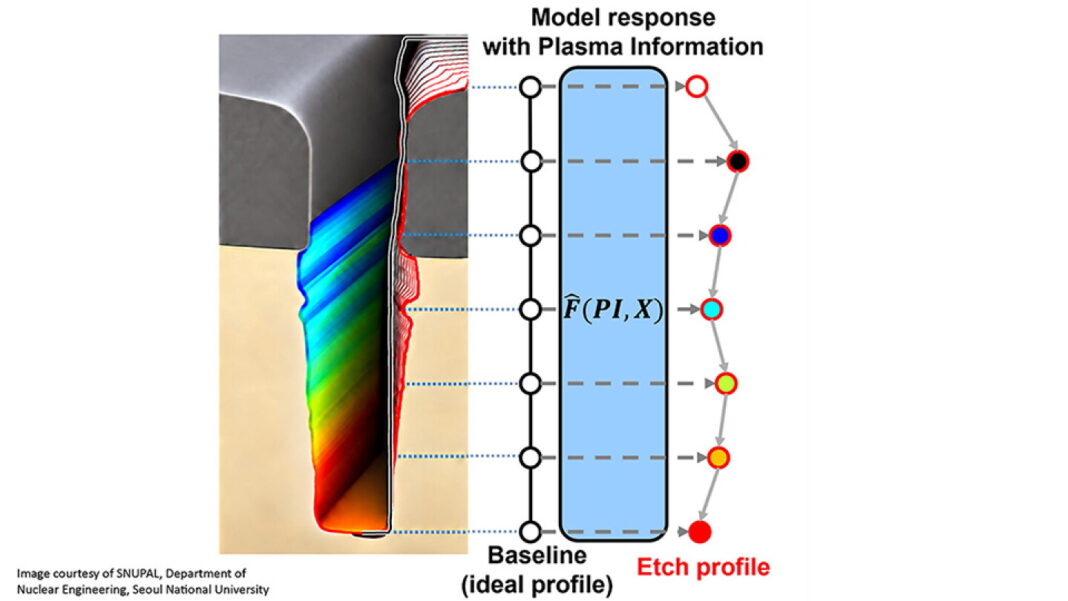
To better understand the effects of plasma conditions on the etching profile, Park et al. used plasma physics-informed explainable artificial intelligence (XAI) to investigate the physical causes behind variations in etching. The researchers fed etch profile image data to the XAI and analyzed how the profiles changed in relation to the plasma conditions. They found the XAI’s mathematical index can be used as the interpretable index for plasma physics.
“This gave us the insight that the process result image data, which was not highlighted compared to the other sensor data, could be applied to extract new information about the plasma reaction properties during the process,” said author Jihoon Park.
From the results, the researchers developed a plasma physics-informed profile-analysis framework for HAR plasma etching. This allows quantification of plasma-surface balance from measured etch profiles instead of statistical attribution alone.
“Processing plasmas are very difficult to understand because of the complexity of inhomogeneous chemical reactions, physical reactions, and numerous mechanical and electrical parts of the system,” said author Seolhye Park. “Because of this, finding a new source of information about the plasma reaction would have a similar effect to installing a new diagnostic tool without any hardware investment .”
The researchers believe their methodologies could be useful to other areas of plasma physics and diagnostics as well. They intend to apply their findings to understanding plasma process-driven phenomena in nuclear fusion.
Source: “Plasma-physics-informed explainable artificial intelligence for geometry-dependent etch-profile response in fluorocarbon-based high-aspect-ratio plasma etching,” by Jihoon Park, Taejun Park, Ji-Won Kwon, Gon-Ho Kim, and Seolhye Park, Journal of Vacuum Science and Technology: A (2026). The article can be accessed at https://doi.org/10.1116/6.0005860 .
!function(f,b,e,v,n,t,s)
{if(f.fbq)return;n=f.fbq=function(){n.callMethod?
n.callMethod.apply(n,arguments):n.queue.push(arguments)};
if(!f._fbq)f._fbq=n;n.push=n;n.loaded=!0;n.version=’2.0′;
n.queue=[];t=b.createElement(e);t.async=!0;
t.src=v;s=b.getElementsByTagName(e)[0];
s.parentNode.insertBefore(t,s)}(window,document,’script’,
‘https://connect.facebook.net/en_US/fbevents.js’);
fbq(‘init’, ‘1636721011403173’);
fbq(‘track’, ‘PageView’);