Original Coverage & Source Attribution: www.miragenews.com
EPFL researchers have developed a theory explaining how fusion plasmas enter a state of improved energy confinement, addressing a longstanding problem in the design and operation of tokamak reactors.
Nuclear fusion promises a source of energy by combining light atomic nuclei, the same process that powers the Sun. To achieve fusion on Earth, scientists must heat a gas to extreme temperatures, creating a charged state of matter called plasma. Keeping this plasma hot and stable long enough for fusion energy production is one of the main challenges facing the technology.
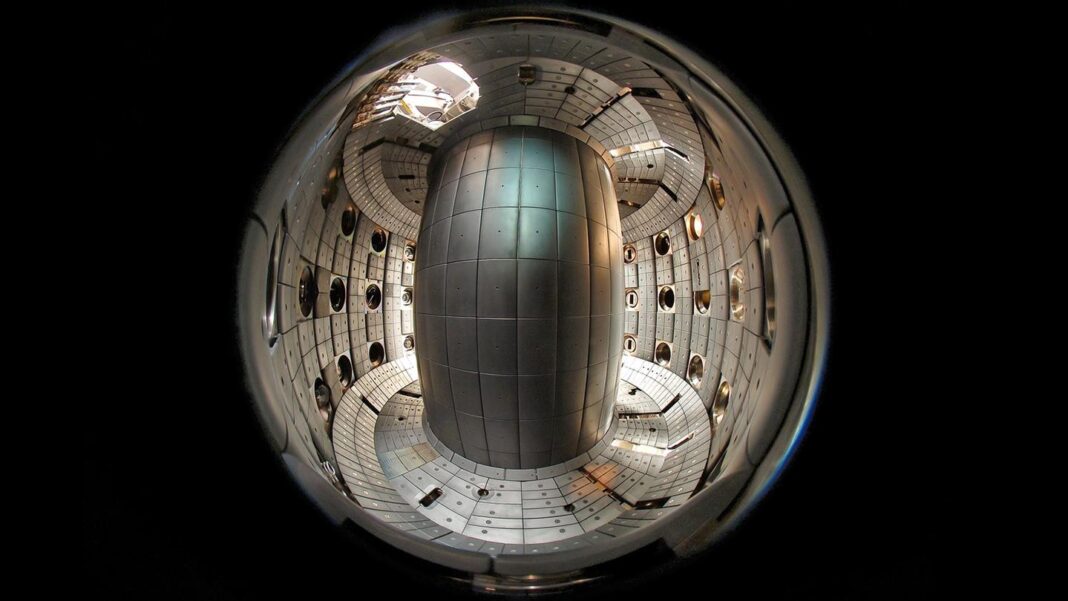
One approach uses machines called tokamaks, which employ powerful magnetic fields to confine plasma inside a doughnut-shaped chamber. But plasma is turbulent. Fluctuations carry heat away, making it difficult to maintain the conditions needed for fusion.
In 1982, researchers discovered that increasing the heating power beyond a certain threshold triggers a sudden change in plasma behaviour. Turbulence near the plasma’s edge drops sharply, allowing the plasma to retain energy much more effectively. Scientists call this the transition from low confinement (L-mode) to high confinement (H-mode).
Although H-mode is essential for future reactors such as ITER, the largest international fusion project, researchers have struggled to determine the heating power needed to trigger the transition. In particular, the threshold changes with plasma density and the direction of the magnetic field, two observations that existing theories have not fully explained together.
Understanding the transition
A team at EPFL’s Swiss Plasma Center (SPC) has developed a theory that accounts for these effects within a single physical framework. This study, led by Brenno De Lucca, doctoral-assistant at the SPC, published in Physical Review Letters, offers a way to predict the heating power required to reach H-mode.
The researchers used computer simulations to reproduce the behavior of plasma inside a tokamak as heating power increases. They then identified the physical processes responsible for the transition, developed a mathematical model to describe it, and compared its predictions with experimental measurements from existing tokamaks.
Their results show how turbulence in the plasma generates flows that move at different speeds across its outer region. These differences help suppress the turbulence itself, reducing heat losses and allowing the plasma to retain energy more effectively.
The researchers also explain why the direction of the magnetic field matters. Their calculations show that the direction of the magnetic field, the flows within the plasma and collisions between particles combine to make the transition easier in one magnetic configuration than in the other.
Predicting the power needed for fusion
The researchers derived equations describing how the power threshold changes with plasma density and other operating conditions. The theory explains why the required power increases with density in one regime but decreases in another, producing a density at which the heating requirement is lowest. Their predictions offer the basis for a reliable extrapolation to future experiments.
Indeed, applying the model to future reactors, the researchers predict that ITER, the large international fusion experiment under construction in France, would need at least 43 megawatts of heating power to reach H-mode, below its planned 73-megawatt capacity. For SPARC, a compact, high-field tokamak being developed by the US company Commonwealth Fusion Systems, the predicted minimum is 26 megawatts, close to its planned 25-megawatt capacity, leaving considerably less room for uncertainty.
The findings provide a physics-based criterion for estimating the conditions needed to achieve improved plasma confinement, helping researchers assess the operating requirements of future fusion devices.