Original Coverage & Source Attribution: robertreich.substack.com
Friends,
Sorry to bother you for a second time today, but I want to update you on what’s happened on Wall Street and Silicon Valley, which together now form the epicenter of the American economy if not the world — and I want to sound an alarm.
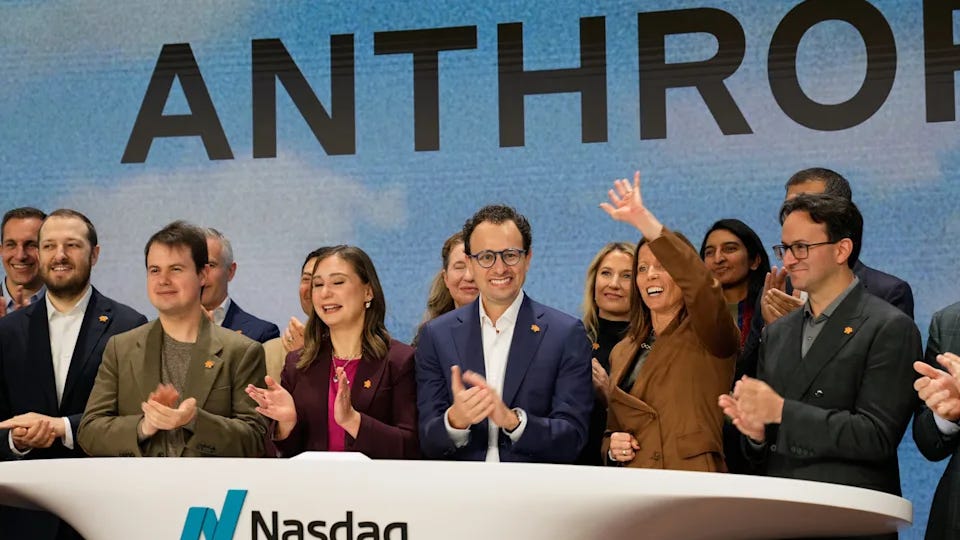
The headline news today is that Anthropic, the not-yet-six-year-old AI giant behind the popular Claude chatbot, has now become a publicly traded company after raising $81 billion in the largest offering of all time.
The mega-gamblers behind AI and Wall Street seem to have done well, at least for now. Anthropic’s shares opened on Nasdaq at $111.50, up from its $83 offering price.
But no one should be fooled about what’s really going on here. AI and finance are completely intertwined. And you and I are bearing a big part of the resulting risk — not only in terms of our jobs that may be replaced by AI and our safety that may be jeopardized by rogue AI, but also our current savings and incomes.
More than a third of the entire value of all shares of stock traded in the U.S. stock market are now in AI. Tech stocks account for more than half of the value of the S&P 500. In other words, your 401(k) — and any other savings you now have — is now dependent on AI.
Anthropic, OpenAI, and Nvidia aren’t just AI corporations. They’re also giant financial corporations — yet their finances are almost completely unregulated and utterly opaque.
Nvidia, for example, isn’t just a maker of the world’s most advanced chips; it’s also one of the nation’s major investors in data centers and other AI-related projects. (The progenitor of Nvidia’s aggressive financial moves is, appropriately, Colette Kress, who’s just been named its interim chief executive.)
Much of the debt that the AI industry is now taking on is hidden, off the books. Much of the rest is being financed by private credit, whose operations are also largely hidden.
Now AI corporations are pulling insurance companies into the AI orbit to insure these gigantic loans against default. This is frankly nuts. (Anyone remember A.I.G., and its collapse?)
I don’t care which giant corporations or ultra-wealthy investors strike it big and which lose their shirts. I worry about the economy as a whole, about working families who could lose their jobs and savings.
The losses when the AI bubble bursts could ricochet across America.
Recall the dot-com bubble of the late 1990s. The housing bubble of 2006-2007. There was also the tulip-mania bubble of the 1630s and the South Sea bubble of 1720.
All followed a well-worn pattern.
An asset generates excitement among investors because its value starts rising — mainly because other investors are also becoming excited and investing in it. Investors borrow piles of money to get in on the action.
The bubble bursts when it becomes evident that way too much has been invested relative to the potential for real-world profits. Smart investors cash out first. Everyone else is left with worthless pieces of paper. Borrowers go broke. Those insuring the borrowers disappear. If bad enough, governments have to bail out the biggest borrowers.
I wouldn’t be sounding this alarm if I had any faith in the Trump regime to watch over this increasing amalgam of high-risk AI and high-risk finance, but I have zero confidence.
Today’s public offering of Anthropic is being cheered on Wall Street and Silicon Valley. It should be booed on Main Street. Beware.