



Original Coverage & Source Attribution: koreatechdesk.com
A railway robotics company developed technology through a research project initiated by Seoul Metro, giving its work a credible connection to an industrial need. Yet the potential size of its business presented a more difficult question. KyungJin Hyung, who assessed the company during his years at Korea Technology Finance Corporation, saw how a promising technology could support a favorable appraisal while leaving venture investors unconvinced about its commercial upside. And both assessments could actually be reasonable, even when they reached different financing conclusions.
Korea’s Technology Appraisal Already Considers Commercial Viability
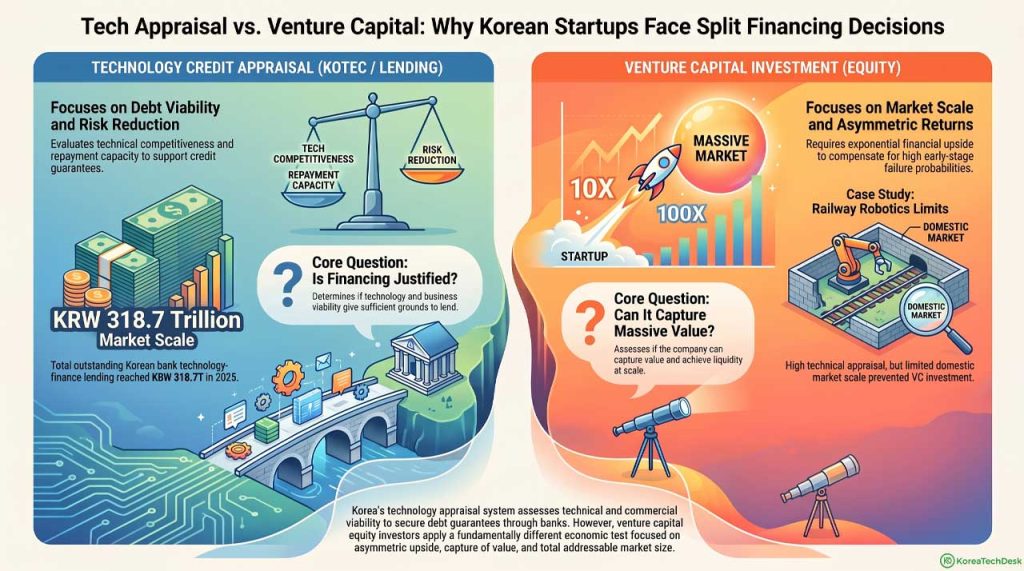
Korea has built a technology-financing system designed to help companies whose technological capabilities may be stronger than their financial records or available collateral. The Korea Technology Finance Corporation (KOTEC/KIBO) provides technology credit guarantees that can help eligible companies obtain financing through financial institutions.
Its assessment framework examines more than technical sophistication. According to KOTEC’s official technology appraisal guidance, its services include technology valuation, technology project viability assessment, and comprehensive technology appraisal, with factors such as technological competitiveness, market prospects, commercialization potential, and business capabilities informing different evaluations.
A favorable appraisal can therefore reflect a considered judgment about the commercial prospects of a technology-based business. However, the purpose of the assessment and the financing arrangement it supports influence how that judgment is used.
Korea’s expanding technology-financing market underscores the role of these evaluations in supporting business financing. According to the Financial Services Commission, outstanding technology-finance lending across Korean banks reached KRW 318.7 trillion in 2025, up from KRW 302.8 trillion in 2024, reflecting the substantial role of technology-based assessments in Korea’s banking system.
For founders, access to technology-based financing can be valuable when conventional lending criteria do not adequately reflect their business potential. Yet recognition of technological and commercial merit does not automatically establish the investment returns that a venture capital fund must pursue.
A Railway Robotics Assessment Reveals the Limits of Market Size
KyungJin Hyung, now CEO of BlissVine Ventures, spent nearly two decades at KOTEC working across technology appraisal, financing, and commercialization before moving into venture investing.
In an exclusive interview with KoreaTechDesk, he described how his experience evaluating companies for technology finance differs from assessing them as potential equity investments. He mentioned one intriguing case involving a company developing robotic technology for railway condition monitoring. Its development was connected to a demand-driven research and development project initiated by Seoul Metro, giving the technology a more concrete industrial context than an invention developed without an identified use.
However, the commercial environment presented complications beyond the technology itself. Hyung recalled an established competitor already operating within the railway ecosystem associated with Korea Railroad Corporation (KORAIL), while the combined domestic market represented by Korean metropolitan railway operators remained relatively limited for the company’s growth ambitions.
“The company could receive a high technology appraisal rating for credit guarantee purposes, but from a VC perspective, its limited addressable market made it difficult to justify an equity investment without a credible international expansion strategy,”
Hyung explained.
It means that the technology’s commercial potential faced a different test under venture capital investment criteria, where market reach, established competition, and opportunities for international expansion shaped the returns an equity investor could reasonably expect.

Industrial Demand Does Not Define the Full Investable Market
A demand-driven development project offers meaningful evidence that an industrial problem exists. It does not necessarily establish how many customers can purchase the resulting technology, how much they might spend, or how effectively a new supplier can compete with established vendors.
In the railway example, the domestic opportunity was constrained by the size and structure of the potential customer base. A venture investor evaluating the company would need to understand how much of that market was realistically accessible, alongside the commercial costs and uncertainty involved in winning customers.
International expansion could change the calculation by introducing additional railway operators and infrastructure markets. Nevertheless, a global market estimate would need to be supported by a credible strategy for reaching buyers, competing for contracts, and converting the technology’s advantages into revenue.
The important issue is how the relevant market translates into attainable company value. A specialized business can serve customers successfully within a relatively small industry while offering limited potential for the scale of returns expected by a venture fund.

Technology Credit Guarantees and Venture Capital Underwrite Different Outcomes
The underlying financial arrangements help explain why knowledgeable evaluators can reach different conclusions about the same company. A technology credit guarantee supports a lending decision under defined eligibility, repayment, and risk-assessment conditions, while a venture equity investment exposes the investor to the company’s future valuation and potential exit proceeds.
KOTEC’s credit guarantee framework involves credit investigation, technology assessment, guarantee approval, and issuance before financing is provided by a lending institution. A technology rating can inform the process, but it does not independently constitute an approved guarantee or a loan commitment.
Venture investors face a different economic requirement because their returns depend on the eventual value of their ownership stake. They must assess not only the company’s prospects for operating successfully, but also the likelihood that its growth and eventual liquidity could produce returns appropriate to the risks of early-stage investing.
“In technology finance, one often asks whether the technology and the company provide sufficient grounds to extend financing. In venture capital, the question is more asymmetric: Can this company become valuable enough that the upside compensates for the very high probability of failure inherent in early-stage investing?”
Hyung told KoreaTechDesk.
These financing structures also carry different exposures. Credit guarantees can involve losses when borrowers default, while equity investors can lose their invested capital if a company’s business or investment outcome falls short of expectations.
A company may therefore meet the risk criteria for one form of financing while falling short of the returns expected by an equity investor, even when both assessments recognize the technology’s commercial potential.
KOTEC’s Own Investment Process Reflects the Separate Equity Question
KOTEC’s institutional framework provides another illustration of how technology assessment and investment approval serve different purposes. The corporation also operates a guarantee-linked investment program that allows eligible companies to receive direct equity investment under a dedicated evaluation and approval process.
According to the program’s guidelines, eligibility includes an investment-purpose technology evaluation grade of TI8 or higher, alongside other requirements. The process subsequently involves investment assessment, negotiations, and review by an investment committee, with profitability among the considerations.
This additional investment review shows that a qualifying technology assessment does not settle every question about an equity commitment. Even within an institution experienced in technology financing, investment eligibility and final investment approval involve further judgment.
KOTEC’s distinctive investment review process illustrates how financing decisions can require additional scrutiny even after a company meets the relevant technology assessment criteria. After all, private venture investors apply their own investment strategies, risk expectations, and return requirements when evaluating the same business.
Venture Investors Must Establish Who Captures the Economic Value
Hyung identified another question that becomes especially important when a technology has already demonstrated credible technical and commercial potential. The investor must determine how much of the value created by the technology can ultimately be captured by the company seeking investment.
“As a venture investor today, I ask an additional question: if the technology succeeds technically, can the value created by that success accrue to this company at sufficient scale?”
he said.
That question involves the company’s position within its commercial environment. Customers, established suppliers, purchasing relationships, and the cost of entering new markets can all influence how technological advantages translate into business value.
For the railway robotics company, a technically credible solution did not remove the competitive and market-size considerations surrounding domestic railway operators. Even a successful deployment would require further analysis before an investor could estimate how much business the company might ultimately win.
Formal technology valuation has its own role in establishing a disciplined economic assessment. Its conclusions depend on assumptions about market potential, commercialization, and the conditions under which technological value may be realized.
“A valuation model can estimate the economic potential of a technology under certain assumptions. An investor has to decide whether those assumptions are likely to become reality through this particular company and this particular team,”
Hyung explained.
The investor therefore has to examine the path connecting the assessed technology to the company’s future earnings and equity value. A credible technology appraisal can strengthen that investigation, but the assumptions behind it still need to be tested against the investment being considered.
This is particularly relevant to international investors examining Korean deep-tech startups. A strong domestic technology assessment can provide valuable evidence about the underlying business, while overseas expansion prospects, accessible customers, and expected investor returns require their own supporting analysis.
The Question a Strong Appraisal Cannot Settle
In the end, a founder who receives a favorable technology appraisal may have indeed gained potentially useful evidence for financing discussions. But the mistake would be assuming that every subsequent investor must reach the same conclusion because the technology has already been evaluated.
If a venture investor remains unconvinced, repeating the technical merits may do little to resolve the disagreement. The unanswered question may concern how much of the market the company can realistically reach and how much economic value its position allows it to retain.
In Hyung’s railway example, international expansion could have altered the investment proposition, but only if the company could demonstrate a credible route into additional markets. The technology assessment could help establish the starting point; the future business still had to justify the equity risk.
A productive financing conversation therefore begins by identifying the decision each assessment was designed to support. Founders who understand that question can use an appraisal as evidence without expecting it to answer every question about venture investability.
Key Takeaway
- Korea technology appraisal assesses more than technical quality. KOTEC’s framework considers marketability, commercial viability, and business capabilities when supporting technology-financing decisions.
- A favorable appraisal does not guarantee venture investment eligibility. Credit-guarantee underwriting and venture equity decisions involve different financing structures, risk assessments, and expected economic outcomes.
- Market size can change the investment conclusion without changing the technology assessment. KyungJin Hyung’s firsthand railway robotics example shows how credible industrial development can coexist with constraints on venture-scale returns.
- Technology valuation and venture capital require different evidence. A formal assessment can estimate technological and commercial potential, while an investor must judge how much value the particular company can capture.
- Global founders and investors should examine the purpose behind a Korean technology assessment. Its value in investment due diligence depends on understanding the assumptions, financing context, and commercial questions it was designed to address.
– Stay Ahead in Korea’s Startup Scene –
Get real-time insights, funding updates, and policy shifts shaping Korea’s innovation ecosystem.
Follow KoreaTechDesk on LinkedIn, X (Twitter), Threads, Bluesky, Telegram, Facebook, and WhatsApp Channel.
Looking to connect with verified Korean companies building globally?
Explore curated company profiles and request direct introductions through beSUCCESS Connect.