



Original Coverage & Source Attribution: www.heraldscotland.com
However, that target has rarely been met and Permanent Secretary Joe Griffin revealed that “compromises” were made with trade unions, meaning the policy could not be enforced.
Against that backdrop, Mr McKee has been asked to lead efforts to overhaul Scotland’s public sector after First Minister John Swinney created a new Cabinet portfolio on reform, making it one of the most pressing issues over the next five years.
In an exclusive interview, the Public Service Reform Secretary was challenged over findings from The Herald’s Out of Office investigation, which has highlighted concerns over underused public buildings, low office attendance and spending across the public sector.
Asked whether he knew what compromises had been agreed with trade unions, Mr McKee declined to say, telling The Herald only that “conversations” with union officials were ongoing.
Pressed on whether unions would be allowed to control the policy, he insisted the Scottish Government called the shots.
“The Scottish Government has got a view on that,” he said. “And that is that people should be spending a percentage of the time in the office. And I’m not going to obviously talk to you about specific conversations that we have with trade unions, but the Scottish Government position is on that is clear.”
Asked if ministers were scared to challenge union opposition to tougher office attendance rules, he replied: “We’re not scared. We’re very clear in terms of what our expectation is and that’s part of broader conversations with trade unions about the shape of public services going forward.”
The Scottish Government has also stopped publishing office occupancy data for those subjected to the hybrid policy since The Herald revealed the target to spend at least two days per week in the office was not being met by core civil servants.
Despite being the minister responsible for reform, Mr McKee would not say whether he knew if the 40% target was being met, saying that it was the Permanent Secretary’s job to “manage” that aspect.
The Herald asked whether the Permanent Secretary provided feedback on the effectiveness of the policy. Mr McKee said: “There’s conversations between him and the First Minister.”
“But the policy is clear in terms of 40%,” he said, speaking in his ministerial office in Holyrood.
“It’s important that people are coming into the office to work with the teams they’re part of, to be able to engage face-to-face with people but clearly they have the flexibility to be able to work remotely when it makes sense to do so.
“That 40% requirement has been clearly laid out. There’s conversations with the workforce about taking that forward.”
Prior to introducing the remote working policy, the Scottish Government was clear that its aim was to ultimately increase this to 60% office attendance – the figure already used and enforced by the UK Government.
Throughout the interview, Mr McKee repeatedly referred to the policy as a “requirement”, however, Scottish ministers are unable to compel staff to comply with it.
The Permanent Secretary, who is Scotland’s top civil servant, told Holyrood’s finance committee in March that there were “shortcomings” in the hybrid policy after The Herald revealed trade unions warned they could take strike action if it was mandated.
Disciplinary action is not taken against staff who do not meet the target with Mr Griffin insisting that was a result of “compromises” made with trade unions over fears it would result in “conflict”.
When pushed by The Herald on what these compromises were, Mr McKee could not say but said the government was “clear that people should be spending a certain amount of time in the offices. That’s a very clear position.”
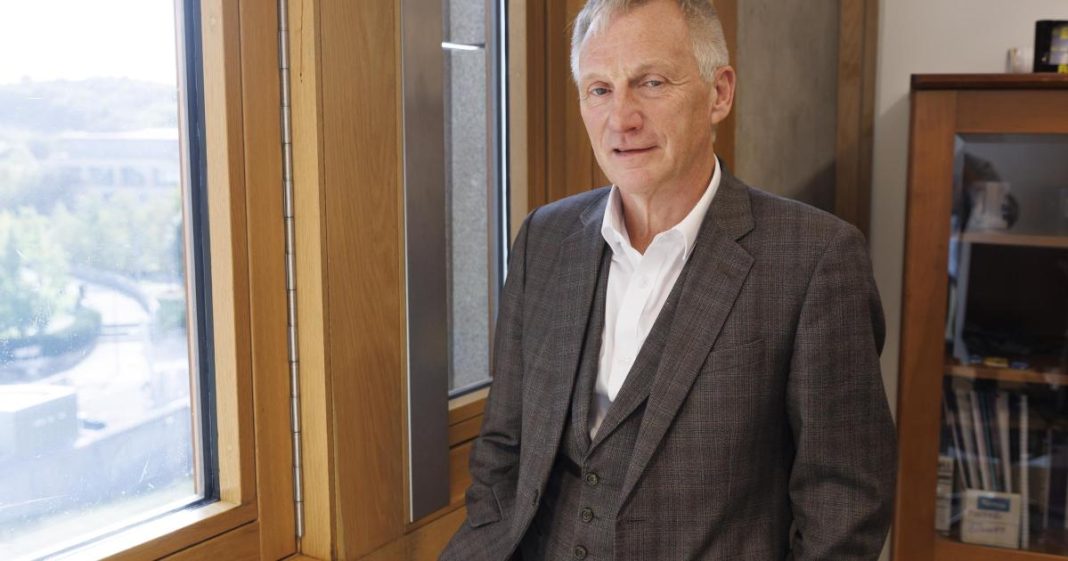
Ivan McKee MSP, Cabinet Secretary for Public Service Reform pictured during an interview at the Scottish Parliament with The Herald’s deputy political editor Rebecca McCurdy. (Image: Colin Mearns)
Official data now only reveals occupancy levels by all staff in Scottish Government buildings, meaning the figures are higher with contractors and agency workers included.
In June 2026, the occupancy rate at Victoria Quay, in Edinburgh, was just 27%, while Saughton House was 29.5% full based on the statistics for all staff.
But in January, before the Scottish Government stopped tracking how many core civil servants worked from the office, the average monthly percentage at Victoria Quay was 12.1%. In Saughton House, the average attendance for core civil servants was 8.2%.
Atlantic Quay in Glasgow was 32.5% full in January among core civil servants – but that figure was 70.8% in June when other staff were factored in, demonstrating how the newer measures produce substantially higher rates.
The Scottish Government has spent £41.8 million since 2020 on running costs for just five of its buildings – Bute House, Saughton House, St Andrew’s House, Victoria Quay and Atlantic Quay.
In 2023, Mr McKee described Leith’s Victoria Quay as “empty”, warning around 80% of the office building was not being used.
Alongside fellow SNP MSP Ben Macpherson, Mr McKee said office space should be opened up to businesses to increase productivity while ensuring value for money.
The Herald asked if he still believed that today now that he was in a position of power. He did not answer that particular question but said there were efforts to move other public sector organisations into the 35,000 square metres building which can accommodate around 2,000 civil servants.
He said: “I think that if you look at what we’ve done, is we’ve gradually shut other offices around and in Edinburgh and it’s not just government, its public bodies. More and more are getting moved into Victoria Quay. And there’s obviously more work to be done.”
“The position is that we should make use of that building the best we can.”
He also suggested the future of Saughton House could be reviewed once the building’s data centre reaches the end of its operational life.
“Saughton House, there is work happening there as the data centre reaches the end of its life to be able to assess the need for that building,” he said.
Despite the questions over the effectiveness of the hybrid working policy, Mr McKee insisted progress was being made in reducing waste across the public sector.
He claimed reforms to the government estate had already saved £52 million and resulted in the closure of 15 buildings, while ministers were examining management structures across government and public bodies.
Asked whether taxpayers could trust him to deliver reforms, he said: “We have to – and we will. We’re determined to take that forward.”
Out of Office – our pledge to expose how your money is being wasted on empty civil service buildings. Join us. Share your thoughts: [email protected].