Original Coverage & Source Attribution: www.kyivpost.com
French President Emmanuel Macron called for reopening discussions on Ukraine’s NATO membership, arguing that Russia’s maximalist negotiating demands and Ukraine’s increasingly powerful armed forces had made the issue central to Europe’s long-term security.
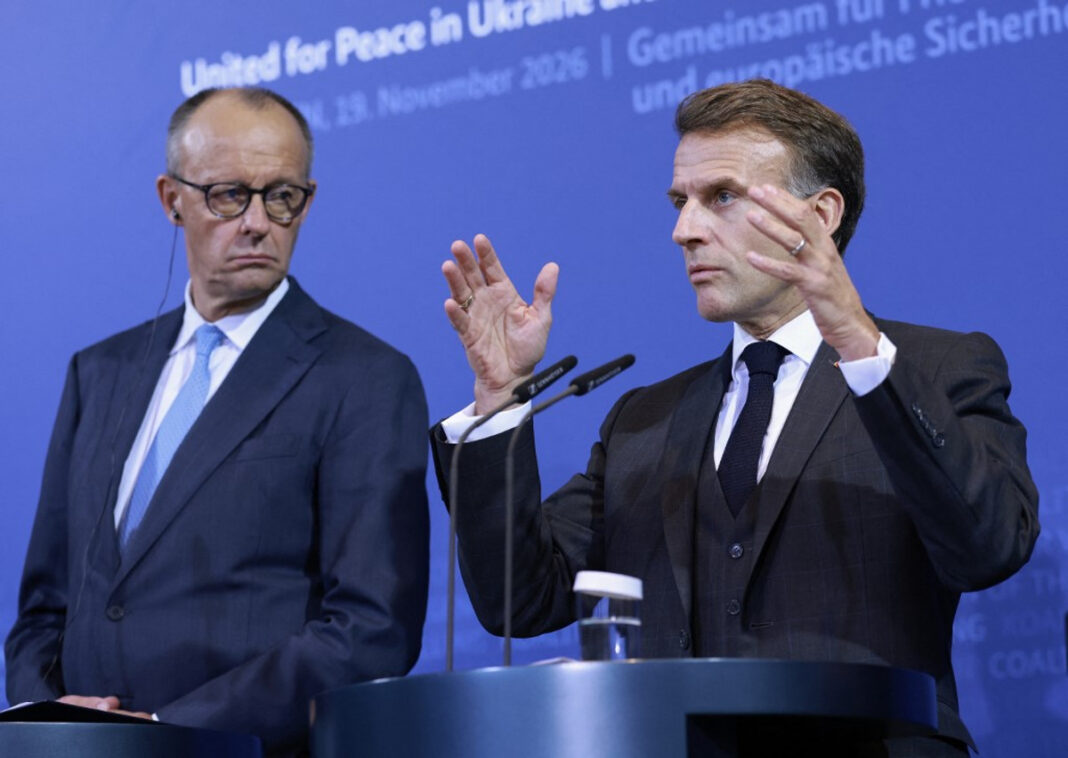
“Faced with the maximalist nature of the Russian position, I believe we need to reopen the question of Ukraine’s accession to NATO,” Macron said following the Coalition of the Willing summit in Berlin on Thursday, Nov. 19.
His remarks signaled a renewed push to place Ukraine’s NATO membership on the negotiating agenda, despite longstanding opposition from Moscow and the reluctance of some Western allies to admit Kyiv while Russia’s war continues.
Macron said Ukraine’s potential accession had previously been set aside under different circumstances, but argued that Europe’s security environment had since changed.
Ukraine’s battle-hardened military, strengthened through years of fighting Russia’s invasion and equipped with increasingly sophisticated Western weapons, should now be considered an asset to European security, he suggested.
“For our long-term security, Ukraine’s membership of NATO makes sense,” Macron said.
His comments came hours after US President Donald Trump met Russian President Vladimir Putin and Chinese leader Xi Jinping at a trilateral summit in Shenzhen, China, without Ukrainian or European representatives present.
Other Topics of Interest
Russian strikes damaged three bridges over the Dnipro River, disrupting traffic between Kyiv’s banks as fires broke out in several districts.
The Berlin meeting, attended by President Volodymyr Zelensky, European leaders and US envoys Jared Kushner and Steve Witkoff, sought to demonstrate continued Western support for Kyiv and establish Europe’s role in future negotiations.
Ukraine’s military strength changes NATO debate
Macron argued that the question of Ukraine’s future security arrangements must account for the country’s growing military capabilities and its role in defending the European continent.
He noted that Ukraine’s possible NATO accession had been set aside at the beginning of Russia’s full-scale invasion in 2022, when Western governments sought to avoid a direct confrontation between NATO and Russia.
But that decision, he suggested, had been made in a substantially different context.
Ukraine now possesses one of Europe’s largest and most experienced armed forces, having spent nearly five years defending itself against Russia’s full-scale invasion.
Macron argued that this military strength would remain relevant to the security of NATO members after the war.
His position adds a new dimension to discussions that have increasingly focused on providing Ukraine with NATO-style security guarantees without necessarily granting it membership in the alliance.
NATO’s Article 5 collective defense clause treats an armed attack against one member as an attack against all, although each ally determines the action it considers necessary in response.
Ukraine has repeatedly argued that full NATO membership offers the strongest protection against renewed Russian aggression.
Speaking at the same Berlin summit, Zelensky reiterated that position.
“I am grateful to the E3 countries and to all our partners who clearly state that the best security guarantee for Ukraine – and, in fact, for all of Europe – is NATO membership,” Zelensky said in a statement published by his office.
Despite Macron’s renewed endorsement, Ukraine’s accession would require consensus among NATO allies, and no membership timetable was announced in Berlin.
Macron calls for urgent air defense deliveries
Macron also used the Berlin meeting to call for an immediate increase in military assistance, particularly air defense systems capable of protecting Ukrainian civilians and critical infrastructure from Russian missile and drone attacks.
“The top priority is to deploy new anti-missile systems and new interceptors,” Macron said.
He urged governments possessing the necessary defensive equipment to transfer it to Ukraine without delay.
“All those who have the capacity to provide means of defense and protection for Ukrainian citizens must do so now,” he added.
His appeal came as Russia continued its attacks on Ukrainian cities and energy infrastructure, including strikes on Kyiv earlier Thursday that killed one person and damaged diplomatic missions and the historic St. Volodymyr’s Cathedral.
The Coalition of the Willing’s joint declaration identified strengthening Ukraine’s defenses against ballistic missiles as a priority ahead of winter.
Participating leaders also reaffirmed their commitment to long-term military assistance and additional measures targeting Russia’s ability to finance its war.
Macron described the coming weeks as critical for Ukraine, its population and European security.