Original Coverage & Source Attribution: www.nationpathindia.com
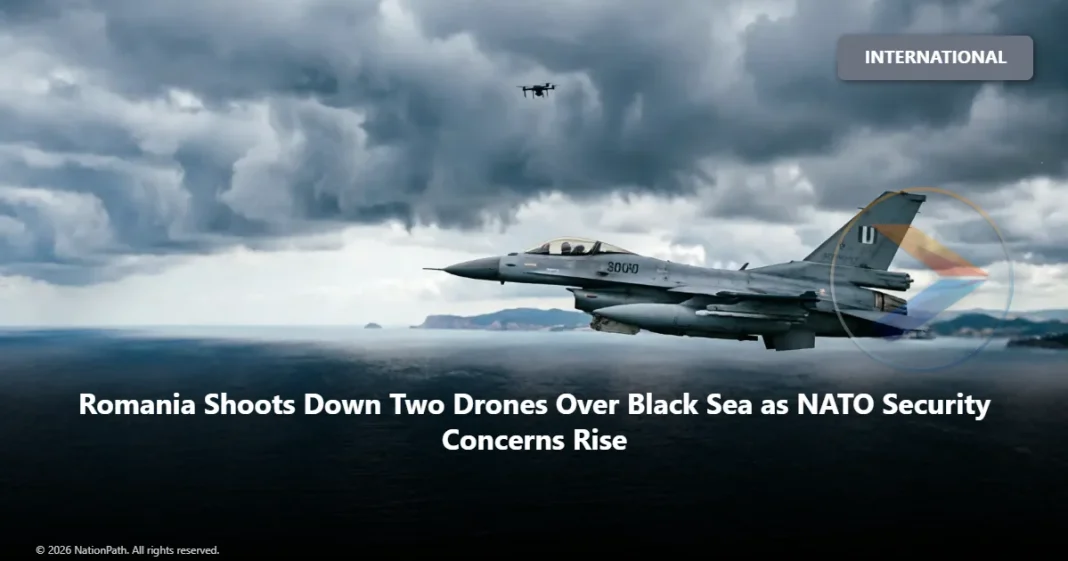
Romania has intercepted and destroyed two drones over its territorial waters in the Black Sea, highlighting growing security concerns along NATO’s eastern flank as drone-related incidents and attacks on commercial shipping continue to affect the region.
According to Romania’s Ministry of National Defence , two F-16 fighter jets were scrambled from the 86th Air Base at Borcea on the evening of October 17 after radar surveillance systems detected aerial targets approximately 120 kilometres east of Snake Island, heading southwest.
The Romanian aircraft subsequently engaged two drones that had entered the country’s airspace without authorisation. Romanian Defence Minister Radu Miruță said the first drone was shot down approximately 25 kilometres southeast of Sulina, while the second was intercepted around 20 kilometres east of the town.
The defence minister said the drones were likely Russian-made Geran-4 models, based on their reported speed of approximately 450 kilometres per hour and their apparent propulsion characteristics. He described the interception as the first time Romania had shot down drones of this particular type.
The identification remains a Romanian assessment rather than independently established proof of the drones’ origin or launch location.
The incident comes amid a series of drone-related security concerns around the Black Sea, including attacks on commercial vessels near Romania’s coastline. The developments have intensified questions about the protection of civilian shipping, the security of maritime trade routes and the ability of European NATO members to respond to increasingly complex aerial threats.
Romania shares a 614-kilometre border with Ukraine and occupies a strategically important position along the Black Sea and the Danube River. Its location makes the country particularly exposed to security incidents associated with Russia’s war against Ukraine, which began with Moscow’s full-scale invasion in February 2022.
Romanian authorities have reported repeated drone incursions and related incidents since the war began. The latest interception therefore represents more than an isolated military operation: it highlights the growing difficulty of maintaining secure airspace and maritime corridors close to an active conflict zone.
Black Sea Shipping Under Growing Pressure
The latest drone interception follows incidents involving two chemical tankers that caught fire in Romanian territorial waters near the mouth of the Sulina Canal earlier in the week.
One of the vessels, the Wine Trader, sent an emergency alert, and seven of its 12 crew members were reported missing while five were rescued. A second vessel, the Yara J, also caught fire, although its crew were reported safe.
Romanian officials initially stopped short of confirming that the fires were directly caused by the drones. The incidents nevertheless underline the risks facing commercial vessels operating near areas affected by the Russia-Ukraine conflict.
The Sulina Canal is an important connection between the Danube River and the Black Sea. It also forms part of the wider transport network used to move Ukrainian exports, including agricultural commodities, towards international markets.
Repeated attacks on shipping can increase insurance costs, delay deliveries and discourage operators from using exposed maritime routes. These consequences extend beyond the immediate conflict, particularly because the Black Sea region is important to international grain, energy and industrial commodity markets.
NATO’s Eastern Flank Faces a New Security Challenge
Romania is a member of the North Atlantic Treaty Organization (NATO), the military alliance whose collective-defence commitment is central to the security of its members.
Drone incursions near NATO territory present a difficult operational challenge. Military authorities must identify incoming aircraft, assess their flight paths and potential threat, and determine whether interception is necessary—all while avoiding unintended escalation.
The latest incident also comes as neighbouring Bulgaria seeks additional NATO support, including combat aircraft and counter-drone systems, following a series of attacks affecting commercial shipping in the Black Sea.
NATO officials have reaffirmed the alliance’s readiness to protect member states. A North Atlantic Council meeting scheduled for October 20 is expected to address Black Sea defence and deterrence, according to reporting on the latest developments.
However, the interception of drones over Romanian waters does not itself mean that NATO has entered a direct military confrontation with Russia. Any assessment of the wider implications must distinguish between national air-defence operations, alliance consultations and decisions involving collective-defence measures.
For Romania and its allies, the immediate challenge is to strengthen surveillance, protect civilian infrastructure and shipping, and prevent further incidents from endangering lives or destabilising the wider region.