Original Coverage & Source Attribution: www.hollywoodreporter.com
The Estonian film industry may be small but has big ambitions. And there is more that the Baltic country’s institutions can and must do to make the sector more sustainable as it balances big foreign productions visiting and local work. Those were key messages of an event at the 25th edition of the Industry@Tallinn & Baltic Event (ITBE) market, part of the 30th edition of the Tallinn Black Nights Film Festival (PÖFF).
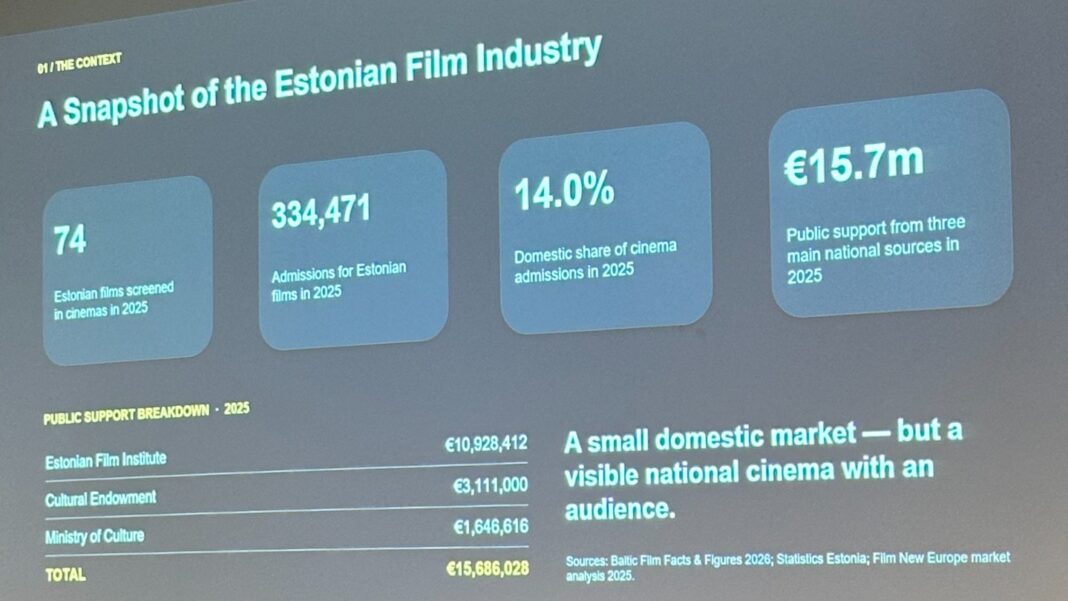
Lennart Mathias Männik and Kätlin Palm presented findings from their master’s theses. Among the data findings was that 74 Estonian films screened in the nation’s cinemas in 2025. “It’s not all new films. It’s films in general,” Männik shared. “And looking at our market and looking at our country size, it’s quite an achievement.”
Admissions for Estonian films last year hit 334,471, making the domestic share of cinema admissions in Estonia account for 14 percent. The by far biggest public funding support came from the Estonian Film Institute at €10.9 million ($12.0 million), followed by the Cultural Endowment at €3.1 million ($3.4 million) and €1.7 million ($1.9 million).
Männik’s conclusion: Estonia has “a small domestic market, but a visible national cinema with an audience.” But he summarized what he sees as key for the future outlook this way: “building a stronger, more sustainable Estonian film industry.”
Two key areas that need to be addressed: “underfunding limits production and creative freedom is under pressure” due to a lack of development resources and “rigid or unclear support expectations,” which can lead to creative caution.
Last but not least, foreign projects “bring both value and tension,” Männik highlighted. “Service productions [from abroad] bring investment, work and expertise but draw on the same limited workforce as domestic films. Without stronger local production capacity, international growth can leave Estonian films more vulnerable.”
Among the foreign films and series shot in Estonia have been the likes of Paramount+ spy thriller series The Agency and Tenet.
His suggestions for the Estonian sector and its support: adopt a long-term audiovisual strategy, make funding more diverse and stable, and strengthen the whole production ecosystem.
The big cutting-edge film studio complex Ida Hub just opened last month, with the goal of making Estonia’s Ida-Viru region a key production hub. But Männik highlighted: “Production conditions are only one part of how the ecosystem works.”