Original Coverage & Source Attribution: risingnepaldaily.com
Healthcare is rapidly advancing with the help of artificial intelligence (AI). The use of AI in disease detection, medical diagnosis, laboratory investigation, and drug discovery is transforming the overall healthcare system. Similarly, AI is reshaping patient monitoring and overall hospital management. In recent times, AI has become an important component of modern medicine.
It has the potential to advance the overall healthcare system by improving accessibility, quality, efficiency, and affordability. These improvements are particularly significant for developing economies such as Nepal, where inadequate infrastructure, shortages of healthcare professionals, geographical barriers, and limited investment in health continue to exist and challenge healthcare delivery.
Applications
Disease diagnosis is one of many fields where AI can play a significant role. Large volumes of medical data that include X-rays, CT scans, MRI images, laboratory values, and electronic health records can be analysed with the help of AI in a short period of time. The disease pattern, thus, can be identified precisely that may be difficult for healthcare professionals and consume significant human efforts.
In the field of radiology, AI can help detect tuberculosis, lung cancer, breast cancer, and other diseases at an early stage. AI-powered retinal imaging has been used for identifying diabetic retinopathy so as to prevent avoidable blindness. It has increasingly been used for predicting cardiovascular diseases, complications of pregnancy, and even outbreaks of infectious diseases.
Medical diagnosis has to consider various factors for proper management of the disease besides interpretation of test results. Medical histories, social circumstances, psychological conditions, and symptoms being experienced by patients are also important for accurate diagnosis. The final clinical decision must be taken by a qualified healthcare professional.
AI can improve healthcare accessibility and equity. People from rural and remote places face difficulty in accessing quality healthcare. People living in mountainous and isolated areas often travel long distances to consult specialists. The situation is further complicated by shortages of qualified healthcare professionals in remote areas. AI-powered telemedicine system can be utilised by local health workers to identify warning signs, provide preliminary assessments, and refer patients to appropriate healthcare facilities.
It is important to acknowledge that the utilisation of digital technologies needs reliable internet connectivity, appropriate digital devices, electricity, as well as digital literacy. Otherwise, the existing inequalities may be widened in the absence of support facilities for AI. Therefore, AI-supported devices should be utilised to address the needs of disadvantaged populations rather than only for people from urban and affluent communities.
AI has tremendous potential in the broader public health domain besides individual patient care. It has potential to strengthen public health programmes such as disease surveillance, prediction of outbreaks, health planning, and resource allocation.
AI systems, with the help of epidemiological data, weather patterns, and population movements, can predict the spread of infectious diseases. Moreover, it can be utilised for monitoring many communicable diseases such as dengue, malaria, tuberculosis, and seasonal influenza.
AI can also be utilised to support early warnings for epidemics and pandemics. It can assist health authorities in planning during public health emergencies for hospital bed demand, identify high-risk populations, and distribute essential medicines and supplies more rationally. Furthermore, digital health technologies can be utilised to support the analysis of national health data and help policymakers develop evidence-based policies for health interventions.
Research institutions such as the Nepal Health Research Council AI can assist strengthen health research to promote evidence-based decision-making and improve translating research findings to health policies. Drug development is often time-consuming, expensive, and complex. AI can accelerate drug development processes. It can analyse scientific literature, identify potential drug targets, predict molecular interactions, and also help design clinical trials. However, it is necessary to validate AI-generated research findings scientifically. It is the duty of researchers to maintain transparency, protect the confidentiality of research participants, and ensure the scientific integrity of AI-generated data.
Challenges
It is important to remain cautious while integrating AI into healthcare systems, as it can raise issues in ethical, legal, and practical areas. In medical practice, patient confidentiality and data security are of utmost importance. Healthcare information is very sensitive, and therefore, misuse or unauthorised disclosure of medical records can initiate ethical and legal action and undermine public trust.
It is the right time to initiate discussion on accountability for any harm caused by AI-assisted diagnosis and treatment. It must be clear whether a healthcare professional, hospital, software developer, or institution implementing the technology is responsible for the harm caused by AI-assisted treatment. It is , therefore, important for the government to promulgate regulatory policies, ethical standards, data protection, and accountability systems prior to implementing AI technologies in the healthcare system on a large scale.
It is important to acknowledge that AI can be used as a strategic component in health system strengthening. All the stakeholders from the Ministry of Health and Food Safety, Nepal Health Research Council, Healthcare professionals, and national and international development partners should collaborate for the development of AI in healthcare.
A national digital health infrastructure with robust electronic health records and a secure health information system should be developed. Therefore, investment in AI research and innovation in areas such as maternal and child health, infectious diseases, non-communicable diseases, and emergency preparedness should be allocated. It is also important to educate healthcare professionals in digital health, AI literacy, data science, and health ethics. In order to evaluate the effectiveness, safety, and affordability of AI-based interventions, pilot programs should be introduced in selected urban and rural healthcare facilities before expanding them nationally.
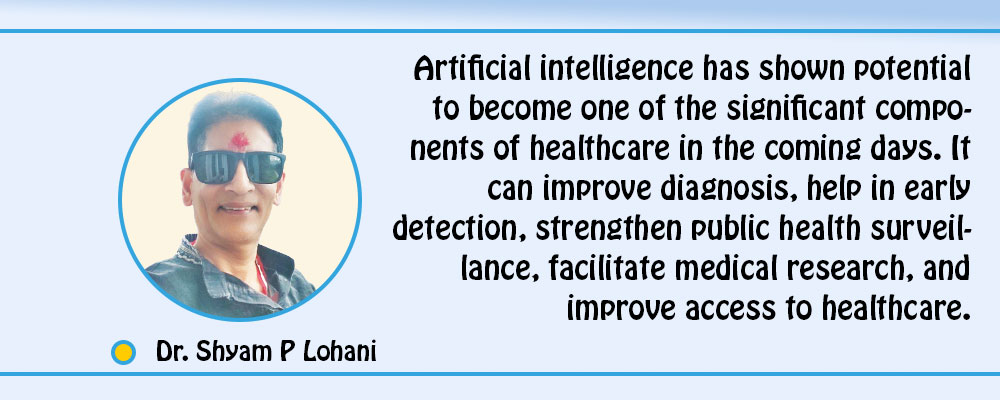
Artificial intelligence has shown potential to become one of the significant components of healthcare in the coming days. It can improve diagnosis, help in early detection, strengthen public health surveillance, facilitate medical research, and improve access to healthcare. In conclusion, the benefits of AI can be utilised to overcome health system challenges of developing economies, such as shortages of qualified healthcare professionals, geographical barriers, inadequate infrastructure, and unequal access to specialist services through responsible implementation and strong governance.
(Dr. Lohani is the clinical director at the Nepal Poison Information Centre. [email protected])