Original Coverage & Source Attribution: www.motorbiscuit.com
YouTuber Maisteer is machining a square-piston two-stroke engine, designed by a McLaren mechanic in the 1970s, on a desktop CNC mill at home.
His video, “I’m Building the Engine Nobody Has Built Since 1977,” went up on Nov. 12 and had passed 499,000 views four days later. As far as he can tell, he says, only two prototypes of the design have ever been made, the last of them in 1977.
It doesn’t run yet. This is part one, and it ends with the engine test-assembled and a crankshaft that still needs work.
The Piston and Connecting Rod Are One Part
The inventor is Norman Hossack, a Scot who grew up in Rhodesia and joined Bruce McLaren Motor Racing in 1972. According to a 2022 profile in The Vintagent, he crewed on McLaren’s Indianapolis team for three years, and McLaren won the Indy 500 in 1974. He’s better known for the Hossack front suspension, which BMW adapted as Duolever.
“I stumbled over his biography earlier this year and since then I wanted to build one,” Maisteer says.
In Hossack’s engine, the cylinder is rectangular, and the piston and connecting rod are a single piece with no wrist pin. Its crown rocks from side to side as the crank turns.
In a normal piston-ported two-stroke, the exhaust opens first and closes last, and Hossack’s own write-up of the design says up to 30 percent of the fresh charge can escape through it. His rocking piston gets around that with ports on different sides of it, so the exhaust opens and closes earlier than the transfer ports. Maisteer says it does that “without adding valves or camshafts.”
Hossack’s own prototype started, but it would only run for about five seconds. He shelved it and went back to it in 2011, when a new carburetor fixed the problem. “During the time I wanted it to work, it didn’t,” he told The Vintagent. “When I got it to work, no one was interested in 2-strokes anymore.”
The Crankshaft Barely Turns by Hand
Maisteer had never CNC machined anything; his experience was in 3D printing. “I’m not even sure if a desktop CNC machine is capable of making it. I just hope I won’t break it,” he says. The machine is a Makera Carvera Air, and Makera sponsored the video.
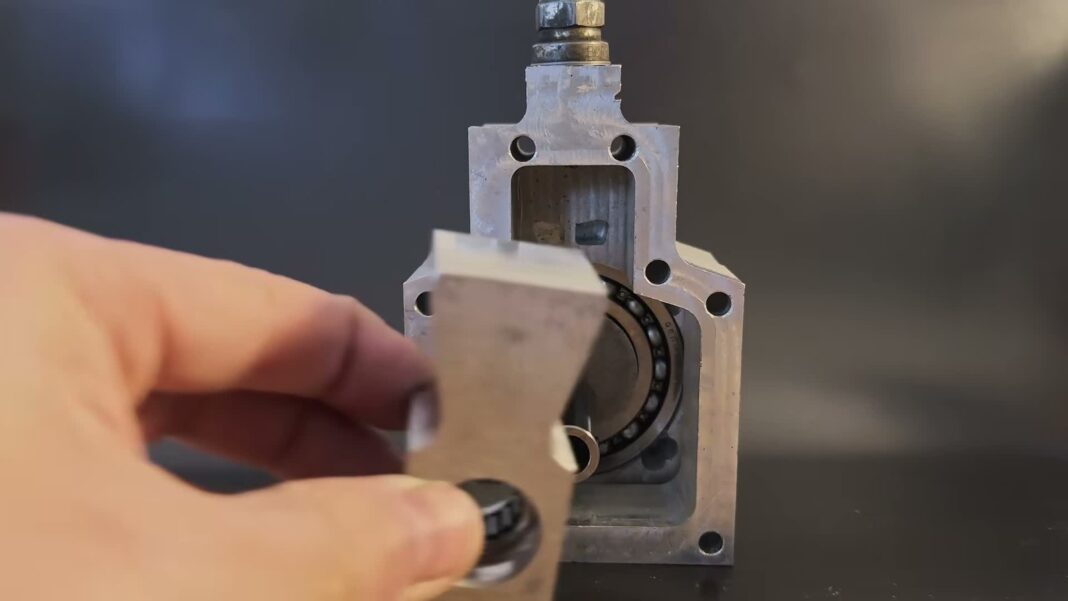
He first planned to reuse the bottom end of a broken two-stroke. Even with the longest end mills he could find, at 30 mm (about 1.2 inches), he couldn’t make a design fit it, so he redesigned the whole engine from scratch, crankshaft included.
He cast his own aluminum blocks, and the first came out with “more holes than a Swiss cheese.” The square piston came out right on his first attempt. The cylinder head didn’t, after he set the workpiece origin wrong. Before cutting the side housings, he ran his programs on wood, so he could test-assemble the engine before risking metal.
The bearings went in after he heated the housings on a cooking plate. The crankshaft is cast iron, cut on the Carvera’s rotary fourth axis, a material he says he now understands isn’t recommended for it. He ruined one half by getting the crankpin hole wrong.
“After test assembling the engine, I could barely turn it by hand. That’s not going to work,” he says.
The crank, the intake, the ignition and the seals are still to be sorted. “I really wish I had solved all of this in time for this video release, but this is new territory for me too,” he says. A running prototype is for part two.