



Original Coverage & Source Attribution: www.psychologytoday.com
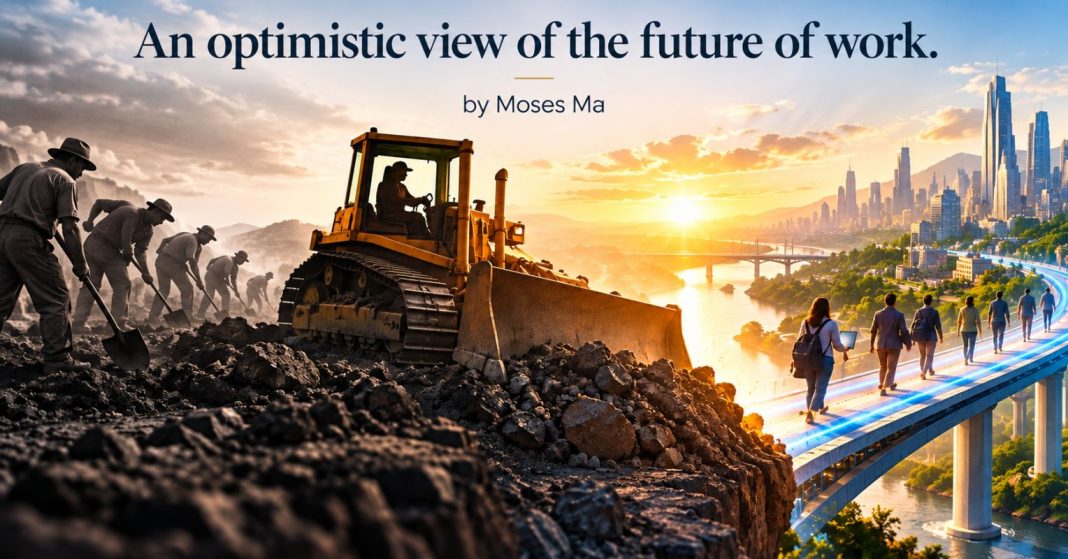
My favorite analogy for the future of work: Years ago, a hundred men with shovels would dig a trench, slowly, methodically, their labor measured in sweat and hours. Then came the bulldozer. Inevitably, a group of ditch diggers must have sat together, shaking their heads, lamenting that this infernal machine would take all their jobs. And in a narrow sense, they were right. The bulldozer did replace them. But that framing, while emotionally poignant, was economically incomplete. The bulldozer redefined the unit of labor itself: A single operator could now do the work of a hundred humans.
The key learning is that the outcome was not a world with 99 unemployed workers lingering at the margins of society. Instead, something more interesting happened. Entirely new roles emerged around the machine—operators, mechanics, planners, supervisors, automotive engineers and designers, bulldozer salesmen—and more importantly, the cost of excavation collapsed. And when something becomes cheaper, humans in a society don’t simply do less of it with fewer people; we start doing dramatically more of it. Roads stretched farther, cities expanded faster, infrastructure projects that once seemed uneconomical suddenly became viable. The bulldozer didn’t eliminate work; it expanded the frontier of what was worth building. Productivity, in this sense, doesn’t shrink the economy—it enlarges it.
Now we are living through a similar moment, except the bulldozer has moved from the physical world into the cognitive one. AI is not a better shovel; it is a bulldozer for the mind. It compresses activities that once took days into minutes—coding, design, analysis, synthesis, writing, planning—and allows a single individual to produce at a scale previously reserved for teams. And so, predictably, the same fear returns.
A recent paper, The AI Layoff Trap by Brett Hemenway Falk and Gerry Tsoukalas, articulates the systemic risk with unusual clarity. As they write, “If AI displaces human workers faster than the economy can reabsorb them, it risks eroding the very consumer demand firms depend on.” This is the core paradox. Companies automate to reduce costs and increase efficiency, but in doing so, they may undercut the income base of the very consumers who sustain demand. The problem compounds because no individual firm can afford to opt out. As the authors note, “demand externalities trap rational firms,” creating a dynamic where each company, acting logically in isolation, contributes to a collectively suboptimal outcome. We are not facing a failure of intelligence or intent, but a coordination failure embedded in the system’s structure itself.
The risk, then, is not that AI will replace work—that is inevitable—but that it will do so faster than society can metabolize the change. This creates what might be called a bridge problem. We are crossing from one economic paradigm to another, from a system where labor income drives consumption and growth, to one where AI-driven productivity becomes the dominant force. But the bridge between these worlds is narrow and unstable. If too many people try to cross at once—if displacement outpaces reintegration—the result is not a smooth transition but an avalanche. The issue is not the destination, but that crossing into the future. The key is to build a stronger bridge, an economic metric or a labor transition cushion.
The solution, then, is not to slow down the adoption of the bulldozer. History suggests that attempts to halt technological progress are both futile and counterproductive. Instead, the focus can shift to building the infrastructure, and people can learn how to operate that new technology and be productive within the new system. In practical terms, this means universal, continuous, and affordable AI reskilling—not as a one-time intervention, but as a persistent layer of the economy, as fundamental as education or transportation. The constraint is no longer raw intelligence; it is fluency in collaborating with increasingly powerful systems.
If we get this right, the story unfolds much as it did before. The ditch diggers do not disappear; they evolve. They become operators, orchestrators, designers of systems that move far more earth—literal or metaphorical—than ever before. One may have a dream of becoming an architect; dedication and sheer will make it happen.
And the economy, rather than contracting under the weight of automation, expands into new domains of possibility. The bulldozer does not end work. It changes its shape and scope, eventually expanding the imagination of what is possible for someone with a dream, or all of humanity.