



Original Coverage & Source Attribution: www.yahoo.com
For generations, suburbia has been sold as a marker of success that delivers more space, more privacy, and more freedom.
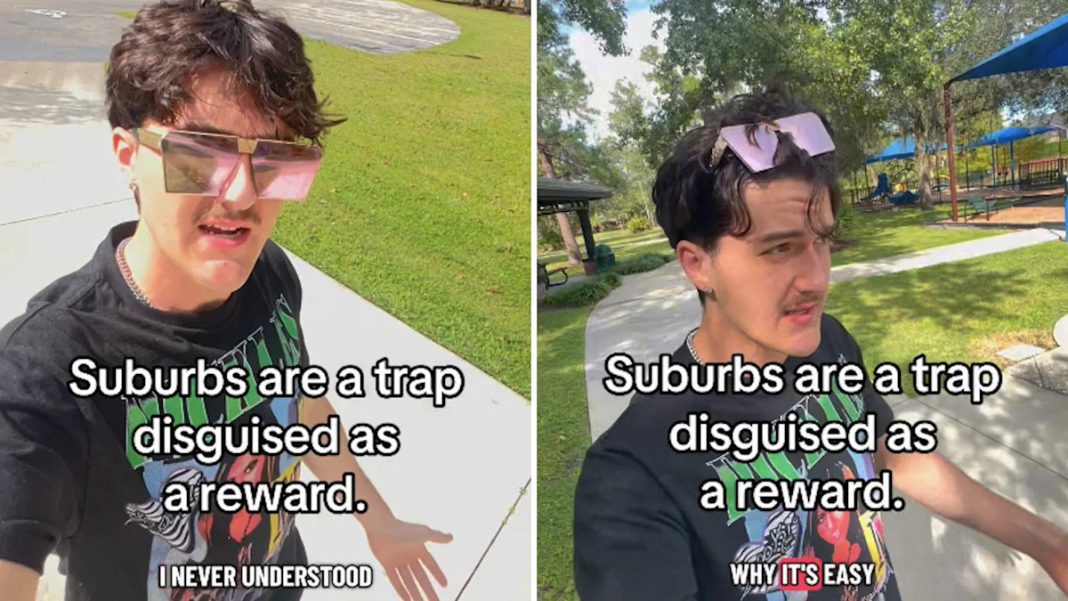
But TikTok creator Oopsiez (@oopsiez) is connecting with viewers by arguing that the promise often turns into a life organized around car trips, home maintenance, and a lingering sense of disconnection.
Here’s what to know
Using their own experience as a starting point, Oopsiez argued in a TikTok video that suburban life can leave people feeling cut off instead of liberated.
“Something about the suburbs just doesn’t feel right,” the creator wrote in the caption. “There’s a reason for that.”
“As a survivor of the suburbs, I never understood the worship of isolation as freedom,” Oopsiez said. The creator described a version of suburban life in which people they knew were “deeply unhappy” yet still held onto an image of success that consumed their time through “driving everywhere, yard work, and shopping constantly.”
As the on-screen text declared: “Suburbs are a trap disguised as a reward.”
Viewers echoed that perspective in the comments. One said the appeal of a “large spacious home” made more sense historically before “everywhere became a suburb,” while another revealed they “moved to the suburbs as an adult omg it’s so isolating.”
At the center of the video is a broader point about how communities are built: “We built a world so dependent on cars that even imagining a life without one is almost unheard of.”
More background
Rather than treating distance from other people as the goal, the video questions why that kind of separation gets packaged as something desirable.
In the replies, people shared examples from their own lives. A Southern California commenter pointed to “The Great IE Migration of the early 00s,” recalling families who moved to places like Riverside and Rialto for the promise of “moving up,” only to find the experience “insanely slow and isolating compared to the city.”
Another commenter pushed back on stereotypes about city life, especially for city kids.
“There are parks everywhere, school is walkable, public transit is abundant, and the food isn’t all chain restaurants,” they wrote.
The Southern California commenter, meanwhile, said many residents spent “most weekends driving back to have fun and see family and friends.”
A routine built around constant driving and private upkeep can drain away time, spontaneity, and connection with other people, even while being presented as the dream.
What can be done?
For some viewers, the answer was finding a different kind of housing. One commenter said the novelty of a “big ass 4 bedroom house in the suburbs” eventually faded and that they now live “in a cute apartment complex where they have free food events every month.”
“I even moved a few friends into the complex so it’s like having our own little community,” they added.
Others pointed to features that can make a place feel less isolating and less car-dependent, including parks, areas where “school is walkable,” and places where “public transit is abundant.”
Where can I learn more?
Not every community is built around cars. That only sharpens the frustration for those that are, or where public transportation simply isn’t an option.
• In Tempe, Arizona, residents say a first-of-its-kind car-free neighborhood feels less isolating and more connected.
• A tense crossing showed how one poorly-designed neighborhood street can put families at risk.
• Across daily commutes, many riders say giving people choice made leaving cars behind possible.
Get TCD’s free newsletters for easy tips, smart advice, and a chance to earn $5,000 toward home upgrades. To see more stories like this one, change your Google preferences here.