



Original Coverage & Source Attribution: www.townandcountrymag.com
The Bayerischer Hof is a hotel literally fit for a king. Commissioned by King Ludwig I, it has stood at the heart of the Bavarian capital of Munich since 1841. Some of those walls have have truly stood the test of time, and if they could talk, they could sell boundless memoirs given the VIP guests who have come and gone in the last 185 years.
The hotel passed into the hands of the Volkhardt family in 1897, who have owned it for four generations of the family since. They guided the hotel through two World Wars, refusing to hand it over to the Nazi government when it came calling in 1933, and then rebuilding it almost from scratch after bombs destroyed much of the property on the night of April 24, 1944. Only the Hall of Mirrors, where the hotel’s swanky Falk Bar is located today, miraculously survived the shelling. By October 1945, the family had reopened Munich’s first postwar restaurant.
An archival image of the hotel, prior to World War II.
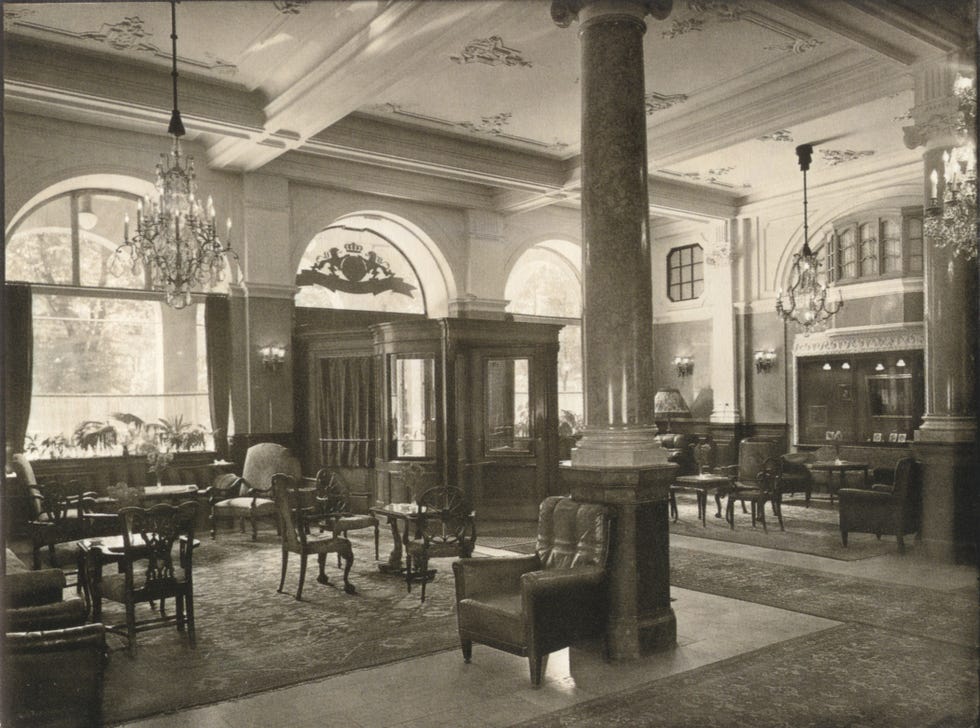
The hotel lobby, as seen before the war.
Over the following decades, the Bayerischer Hof rebuilt its reputation as one of Europe’s Grand Dame hotels, welcoming royals, heads of state, fashion visionaries, and celebrities from around the world, including Princess Grace of Monaco, Franz Kafka, Romy Schneider, Helmut Lang, Robert De Niro, and Tom Cruise. The annual Munich Security Conference—which has drawn world leaders including Angela Merkel, Hillary Clinton, Nicolas Sarkozy, David Cameron, and Vladimir Putin in recent decades—has been held at the Bayerischer Hof since the 1960s.
Additionally, the German Film Ball, held at the hotel annually since 1974, has attracted international celebrities including Catherine Deneuve and Daniel Craig. Lenny Kravitz even penned a handwritten note that was published in a book about the history of the hotel with the inscription referencing his 1989 album, “Let Love Rule.”
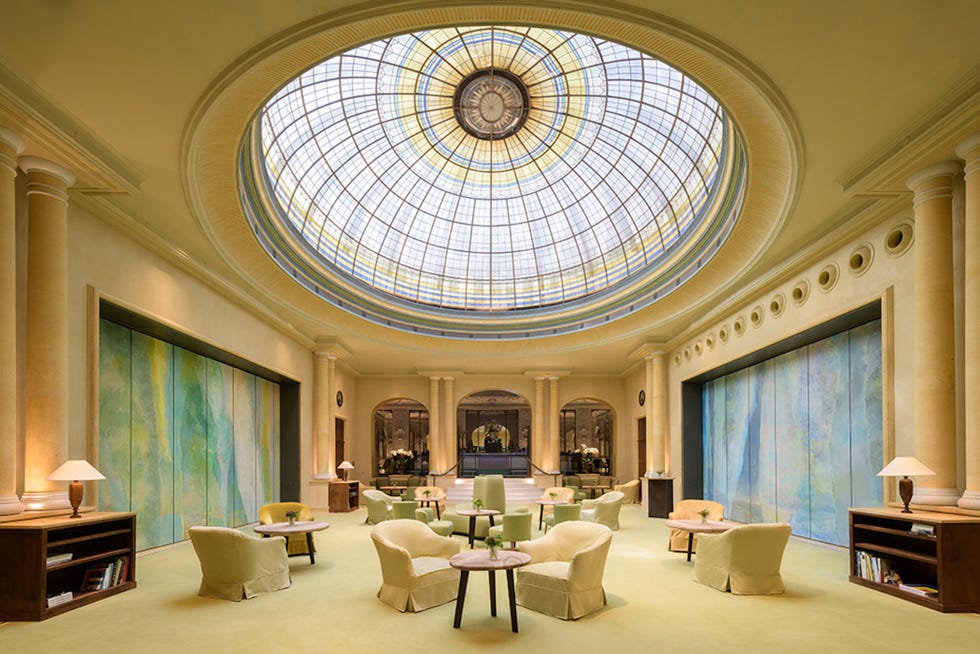
Redesigned in 2024, the atrium is crowned by a 28-foot glass dome that floods the space with natural daylight.
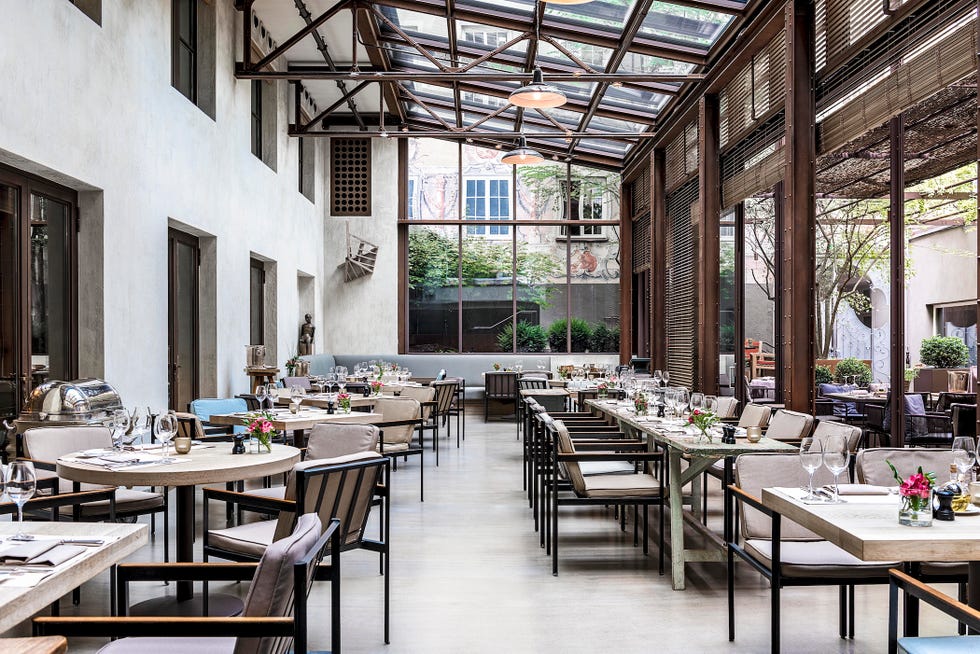
The ground-floor brasserie was designed in an industrial-style in a nod to the city’s heritage.
In 1992, Innegrit Volkhardt took over as the fourth generation of the family to run the hotel, launching a new era with a renovation job costing more than €140 million ($162 million). The most significant design partnership of that era has been with Belgian interior designer Axel Vervoordt, whose wabi-sabi aesthetic and preference for natural materials, antiques, and understated elegance has shaped the hotel across ten successive projects since 2009, most recently the redesign of the reception area in 2025. Among some of his other hospitality projects have included the Greenwich Hotel in New York City and the Purs on the Rhine in Germany.
Here, Volkhardt tells T&C all about the best room at one of Munich’s most historic hotels.
What do you consider to be the best room at the Bayerischer Hof and why?
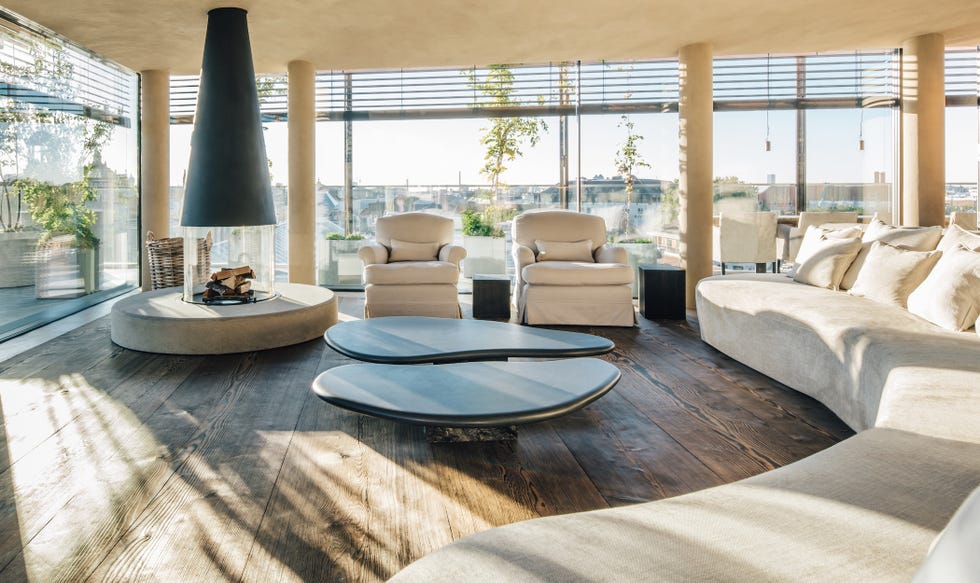
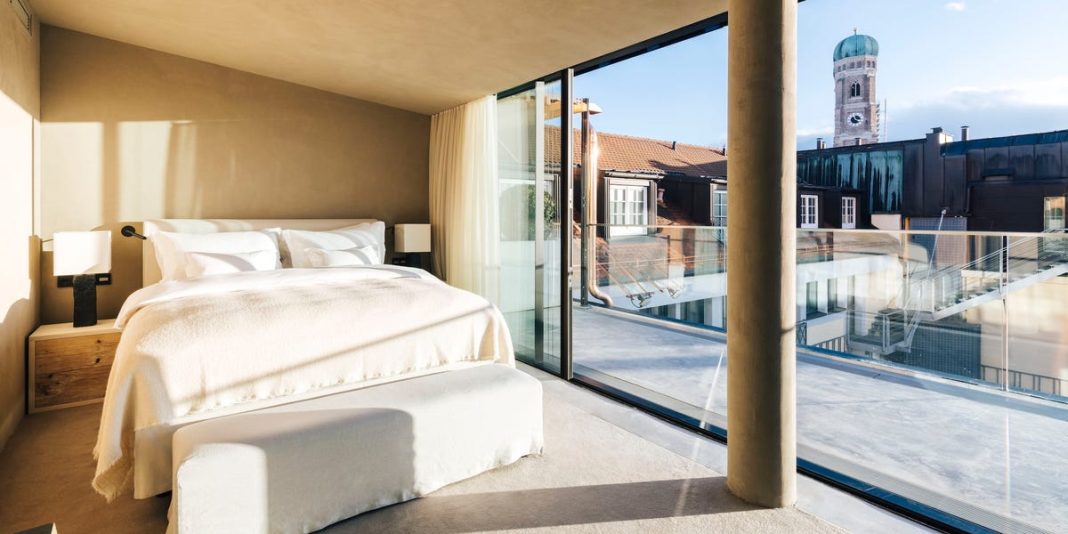
Styled in an understated, Wabi-inspired design featuring light and earth tones, the living area in the penthouse suite can comfortably accommodate up to 16 people.
I feel at home in every corner of the Bayerischer Hof; after all these years, the entire hotel feels incredibly familiar to me. If I had to choose one room, it would be the Penthouse Garden Suite. It has a very special atmosphere. Despite being right in the heart of Munich, it’s so peaceful up there that you can hear the birds singing. It’s a rare combination of absolute tranquillity, privacy, and breathtaking views over the city.
How much does it cost per night?
The official rate for the Penthouse Garden Suite is €15,000 [approximately $16,890] per night.
How would you describe the guests and the vibe at the hotel?
Our philosophy has always been “Live and let live.” It reflects our belief that openness, respect, and tolerance are essential to true hospitality. Over the decades, the Bayerischer Hof has become a place where people from all walks of life naturally come together. Heads of state, artists, entrepreneurs, families, Munich locals, long-standing regulars and first-time visitors all share the same spaces. What matters is not who you are, but that you feel genuinely welcome. I believe this unique mix of cosmopolitan elegance, Bavarian warmth, and mutual respect is what gives the hotel its very special atmosphere. It is luxurious without ever feeling intimidating.
Is there anything about the hotel that you think first-time visitors will find surprising?
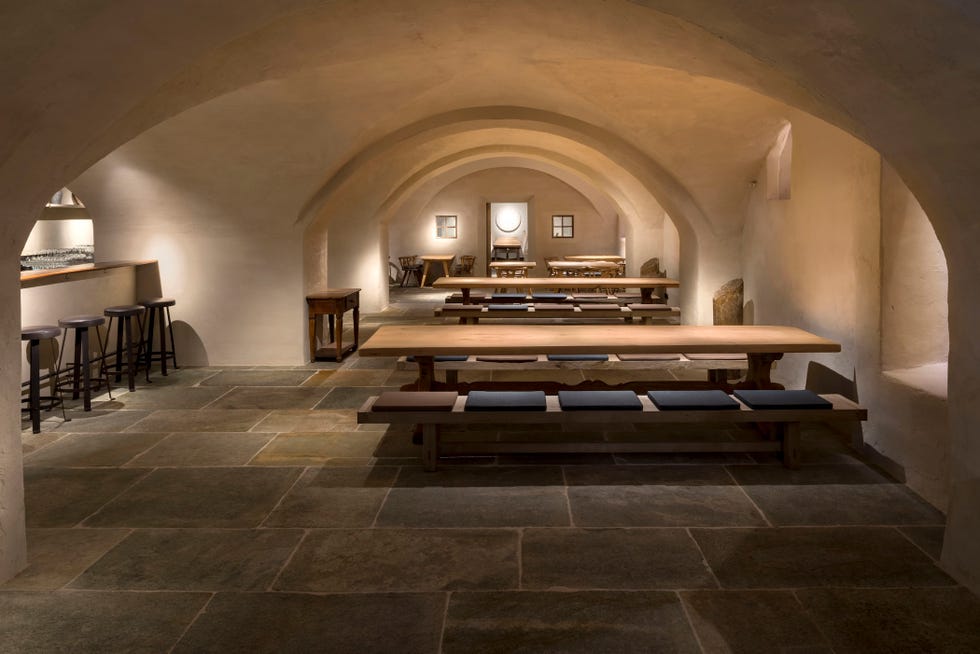
With restored medieval vaulted ceilings and ancient masonry, the Palais Keller offers a private dining and bar space.
Many first-time visitors are surprised by the sheer size and diversity of the hotel. The Bayerischer Hof offers 337 rooms, including 74 suites, five restaurants, six bars, more than 40 event and meeting spaces, a cinema, the Komödie theater (the legendary night club with live jazz), and a spa with a rooftop pool overlooking Munich.
What surprises many guests even more is how all of this still feels personal rather than overwhelming. It’s a place where history and contemporary design exist side by side, creating something that is constantly evolving while remaining true to its heritage.
What’s one design detail in the hotel that guests might overlook?
One of my favorite details is the original mirror in the Falk’s Bar. It survived the Second World War and still bears the marks of that history. If you look closely, you can see traces left by fire and shrapnel. Occasionally, guests ask why the mirror hasn’t been cleaned properly, not realizing that what they see is history itself. I love that we have preserved it exactly as it is. It quietly tells a story that no new design element ever could.
What do you think gives the Bayerischer Hof such a unique identity?
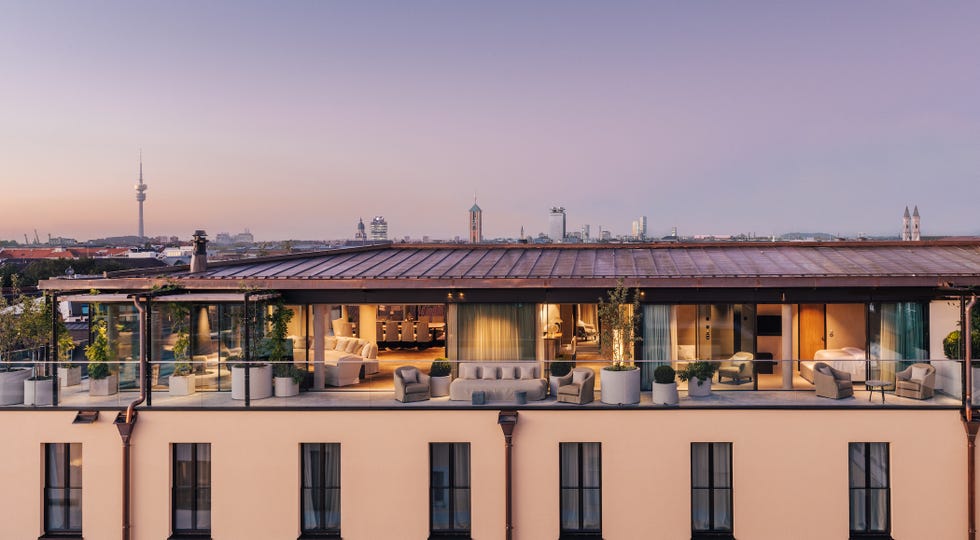
An aerial view of the Munich skyline and the balcony at the hotel’s penthouse suite.
I believe it is the combination of tradition and constant renewal. We carefully preserve the history and character of the house while continuously introducing contemporary ideas and experiences. My father always used to say that no guest should ever have to leave the hotel because everything they might need should be available under one roof. His vision was for the Bayerischer Hof to be “a small city within the city, a world of its own,” a place that reflects Munich while also offering a peaceful retreat.
What’s a local attraction that you always recommend to guests?
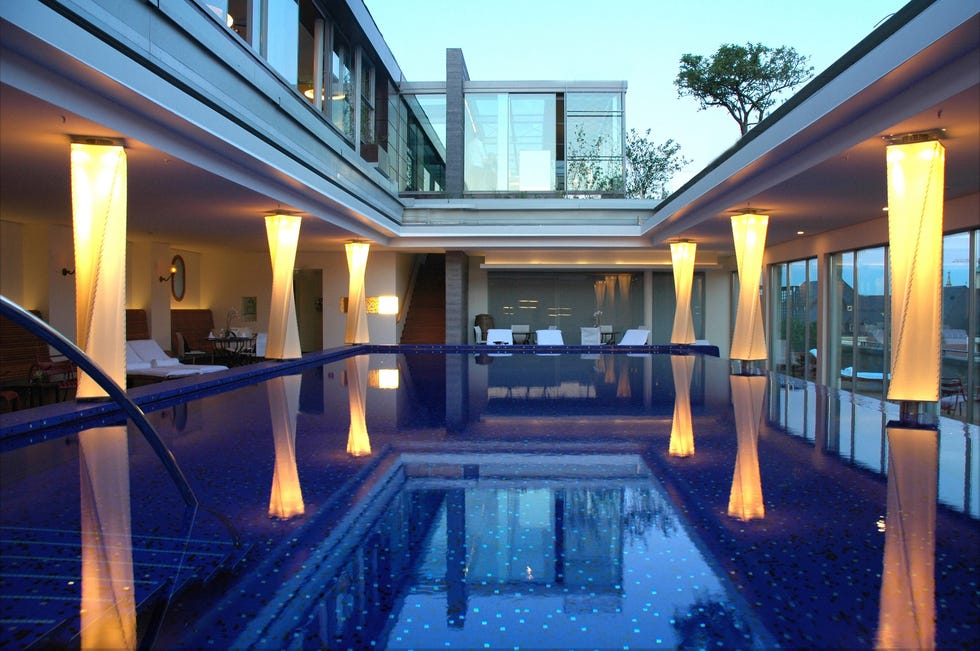
The pool at the hotel spa is open to all guests; seats are first come, first serve when the sun is out.
That is a difficult question because Munich has so many wonderful places. Within the hotel, I always recommend our Blue Spa. On a summer evening, sitting on the rooftop terrace with a view of the illuminated Frauenkirche [the Catholic cathedral] and the rooftops of Munich is simply magical. It reminds me every time how beautiful this city is.
Outside the hotel, I love the Hofgarten. Its beautiful pavilion and relaxed atmosphere make it a wonderful place to pause, and on many days you can hear live Latin American music with people spontaneously dancing. Afterwards, I enjoy stopping by Schumann’s for a cocktail. My personal recommendation there is quite simple: the potatoes with quark—they have been a favorite of mine for years. I also always recommend a stroll through the Viktualienmarkt. It captures the spirit of Munich like few other places—colorful, lively, and full of local character. Whether it’s enjoying a coffee, discovering regional delicacies or simply watching everyday life unfold, it offers visitors a genuine taste of the city.
And, of course, the English Garden is not to be missed. Whether for a walk, a traditional beer garden or to watch the surfers on the Eisbach wave, it perfectly reflects Munich’s unique ability to combine urban life with nature.

Rachel King (she/her) is a news writer at Town & Country. Before joining T&C, she spent nearly a decade as an editor at Fortune. Her work covering travel and lifestyle has appeared in Forbes, Observer, Robb Report, Cruise Critic, and Cool Hunting, among others. Originally from San Francisco, she lives in New York with her wife, their daughter, and a precocious labradoodle. Follow her on Instagram at .