Original Coverage & Source Attribution: foreignpolicy.com
Welcome back to World Brief, where we’re looking at U.S. strikes on Iran, future U.S.-mediated peace talks between Russia and Ukraine, and a challenge to Australia’s landmark social media legislation.
Midterm Surprises
As Americans head to the polls in today’s midterm elections, two last-minute foreign-policy developments could impact voters’ decisions.
On Monday—election eve—the United States attacked Iran’s Qeshm Island, targeting an anti-aircraft facility in what U.S. officials described as a defensive measure amid reports that Iran was planning missile strikes. “It’s just a minor attack. It wasn’t war,” U.S. President Donald Trump told Fox News Tuesday morning.
Prior to the strikes, Iran’s foreign ministry said Monday that it would reopen the Strait of Hormuz if the United States agreed to a set of demands, and Trump posted on Truth Social that a settlement “could happen!” Monday’s attack makes such a deal seem unlikely in the near term, however. On Tuesday, senior Iranian security official Mohsen Rezaei wrote on X that “America’s response to Iran’s rights and demands was not convincing.” Rezaei, who is the secretary of Iran’s Supreme National Security Council, is the official to whom U.S. Vice President J.D. Vance recently sent a letter in an attempt to find common ground on negotiations.
Many analysts fear that Trump may be planning to renew large-scale offensive strikes on Iran following the midterm elections. According to reports in recent weeks, Washington has relocated troops in preparation for an escalation, deployed a Patriot missile defense system to Israel, and urged several Gulf Arab countries to prepare for a military campaign.
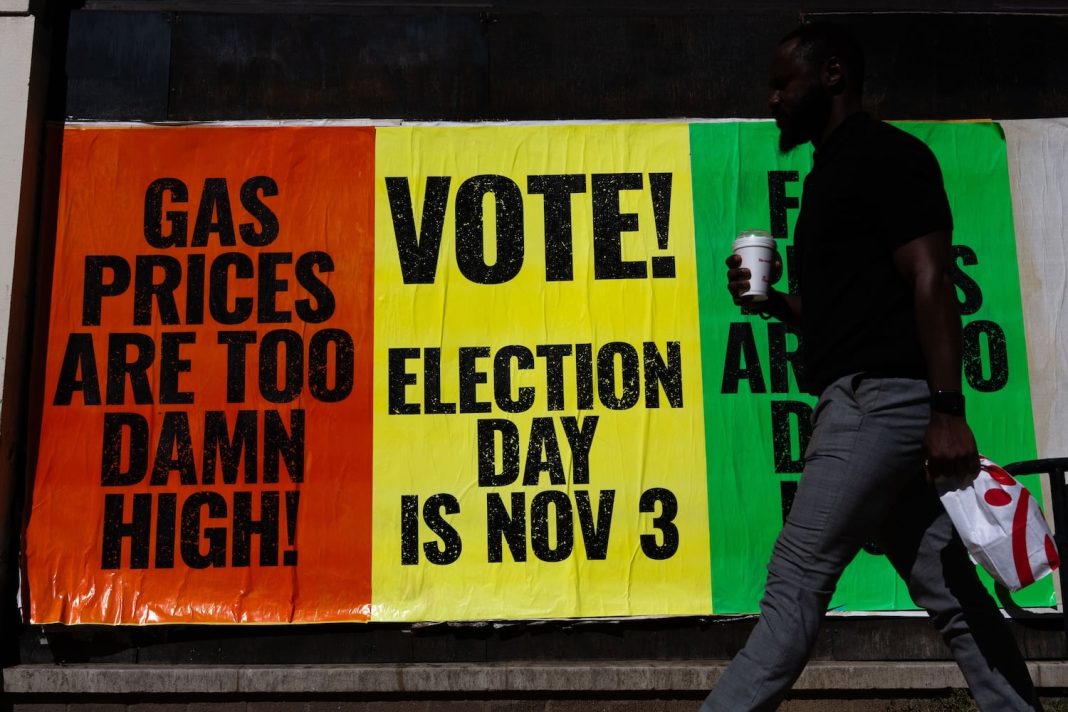
The war and its economic repercussions have been a focal point in the midterms, with a September-October Pew survey reporting that around two-thirds of Americans disapprove of Trump’s handling of the conflict. Mark Zandi, the chief economist of Moody’s Analytics, estimated that the Iran war has cost the average American household an extra $2,000. The closure of the Strait of Hormuz has resulted in soaring gas and diesel prices—up 43 percent and 68 percent, respectively, since the war started—and price increases in global commodities from condoms to Diet Coke.
American voters cite the economy as the top issue in this year’s elections, and if polls forecasting a Democratic takeover of both the House of Representatives and the Senate prove correct, Trump’s war in Iran could be partly to blame. However, if Democrats do win in the Senate, they will have the power to decide whether to stop funding the war, Sen. Chris Murphy told Foreign Policy in October.
U.S. support for Israel has also been a key issue in the midterms, with many progressive Democrats making ending that support a central campaign talking point. And on Tuesday, in what some are interpreting as a last-ditch effort to prevent a blue wave, Trump abruptly announced that the United States would cut off $4 billion in aid to Israel by the end of the year.
Washington currently provides Israel with $3.8 billion annually in military assistance, part of a 10-year deal lasting through 2028 that was struck under former U.S. President Barack Obama. Ending that agreement early would likely require congressional support.
“The left uses the $4 billion payment—that everybody knows about, it’s no secret—as a signal of unfairness, and we can’t allow that to happen,” Trump said.
He said that Israeli Prime Minister Benjamin Netanyahu had agreed to the deal “months ago.” In May, Netanyahu voiced a desire for the U.S.-Israel relationship to move “from aid to partnership.”
However, Israel’s defense ministry seemed blindsided by the news. “We were surprised by the president’s statements, especially today,” a spokesperson told Israeli media. “We are in ongoing talks with the Americans. We will study the implications.”
Today’s Most Read
What We’re Following
Another push for peace. Russia confirmed Tuesday that it will participate in a new round of U.S.-mediated negotiations with Ukraine to end the war. According to special envoy Steve Witkoff, the working-level talks will take place in Abu Dhabi from Nov. 10 to 11 and will “focus on post-war security arrangements, de-escalation, humanitarian efforts, and next steps toward peace.” U.S. first lady Melania Trump will convene Russian and Ukrainian representatives at the White House on Thursday in a separate attempt to foster goodwill between the parties.
The diplomatic efforts come after Russia bombed a humanitarian aid hub in the Ukrainian village of Komyshuvakha on Monday, killing 31 and leaving dozens missing. Ukrainian President Volodymyr Zelensky has indicated that Ukraine will participate in the Abu Dhabi talks, but he said the latest strikes cast doubt on Russia’s willingness to pursue peace.
“There was a moment when the next steps could have shown that progress toward peace was possible,” Zelensky said in a post on X on Monday. “With these killings, Russia is sending an entirely opposite signal: Russia is counting on more killings.”
Access denied. South Africa and Rwanda will be suspended from the African Growth and Opportunity Act (AGOA), effective Jan. 1, 2027, for not meeting eligibility criteria, the Office of the U.S. Trade Representative announced on Monday. The agreement, enacted in 2000, allows sub-Saharan countries to export goods to U.S. markets without paying duties.
Eligibility to participate in AGOA is reviewed annually. U.S. Trade Representative Jamieson Greer said in a statement Monday that the two countries are being removed for engaging in practices that “pose a threat to U.S. national security and foreign policy interests in the region.” The statement also cited concerns about rule of law and human rights in Rwanda, corruption in South Africa, and barriers to U.S. trade and investment in both countries.
The news is stoking anxiety in South Africa, where unions are urging lawmakers to push back against the move, citing risks of thousands of job losses across automobile, manufacturing, and agricultural sectors. The South African government, which said it was prepared for the possibility of suspension, said it recognized these concerns and will continue to pursue diversification of its exports. The Rwandan government has yet to officially respond to the news from Washington.
Ban blowback. On Tuesday, Australia’s highest court began hearing challenges to legislation that bans social media use for youth under age 16. A Sydney-based digital rights advocacy group and the social media platform Reddit are pushing back against the landmark law that they say restricts freedom of expression for Australia’s young people.
The groups argue that the ban, enacted in December 2025, infringes on the rights of youth to participate in political discussion, pointing out that social media is where youth get their news and can engage in debate as they approach voting age. Reddit is one of 10 social media sites—along with TikTok, Instagram, and X, among others—that would be required to restrict the age of its users under the law.
Australia is among more than 60 countries worldwide pushing for legislation restricting social media usage for children—but Australia’s model may be the “most severe,” FP’s Alexandra Sharp reports. The laws aim to protect youth from harmful content and limit the impact of social media on developing brains, such as algorithmic content models designed to keep people on their phones.
Odds and Ends
The Collins English Dictionary has selected its word of the year: “mogging.” Defined as “the act of outshining or outperforming someone or something,” the term is most popular in Generation Z and Generation Alpha circles and is often used in the context of physical appearance. According to copywriter Rachel Quin, the word likely originated from the term “AMOG,” or “alpha male of the group,” which became popular in bodybuilding circles in 2016.