




Original Coverage & Source Attribution: nowthenmagazine.com
Patients and health workers gathered outside the Hallamshire last Thursday.
Nabeela Mowlana.
Last Thursday afternoon, around 60 people gathered outside the Royal Hallamshire Hospital for a demonstration organised by Medact Sheffield. The protest was one of 30 taking place across the country, calling on the UK government to use the break clause in its contract with US spytech firm Palantir and scrap the company’s involvement in the NHS. Demonstrations were also held outside Palantir’s headquarters in London and various NHS offices.
In 2023, Palantir was awarded a £330m contract to develop the NHS Federated Data Platform (FDP), infrastructure intended to bring together and analyse data from different parts of the health service. The stated aim is to make it easier to understand how the NHS is operating and, ultimately, improve services for patients.
But Palantir is not simply a company that provides data analysis. Founded with investment from the CIA, the company specialises in AI-powered surveillance and military software. Its growing presence in UK public services has therefore raised serious questions about who should control some of the most sensitive information held by the state, and what kind of company we want to trust with it.
Trust issue
For Medact Sheffield, which represents health workers across the city, this is fundamentally an issue of health and social justice.
Dr Rory Gibson, a local resident doctor and coordinator with Medact Sheffield, explained that the organisation campaigns on a range of issues where health intersects with social justice, from the impact of black mould in housing to access to healthcare for trans and non-binary people. The campaign against Palantir is part of that wider work.
Medact Sheffield has taken on the national campaign at a local level, seeking to disrupt the rollout of Palantir’s technology and put pressure on local health leaders and politicians.
There is a clear choice available to South Yorkshire. Greater Manchester’s Integrated Care Board decided not to use Palantir’s software, and South Yorkshire could now make the same decision (when approached by Now Then in January, our NHS trusts refused to rule out adopting Palantir’s software).
It felt incredible to be part of that movement, from South America to South Korea
“No Sheffield Trusts are [currently] using the FDP,” Dr Gibson says, with Sheffield Children’s Hospital currently in a ‘pause’ phase of implementation. While this may sound reassuring, campaigners argue that it is not enough. A pause is not a commitment to never adopt the technology, although unless the government intervenes NHS England may make its use mandatory in future.
The South Yorkshire Integrated Care Board (ICB), which commissions primary care services, have provided reassurance to Medact Sheffield that they are not feeding patient data into the platform for now, but as Dr Gibson points out, this is not a sustainable long-term solution. What is needed is a clear political commitment that Palantir’s technology is not in the interests of people in Sheffield.
Sheffield has already said no
There has already been an important intervention from Sheffield City Council.
In June earlier this year, councillors passed a motion opposing the use of Palantir and calling for local NHS organisations and the South Yorkshire Integrated Care Board, which commissions primary care services, to freeze their integration with the platform. Campaigners now want local health leaders to take on the baton and make clear their opposition to Palantir.
Trade unionist Neil Parry at Thursday’s demonstration. Nabeela Mowlana.
Thursday’s demonstration was part of an international movement, with activists in countries including Denmark and the US sending messages of solidarity to the Sheffield protest. For Dr Gibson, the international dimension is important.
“It felt incredible to be part of that movement, from South America to South Korea,” he says, calling it a “powerful demonstration of people coming together to resist this infiltration of our services”. The campaign reflects broader concerns about Palantir’s activities around the world.
International solidarity
The campaign is partly a response to a call from the Palestinian General Federation of Trade Unions for a boycott of companies that have been active in, or complicit with, the genocide in Gaza and the ongoing persecution of Palestinians in the West Bank.
For trade unionists like Neil Parry, who attended the demonstration representing the Sheffield Trades Council, international solidarity means taking those calls seriously. For him, the conditions of people at home and abroad cannot be separated. He points to allegations that Palantir have provided technology and data services that ”profit from grave human rights abuses” (according to Amnesty International), aided Israel’s genocide in Gaza, helped ICE detain and remove people from the US, and facilitated the real-time surveillance of citizens by UK police forces.
Sam Gregory.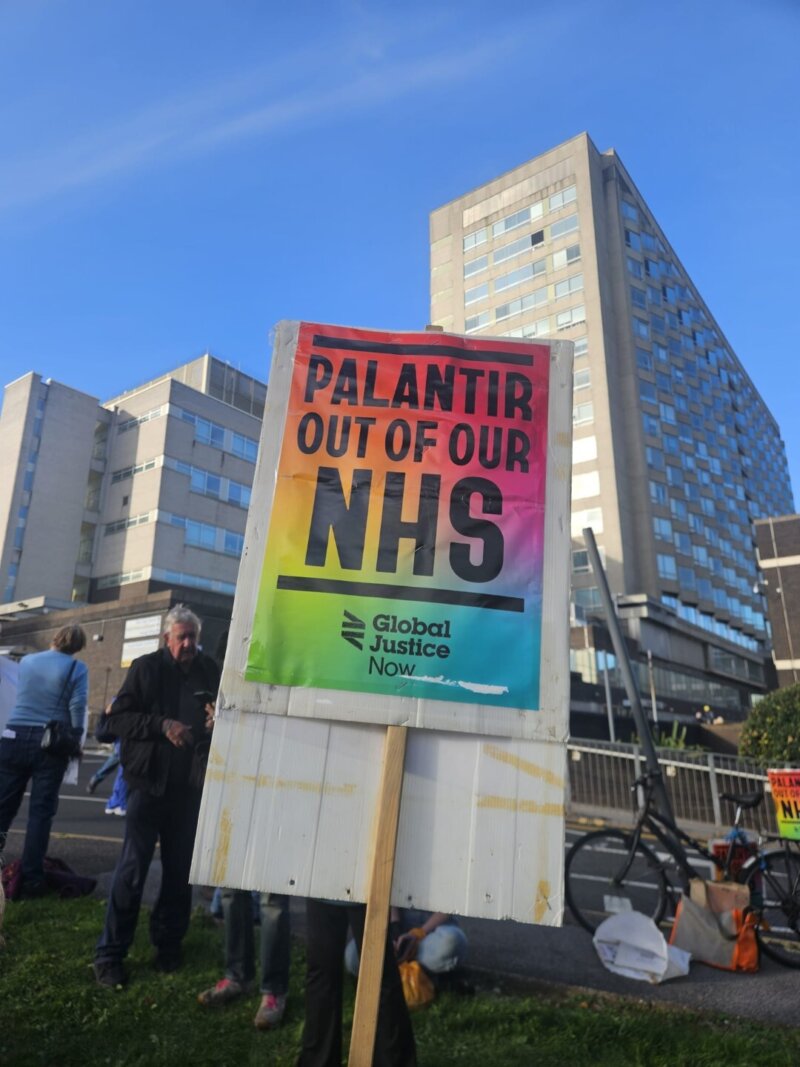
It is clear from conversations with other attendees that these are not distant or unrelated concerns. There is a recognition that the same companies and systems can operate across borders, whether in healthcare, policing, immigration enforcement or military operations. They are part of a wider question about the uses to which powerful surveillance and data technologies are put.
The break clause is the opportunity
The stakes are now becoming higher.
The government has an opportunity to exercise the contract’s break clause in February, allowing it to transition away from Palantir and towards alternative data infrastructure. The parliamentary Science, Innovation and Technology Committee has recommended that the government exercise the break clause and either develop an in-house replacement or seek an alternative from UK-owned and UK-based providers.
Palantir claims that no other provider can deliver what the NHS needs at the scale required. Medact disputes this, saying it has identified alternative approaches.
Medact’s research identifies existing NHS-led systems and a range of technical approaches that could be developed instead. It argues that many of the capabilities provided through the FDP already exist elsewhere in the NHS, and that the government should invest in developing those capabilities rather than locking the health service into one supplier.
Sam Gregory.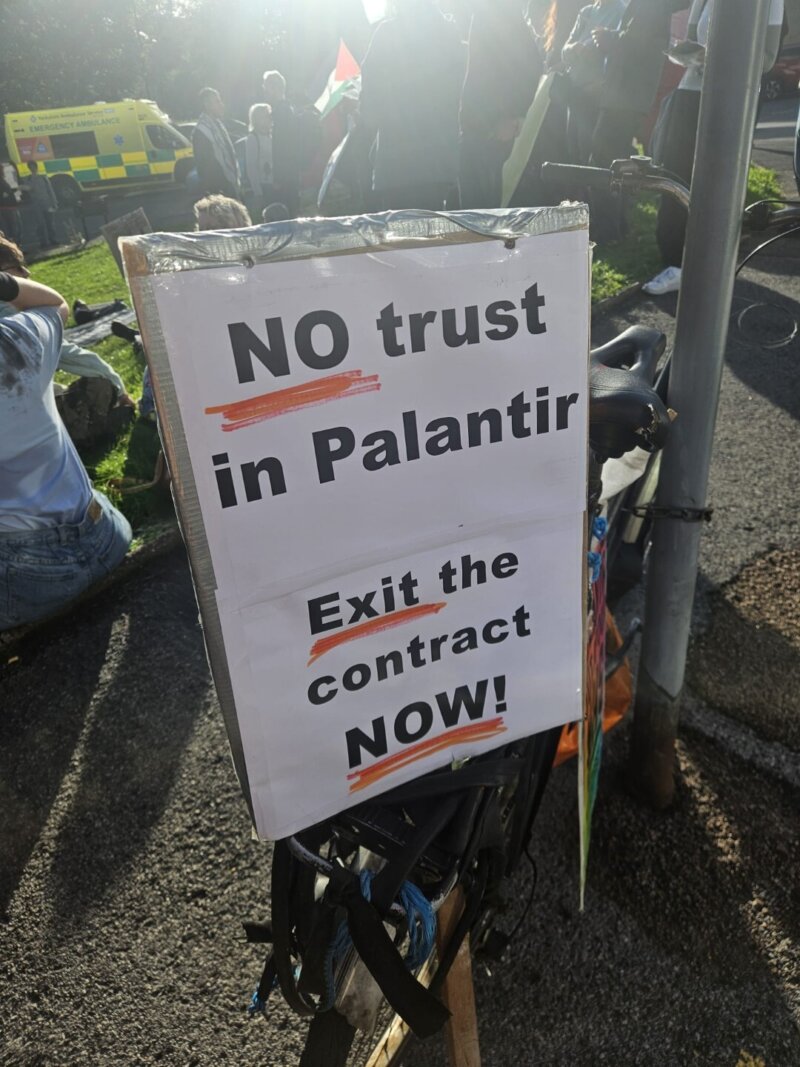
The argument that there is no alternative is becoming increasingly difficult to sustain. The question is therefore not whether an alternative is possible – it is whether the government has the political will to build one.
The founding principles of the NHS
There is also a wider principle at stake. The NHS was created on the understanding that healthcare is something we provide collectively, not a market opportunity to be carved up between competing private interests. Our data should be treated in the same way.
Patient information is not a commodity. The infrastructure used to manage it should not become a private fiefdom, and the expertise required to make sense of it should not be allowed to disappear from the public sector because outsourcing appears easier in the short term.
Labour came to the 2024 general election promising the “biggest wave of insourcing of public services in a generation” and an end to the previous Conservative government’s ideological drive towards privatisation. Prime Minister Burnham has announced a ‘Public Interest Test’ designed to make public bodies consider whether services can be delivered better in-house before outsourcing them.
Sam Gregory.
The new guidance explicitly says that insourcing can improve value, control and resilience, and requires decision-makers to consider longer-term factors rather than simply looking at the immediate price of a contract.
If the state can rebuild the expertise and capacity necessary to deliver essential services, rather than automatically handing them to private companies, why shouldn’t this apply to the NHS?
Sheffield has already made its position clear. Now the Labour government needs to decide whether its promises about insourcing and public control are serious enough to apply to the NHS.