
Original Coverage & Source Attribution: economy.ac
Kalibr-armed submarines can strike Europe without crossing the gap
NATO’s sensors, aircraft and frigates still lag the threat
Denmark’s patrol gap leaves the Denmark Strait thinly covered
In the two years leading up to December 2025, Russian vessels threatening UK waters increased by 30%. The UK Ministry of Defence announced this when London and Oslo signed the Lunna House Agreement. The same announcement named the Yantar, a Russian intelligence ship found lurking off the northern coast of the UK near Scotland and tracked by P-8s from Lossiemouth. Earlier, in October, HMS Iron Duke escorted the submarine Novorossiysk through the English Channel while the submarine was sailing on the surface. None of this would have shocked a Cold War sonar operator. For 40 years Soviet subs were in these waters and NATO had hydrophones deployed across the sea floor from Greenland to Iceland to Scotland. What has changed is what the GIUK Gap has to protect. This is why the GIUK Gap has once again become a focus of NATO’s Northern defense.
How the Kola Peninsula Connects to the GIUK Gap
The Kola Peninsula is Russia’s base for its Northern Fleet, located along the Arctic coast just east of Norway. The North Atlantic Current still keeps the water warm enough that it does not freeze during the winter. The Russian Northern Fleet is headquartered in Severomorsk, just outside Murmansk and Russia’s latest attack submarines are stationed in Zapadnaya Litsa, the furthest west submarine base on the Kola Peninsula and close to the Norwegian border. The only way out of the Kola Peninsula into open ocean is to travel West through the Barents Sea, past North Cape and Bear Island. Then travel southwest into the Norwegian Sea. The Norwegian Sea is located between Norway on its East end and Jan Mayen and Iceland to the West. South of the Norwegian Sea, the seabed begins to rise towards Greenland, Iceland, the Faroe Islands and Shetland. So, a submarine would have to pass through the Denmark Strait or between Iceland and the Faroes or the Faroes and Shetland.
These are the gaps that make up the GIUK Gap. South of them lie the trade routes that would be used to send American troops to Europe in a war, as well as cables and pipelines that, according to the UK Ministry of Defence, carry communications, power and gas to Britain and Norway. NATO considers the Arctic to be an entrance to the North Atlantic, connecting North America to Europe with trade, transport and communication. In the Cold War, this worked. The Soviet Union would keep its ballistic missile submarines safe in the Barents Sea while it tried to send attack submarines through the GIUK Gap to attack ships. NATO would use its hydrophones on the sea floor, P-3s out of Keflavik and its own submarines to intercept them.
Today that is no longer the case. The Russian Yasen-M submarine can fire the 3M-54 Kalibr, which has a range of around 1,000 miles, according to USNI News. Attack submarines armed with such missiles can threaten 75 percent of European capitals from the North Sea. If a submarine is in the Norwegian Sea, it does not need to pass through the GIUK Gap to attack the UK or any other country on the European mainland. In August 2026, an article in the German defence magazine Europäische Sicherheit & Technik went into more detail. It said that Russian submarines armed with Kalibr now treat the GIUK Gap as a barrier of their own, keeping U.S. Navy submarines and other large NATO vessels out of the Norwegian Sea. That turns water the Soviets once used as a transit route into a battlefield.
Russia’s Northern Fleet Is Struggling on the Surface While Building Submarines
The strongest case that NATO is overreacting comes from Norway. The Norwegian Intelligence Service’s threat assessment, Focus 2025, states that the war in Ukraine is draining Russia’s Navy, with the Northern Fleet having to decide whether to complete missions or maintain its ships because it does not have enough room in its dockyards to do both. This can also be seen in the Northern Fleet’s surface ships. The nuclear cruiser Admiral Nakhimov has been out of service since 1999 and in July 2026 the commander of the Russian Navy said he hoped to have its modernisation completed in the coming months. These facts would suggest that NATO is spending money on new assets it would have bought anyway and that this talk of the High North is nothing more than new budgets.
However, the Norwegian Intelligence Service stated that submarines have been able to continue their expansion and that it expects the Northern Fleet to send regular deployments into the Atlantic, with 3 or possibly 4 more Borei-As joining within the next few years. Russia has also continued to build its attack submarine force. The Arkhangelsk, the fifth submarine of the Yasen class, was commissioned on 27 December 2024 and deployed to Zapadnaya Litsa. The Perm will be the first submarine designed from the start to carry the Zircon hypersonic missile and the head of the Russian Navy told the Kremlin that he hopes to have it operational by the end of 2026. The Ulyanovsk was launched on 28 July 2026. It can hold up to 32 Zircon missiles and is due to be delivered in December 2027, with another hull laid down in June.
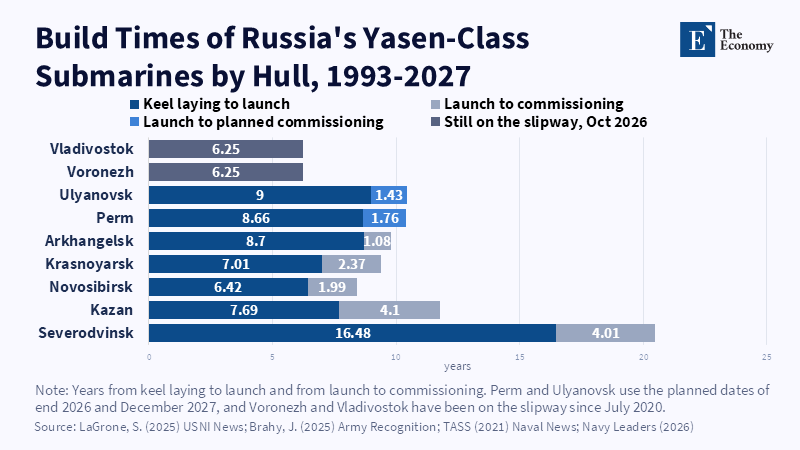
These facts answer the question of whether the Russian Northern Fleet is expanding or NATO is simply meeting it with new technology. The Russian submarine force is smaller than what NATO had to deal with in the 1980s but with each new submarine, Russia can threaten more areas than the Soviet Union could with a larger fleet. NATO is meeting the Russians in the same familiar waters, only with newer technology that can cover the threats. The fact that Russia’s surface fleet is struggling should not deter allies from protecting these waters.
Finding Russian Submarines Takes More Than Patrol Aircraft
Because aircraft can cover a wider area of the ocean, they will always be the most effective way to find submarines. The UK has 9 P-8s based out of Lossiemouth. Norway has 5 based out of Evenes in northern Norway, replacing its old Orion base on Andøya. The U.S. rotates P-8 squadrons through Keflavik. Germany received its first P-8 in November 2025 and is looking to deploy them across the UK, Norway and Iceland. In October 2025, Denmark concluded its Second Agreement on the Arctic and North Atlantic, worth 27.4 billion Danish kroner. This includes acquiring a maritime patrol aircraft capability in cooperation with a NATO ally, as well as 2 new Arctic ships and more drones and follows a first agreement in January 2025 worth 14.6 billion kroner.
Aircraft will always be a short-term solution, because a submarine can just wait for them to leave, so longer-term solutions are needed. The Royal Navy’s Atlantic Bastion concept is one, described in the Ministry of Defence’s Strategic Defence Review from June 2025. It will start with a net of uncrewed vehicles placed in certain areas, probably including the GIUK Gap. This is expected to be run by a private company with the Navy keeping oversight. The Royal Navy hopes to have these sensors in the water during 2026, with the aim of covering the area from the Mid-Atlantic Ridge to the Norwegian Sea. The Lunna House Agreement will see Britain join Norway’s programme to develop motherships for uncrewed mine hunting and undersea warfare systems, as well as working together to bring these autonomous systems to NATO.
Satellites have a smaller role than most would think. They cannot detect submarines, but they can see surface ships, including the Yantar and other ships that support Russia’s Northern Fleet. Satellites are also used to communicate in these higher latitudes, which is why NATO lists the NORTHLINK Arctic satellite project among its new capabilities and the Lunna House Agreement builds on an earlier UK and Norway satellite agreement. In the end, crewed ships are still needed to hunt these submarines. That is what the second stage of Atlantic Bastion does, connecting these sensors to Britain’s Astute-class submarines, P-8s and the new Type 26 frigates, which are designed to hunt submarines. This is what the Lunna House Agreement is trying to achieve with 8 British and at least 5 Norwegian Type 26s. With cheaper sensors, more area can be covered. The only downside is that if these sensors are run by private companies, it is unclear whether they will still be reporting in a crisis.
How NATO Allies Divide the GIUK Gap
NATO has made many changes to its command structure. Joint Force Command Norfolk was created in 2019 and is based in Virginia and one of its main jobs is to keep the sea lanes open between North America and Europe. Its area of responsibility already included Iceland, Norway and the UK and in December 2025 NATO expanded it to include Denmark, Finland and Sweden. JFC Norfolk also leads Arctic Sentry, which began in February 2026. Arctic Sentry gives NATO a better understanding of what its allies are doing in the Arctic and combines these operations with NORAD, U.S. Northern Command, and U.S. European Command. In October 2025 a new Combined Air Operations Centre was established in Bodø, allowing NATO to monitor airspace over the Nordic region, the Baltic Sea, the North Atlantic and the Barents Sea. NATO also established Task Force X-Arctic in June 2026.
Most of these tasks will be broken down among the allies that have coastlines. Norway will be watching the gap closest to the Kola Peninsula, with its P-8s out of Evenes and its intelligence ship Marjata, based out of Kirkenes, watching Russian activity. Britain will be covering the eastern side of the GIUK Gap, as well as the gap between the Faroes and Shetland, where submarines would travel if they wanted to reach the Irish Sea. Through the Lunna House Agreement, Britain and Norway are working together to create a pool of ships that can be used interchangeably, allowing them to share maintenance and technology. Iceland does not have a military of its own, but it provides Keflavik, where NATO has run its air policing mission since 2008 and it hosts Dynamic Mongoose, NATO’s largest anti-submarine exercise. The U.S. provides nuclear attack submarines at a scale no other ally can match, as well as P-8s and ships that can help resupply.
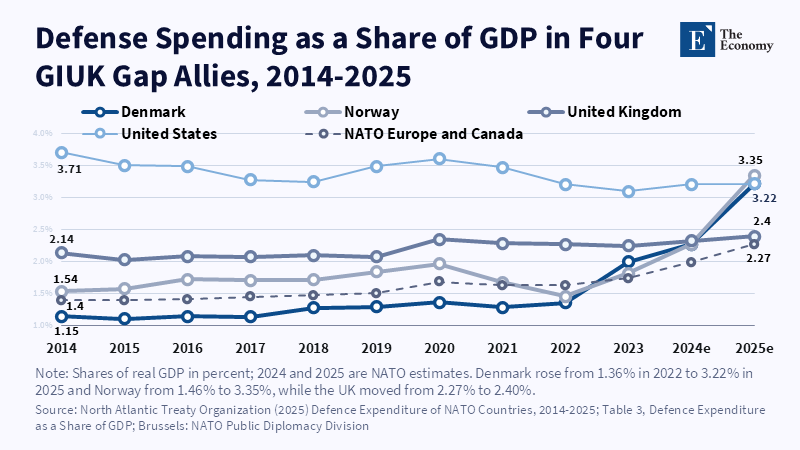
Denmark has been the weak link in this, as it is responsible for Greenland and the Faroe Islands, which means it covers the west and middle of the GIUK Gap, including the Denmark Strait. Denmark has had only 4 Challenger CL-604s to cover this, which are also used for search and rescue and VIP travel, according to Breaking Defense. Copenhagen is looking to buy P-8s at a cost of tens of billions of kroner, but until then it will have to rely on other NATO members to fill this gap. Arctic Sentry will help NATO know what each country is doing, but it still needs a country that can fill that gap.
Current Capabilities Still Fall Short in the GIUK Gap
Compared with what NATO had before, the alliance has come a long way, but not far enough. Norway only ordered its frigates in September 2025, as part of a deal the UK government values at £10 billion and the combined fleet of at least 13 Type 26s for the northern waters is still being built. Britain and Norway currently have 14 P-8s between them to cover the Norwegian Sea, the GIUK Gap and the waters around the UK, which leaves few aircraft that can be deployed to the Denmark Strait. Atlantic Net sensors will start entering the water this year and Denmark still does not have its maritime patrol aircraft. These are real upgrades, but they are still not enough.
Having more ships in the same area will result in more interactions with Russia, as the Yantar and the Novorossiysk have already shown. These ships have been shadowing each other for decades. Allied submarines detecting Russian subs will deter them from attacking, because the Russians know their positions are known. The harder problem comes when a cable or pipeline gets attacked, since that can happen well below the level that frigates and patrol aircraft were built to respond to.
It could be argued that NATO is escalating the situation by increasing its military activity in these areas. However, NATO’s own website shows Russia establishing a new Arctic Command, opening up old Soviet airfields and ports and testing new weapons, all before Arctic Sentry was created. The Arkhangelsk entered service almost a year before the Lunna House Agreement. The one area where NATO may be escalating is in deploying its sensors and submarines further north, closer to where Russia keeps its ballistic missile submarines. Russia sees those submarines as its second-strike weapon, so by trying to protect its cables, NATO may be escalating this issue.
With Russian ships threatening UK waters increasing by 30% in the two years before December 2025, things have clearly changed. Russia is doing more in these waters than it has in the past. If Russia were just doing the same thing that NATO could already defend against, this could be called an upgrade. Because Russia now has weapons that can attack from further away, NATO has to defend against a bigger threat, which is why the Royal Navy calls its concept Atlantic Bastion. The coming years will show whether the new ships and aircraft can hold it.
The views expressed in this article are those of the author(s) and do not necessarily reflect the official position of The Economy or its affiliates.
References
Danish Ministry of Defence (2025) The Second Agreement on the Arctic and North Atlantic Strengthens the Operational Effectiveness of the Danish Armed Forces with New Acquisitions Totalling DKK 27.4 Billion. Copenhagen: Danish Ministry of Defence.
Höller, Linus (2025) ‘New German sub-hunting plane to operate out of Norway, Iceland’, Defense News, 12 November.
LaGrone, Sam (2025) ‘Russia commissions fifth Yasen nuclear attack sub’, USNI News, 2 January.
Martin, Tim (2025) ‘Denmark moves toward P-8 Poseidon maritime patrol aircraft purchase, minister says’, Breaking Defense, 17 September.
Ministry of Defence (2025a) The Strategic Defence Review 2025. London: Ministry of Defence.
Ministry of Defence (2025b) UK and Norway to Operate Together to Counter Russian Undersea Threat through Major New Defence Agreement. London: Ministry of Defence, 4 December.
Ministry of Defence (2026) UK-Norway Lunna House Agreement on Defence. London: Ministry of Defence, 6 August.
Navy Leaders (2026) ‘Russia launches nuclear submarine and confirms hypersonic missile boat plans’, Navy Leaders, 31 July.
North Atlantic Treaty Organization (2026) Arctic Security. Brussels: NATO.
Norwegian Intelligence Service (2025) Focus 2025. Oslo: Norwegian Intelligence Service.
Royal Air Force (2018) UK and Norway Defence Ministers Plan Sub-Hunting Co-operation. London: Royal Air Force.
Royal Navy (2025) HMS Iron Duke Tracks Russian Submarine. Portsmouth: Royal Navy, 14 October.
Willett, Lee (2025) ‘UK takes first acquisition steps for Atlantic Net ASW ISR capability’, Naval News, 22 October.
Willett, Lee (2026) ‘Neues Programm zur U-Boot Abwehr der Royal Navy’, Europäische Sicherheit & Technik, August.