Original Coverage & Source Attribution: jamestown.substack.com
Executive Summary:
-
Belarus’s Western Operational Command held a command-staff exercise from September 15 to 18 near the Polish and Lithuanian borders, focused on communications and counter-drone tasks.
-
In the same window, Ukrainian officials said signal-relay stations for Russian drones on Belarusian territory had switched back on since Minsk shut them off in June, helping Russian drones reach deeper into western Ukraine near the Polish border.
-
Pressure from Russia and Belarus on NATO continued to grow in subsequent weeks. Belarusian balloons again closed Vilnius Airport, Poland warned that Russia might stage an accidental strike on a NATO state, and Washington reportedly cautioned allies that a Russian drone operation could reach Western Europe.
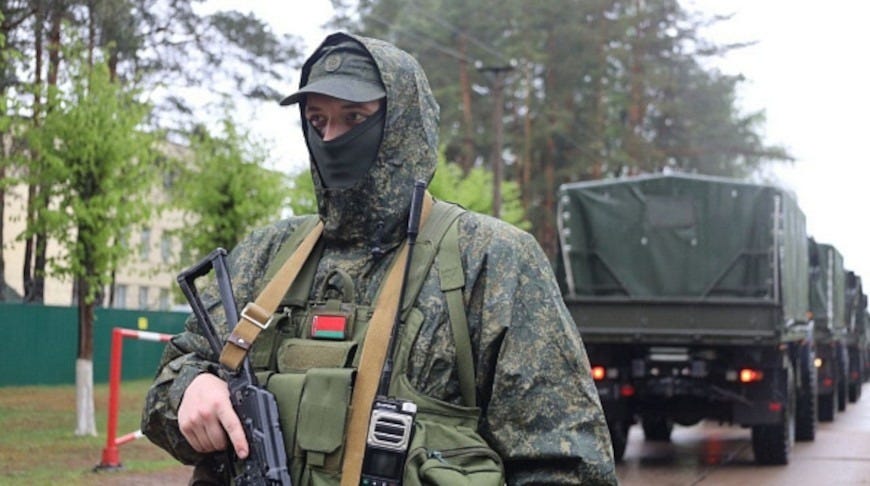
During the night of September 14–15, Italian Eurofighter jets flying as part of the North Atlantic Treaty Organization’s (NATO’s) air-policing mission shot down a drone over Lithuania. This was the first known Russian military drone shot down over Lithuanian territory. Preliminary data showed it entered from Belarus, and the NATO jets shot it down near Kaišiadorys, close to the Kruonis pumped-storage hydropower plant. Lithuanian forces recovered the wreckage and neutralized its explosive payload (LRT, September 16; Lithuanian Ministry of Foreign Affairs, September 18). The same day, Belarus’s Western Operational Command opened a four-day command-staff exercise near the Polish and Lithuanian borders, with announced tasks that included protecting the state border, hunting sabotage groups, and fighting enemy light aircraft and drones (BelTA, September 15). The timing captured Belarus’s current place in Russia’s war against Ukraine, rehearsing defending against drones in the very week that Kyiv said that Russia was using Belarusian territory to get Russian drones to the Polish border.
Pavel Muraveyko, then-Belarusian chief of the general staff, directed the drill. The drill joined the command’s headquarters with those of its subordinate units, and each mechanized brigade contributed a single battalion plus reinforcements. The Belarusian Defense Ministry said personnel and major systems stayed below the 2011 Vienna Document’s notification thresholds. Field activity took place at the Gozhsky range near Lithuania and at two grounds roughly 15 and 60 kilometers (9 and 37 miles) from Poland (BelTA; Kyiv Independent, September 15). Muraveyko framed the exercise as staff work and said that much depended on the ability of the communications and control system to transmit the relevant signals, and insisted the armed forces were not weighing any offensive action (BelTA, September 15).
The drill followed Belarusian President Alyaksandr Lukashenka’s announcement of a continuing military readiness inspection that could extend to readiness for mobilization (Kyiv Independent, September 11). Kyiv was unmoved. Ukrainian State Border Guard Service spokesperson Andriy Demchenko quipped that it would be easier to count the weeks when Belarus is not running some exercise, describing the activity as mainly an information effort to distract from Minsk’s support for Russia. Ukraine’s State Border Guard has reported no strike group massing near Ukraine’s border (Ukrinform, September 16, 18). Taken at face value, Belarus’s September exercise was a command-and-control rehearsal with a thin troop presence. Reading it as a step toward the Suwałki Corridor—a thin strip of land along the Poland–Lithuania border that connects Belarus to Russia’s Kaliningrad exclave—goes beyond available evidence.
The more consequential Belarusian activity is not on the training grounds. On September 12, Russia sent hundreds of drones into western Ukraine along flight paths that hugged the Belarusian–Ukrainian border. Two distinct claims have since converged, and they are worth separating. Serhii Beskrestnov, defense technology adviser to Ukrainian President Volodymyr Zelenskyy, studying the tracks, concluded that the Shaheds used in Belarus “probably have connectivity to Belarusian commercial LTE networks” (Kyiv Independent, September 14). Demchenko, after the drone wave, said that Belarus had switched on purpose-built relay transmitters to boost the signal for Russian Shahed and Gerbera drones, which enter from Russia, skirt the Belarus–Ukraine border to hold the signal, and then push into Rivne, Volyn, and Lviv (Ukrinform, September 16). These two explanations may describe one system or two, but publicly available evidence does not yet settle which.
The claim that Belarus is technologically assisting the transit of Russian drones through its territory into Ukraine rests on more than one voice. On September 18, Demchenko said the drone relays using Belarusian territory and technological assistance to reach deeper into Ukraine had run at a fairly high level since the previous week (Ukrinform, September 18). Oleg Ivashchenko, head of Ukraine’s military intelligence, also reported the resumption of this practice, and the Ukrainian monitoring project E-radar said it had located four transmitters in Belarus’s Homiel region (Charter97, September 14; Belsat, September 18). That convergence matters, but so does its provenance. Every source is a Ukrainian official, a Ukrainian monitoring group, or a Belarusian opposition outlet, actors that share an interest in exposing Minsk’s complicity in Russia’s war against Ukraine. No NATO or Lithuanian technical body has publicly confirmed the drone-relay claim, and Minsk, which routinely casts border drones as Ukrainian, has not acknowledged it. The relay thesis is best read as a well-corroborated allegation, not an established fact.
On June 19, Zelenskyy publicly gave Belarus one week to remove relay equipment that Ukraine said was being used to support Russian drone attacks. Zelenskyy reported that the relays had stopped on June 22, while conceding he did not know whether the equipment had been physically dismantled (Ukrinform, September 16; Kyiv Post, September 17). If the Ukrainian account holds, the June episode shows the relays respond to decisions made in Minsk—switching them off was a political choice, and switching them back on is one too. By mid-September, Ukrainian officials said that Belarus had reactivated the relays.
This problem is especially relevant for NATO because the route Demchenko described runs along Ukraine’s northern border toward Volyn and Lviv oblasts in western Ukraine, both of which border Poland. During the night of September 12–13, a drone destroyed a Ukrainian truck roughly 800 meters (0.5 miles) from the Dorohusk–Yahodyn crossing on the Poland–Ukraine border. Polish border clearance was suspended overnight, and residents of the Lublin and Podkarpackie voivodeships (Polish administrative regions) received alerts as Polish aircraft operated in the area (PAP, September 13). Russian drones also struck the engine of a Kyiv–Warsaw passenger train near Yahodyn, about 2 kilometers (1.24 miles) from Poland (Kyiv Post, September 17). Moscow’s own Defense Ministry said the strikes had targeted western Ukraine rail facilities that move military supplies from Europe, an open admission that it is hitting the corridor linking Ukraine to its partners, and, by Kyiv’s account, doing so with the reach that Belarusian relays extend (Interfax, September 13).
The Russian drone shot down by a NATO jet in Lithuania in September should be read with the same care. After a State Defense Council meeting, Lithuanian President Gitanas Nausėda said the Gerbera was most likely a Russian drone intended for Ukraine that had been diverted from its course by Ukrainian electronic warfare measures before entering Lithuania from Belarus. Vilnius handed Minsk a strongly worded diplomatic protest note and opened a pre-trial investigation into the drone’s origin, ownership, and purpose (LRT, September 16; Lithuanian Ministry of Foreign Affairs, September 18). Investigators have not said whether it relied on Belarusian relays, and that link should not be assumed.
The episode shows how little the accident-versus-intent distinction now explains. Even on Nausėda’s reading, the causal chain ran through Belarusian airspace, and that is the point. A Russian drone campaign that depends on ground infrastructure in Belarus and the use of Belarusian airspace to reach Western supply lines will scatter stray drones over NATO territory as a feature, not a bug. Whether or not any single incursion is deliberate matters less than if the system reliably generates them. Lithuania’s Foreign Ministry came close to saying so, warning of a growing risk of accidental or deliberate violations (Lithuanian Ministry of Foreign Affairs, September 18). Nausėda’s proposed fixes, better identification of incoming objects and alternatives to fighter jets for downing them, treat the airspace over Belarus as part of Lithuania’s threat environment.
Events in the days after the incident supported that reading. On the night of September 21–22, Belarusian balloons again closed Vilnius Airport, one of more than ten such disruptions this year, and Lithuania, which has treated the incursions as hybrid aggression since late 2025, submitted evidence to the International Civil Aviation Organization (CBS News, October 27, 2025; Belsat, September 22). Polish Prime Minister Donald Tusk told his parliament that Russia might purposefully fire drones or missiles into a NATO member’s territory and then call it an accident (Meduza, September 18). The concern reached further west when the Spanish daily El Mundo said Washington had warned of a possible Russian drone strike on Spanish, French, or Italian soil, naming the Gerbera as the likely craft (El Mundo; AeroTime, September 24). Italy’s defense minister called the report unconfirmed, and it rests on anonymous sources. Even so, the report fits in with a campaign whose stray munitions already cross allied borders.
Minsk continues to engage with Washington amid its cooperation with Moscow. U.S. Special Envoy John Coale arrived for talks in Minsk with Lukashenka on September 15, the day the Belarusian military exercise began, after meeting Lithuanian Foreign Minister Kęstutis Budrys in Vilnius, and announced that Belarus would free 25 prisoners in return for U.S. sanctions relief on two firms, Lakokraska and Bellesbumprom (Meduza, September 16). Speaking in Vilnius, where the freed prisoners were taken, Coale said he expected to return to Minsk in about a month for hundreds more releases (Al Jazeera, September 16). The deal extends a process begun in March, when Belarus freed 250 prisoners, and Washington lifted sanctions on the state-owned Belaruskali potash fertilizer company and several financial institutions (see EDM, April 16; Verstka, September 16). Nothing in the public terms of the agreement, however, touches Belarus’s ability to continue its role in Russia’s air campaign against Ukraine. Minsk can thus release prisoners to please Washington while, by Kyiv’s account, its relays help Russian drones strike within a few miles of Poland, even as its integration into Russia’s military machine, nuclear included, deepens (see EDM, June 30, July 7).
For NATO’s frontline states, the most telling signs of Belarusian behavior are not the battalions at Gozhsky. They are the status of the relay network, the routing of Russian drones along the Belarusian border, and the findings of the Lithuanian investigation. The indication that Minsk stopped relays in June suggests Belarus has some control over the process and is therefore a fair negotiating partner, including Washington. The tanks near the Suwałki corridor are what Minsk invites its neighbors to watch. The relays are what Russia’s drone campaign actually uses.