Original Coverage & Source Attribution: thehoya.com
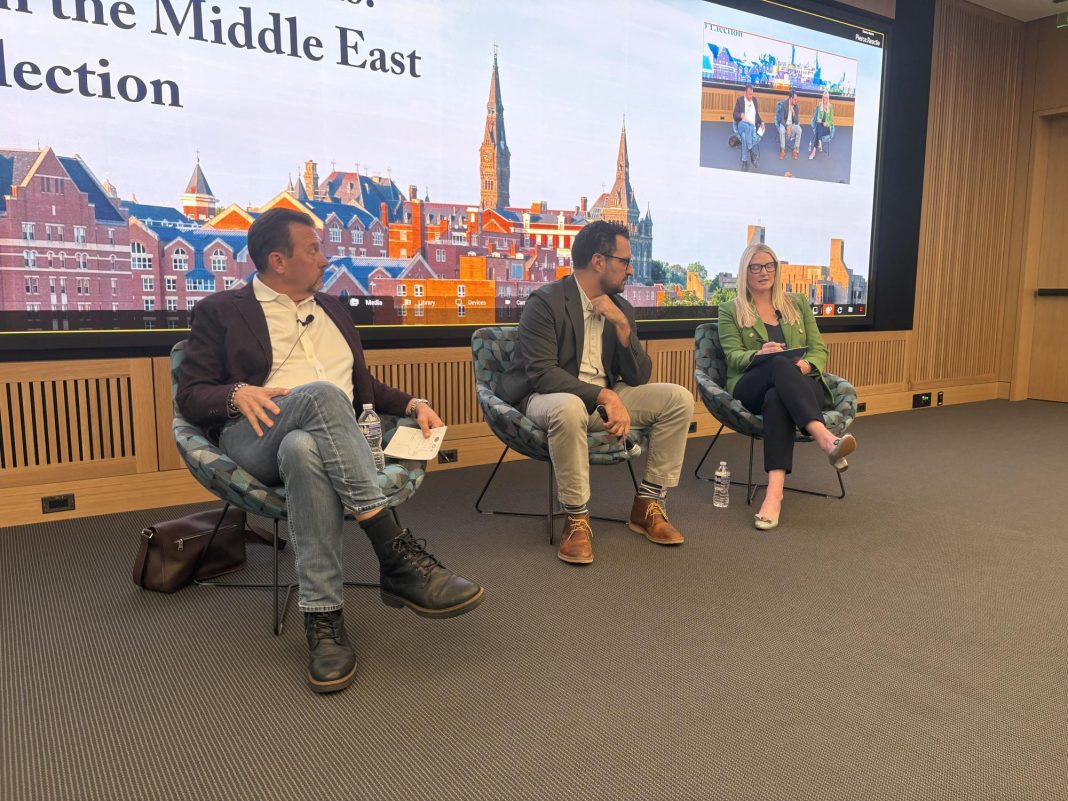
Two foreign policy experts argued a growing affordability crisis and the United States’ ongoing conflict with Iran will merge to form a unique voting issue in the upcoming midterm elections at a Georgetown University event Oct. 19.
Marie Harf, a former U.S. Department of State deputy spokesperson, and Brian Katulis, senior fellow at the Middle East Institute, a think tank, argued foreign policy could play an outsized role in this year’s elections. The Iran war and the White House’s tariff policies have raised consumer prices, which Harf and Katulis said could link foreign policy with economic concerns for U.S. citizens, potentially harming Republicans’ midterm chances.
Harf — who now leads the University of Pennsylvania’s global policy engagement center, the Perry World House — said the Iran war has raised gas prices while tariffs have made foreign goods more expensive, both of which worsened public opinion of the Republican Party.
“When voters say that the cost of living, for many voters, is the most important thing, there are two major things impacting that right now,” Harf said at the event. “Both of which are problems of President Trump and the Republicans’ own making: the war in Iran and tariffs, both of which are foreign policy issues.”
After the United States and Israel launched joint airstrikes on Iran in late February targeting Iran’s growing nuclear capabilities, the resulting conflict has ensnared the Middle East and the Strait of Hormuz, a global trading corridor that funnels 20% of the world’s oil supply. Gasoline and diesel price increases associated with the Iran war have cost over $1,000 per U.S. household, according to experts’ estimates.
After the event, Harf said foreign policy’s current political influence is atypical and speaks to its centrality to affordability.
“The candidates that are doing better are linking the two, making clear for voters that the reason your prices are so high in large part is the war with Iran,” Harf told The Hoya. “That is unusual, particularly for a midterm election.”
The war and its associated costs are a leading issue in the 2026 midterm elections. The Iran war has had a greater influence than expected, eclipsing both immigration and crime in importance to voters.
Katulis agreed with Harf, saying that the war’s unpopularity does not make it a midterm voting issue on its own.
“Will the Middle East impact it? I think only through the factor that Marie identified, which is inflation,” Katulis said at the event. “Democratic candidates that have tied this war to gas prices, to grocery store prices, which I think will actually do quite well.”
According to a report, many midterm races feature attack ads about the Iran war and the economic burdens of the conflict.
Harf said unlike the Iran war or tariffs, she does not believe candidates’ opinions on U.S. relations with Israel will have a significant impact on midterm results because they feel removed from many voters.
“I think voters care about rising costs, inflation, the economy, which is impacted by the Iran war and by tariffs, both foreign policy issues,” Harf said at the event. “They care about healthcare and healthcare costs. They care about the war in Iran in general, but we don’t see voters, in the top number of issues they talk about, talk about their relationship with Israel.”
Katulis said it is unfortunate that voters require economic pressure to care about foreign policy issues.
“I’m alarmed that when you add up the sum total of foreign policy issues — including Iran, Israel, Palestine, but add to it Ukraine, Russia, China — it barely registers when you ask voters what they’re going to go to a poll for,” Katulis said.
Harf said the Iran war and resulting affordability issues could ultimately decide competitive midterm races, pointing to a Fox News poll that showed nearly three-fourths of voters were concerned about the war.
“That’s a really big number when we’re looking at a lot of competitive races and races that are going to be determined by not very large margins,” Harf said.
“Voters care about what’s happening in Iran,” Harf added.