
Original Coverage & Source Attribution: www.theglobeandmail.com
Key Points
-
Amazon is a major player in the AI infrastructure build-out and recently increased its capital spending forecast.
-
The company is seeing results, with its cloud business’ revenue booming.
Amazon(NASDAQ:AMZN) doesn’t need much of an introduction. Most of us know the company very well thanks to its leading e-commerce business, offering customers everything from groceries and mass merchandise to entertainment. This name recognition, as well as its vast fulfillment network worldwide, gives this market giant a solid moat or competitive advantage that has kept revenue marching higher over the years.
The company has also become a tech powerhouse, with the growth of its cloud computing business, Amazon Web Services (AWS). And this unit’s strength in artificial intelligence (AI) has supercharged revenue in recent times — and potentially offers it a major growth opportunity moving forward.
Missed AI’s “Act 1”? Act 2 Could Be 15x Bigger. Most investors think they missed the AI boat because they didn’t buy Nvidia in 2005. But according to our analysts, we’re only at the end of “Act 1″—the R&D phase. “Act 2” is the global rollout. Continue »
Still, Amazon’s stock performance hasn’t been as fantastic as many of its AI peers. While some have soared in the double and triple digits this year alone, Amazon stock has only climbed in the single digits in 2026. With all of this in mind, should you buy Amazon ahead of a key catalyst on Oct. 29? Let’s find out.
<![CDATA[]]>
A major profit driver for Amazon
So, first, we’ll consider the Amazon story so far. As mentioned, the company is known as an e-commerce giant, but in recent years, AWS has become its major profit driver. In the latest quarter, for example, AWS accounted for 60% of operating income. That’s why it’s important to focus on the momentum of this business.
AWS was a growth business prior to the AI boom, offering customers a broad range of core services such as storage and database-oriented options, but the emergence of AI created a fresh element that would significantly boost revenue. The unit now provides non-AI and AI products and services, and demand for both categories has been soaring in recent quarters. Here, however, I’ll focus on AI as it represents a potentially game-changing technology for Amazon and its peers.
In the recent quarter, AWS delivered growth of more than 36%, the fastest rate in 18 quarters. The AI business and the company’s custom chips business each reached an annual revenue run rate of more than $25 billion due to soaring demand. AWS, now at a run rate of $169 billion, could be No. 24 on the Fortune 500 list if it were a separate company, Amazon chief Andy Jassy said during the second-quarter earnings call this summer.
AWS, as the world’s No. 1 cloud services provider, is the natural place for customers to turn to when entering the AI space. They know AWS well, and by coming here, they can keep all of their projects and programs in one location.
“They want their AI inference to reside near their other applications and data, and more of it resides in AWS than anywhere else,” Jassy said during the earnings call.
Amazon’s $220 billion in capex
But what’s the downside of all of this? Amazon has invested heavily and must continue to invest in order to serve demand and prepare for future demand. The company recently increased its cash capital spending forecast for this year by $20 billion to $220 billion. Some investors have worried about the time it will take to monetize such an investment — and have questioned whether Amazon and infrastructure peers are overspending. This weighed on the stock’s performance in recent times, and this could continue to represent a headwind.
Now, let’s get back to our question and the upcoming event on Oct. 29. Amazon is scheduled to report third-quarter earnings after the market closes. Investors will closely watch revenue numbers to assess whether the AI investment is bearing fruit, and they will also listen for comments on demand as well as any changes in capex forecasts.
Amazon’s custom chips business has emerged as a significant growth engine, so growth trends here will be a focus as well.
Should you buy Amazon stock before this potential catalyst? Amazon stock trades at 29x forward earnings estimates, down from about 45x when revenue levels were lower.
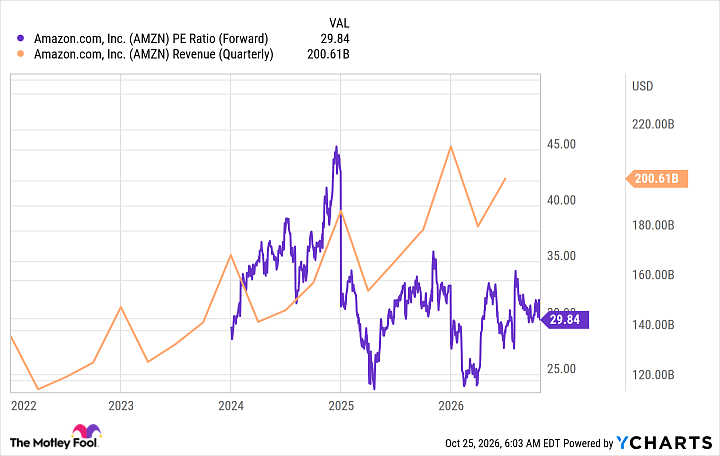
AMZN PE Ratio (Forward) data by YCharts
The stock’s valuation is very reasonable right now considering the stability of Amazon’s e-commerce business, long track record of earnings growth, and the fresh growth possibilities offered by AWS — due to its core business and its AI strengths.
All of this makes Amazon a fantastic buy now. But you don’t have to rush into the stock before the earnings report. That’s because, as a long-term investor, short-term performance — whether positive or negative — won’t have much impact on your gains over time. So you can buy now — or after Oct. 29.
Should you buy stock in Amazon right now?
Before you buy stock in Amazon, consider this:
The Motley Fool Stock Advisor analyst team just identified what they believe are the 10 best stocks for investors to buy now… and Amazon wasn’t one of them. The 10 stocks that made the cut could produce monster returns in the coming years.
Consider when Netflix made this list on December 17, 2004… if you invested $1,000 at the time of our recommendation, you’d have $355,124!* Or when Nvidia made this list on April 15, 2005… if you invested $1,000 at the time of our recommendation, you’d have $1,296,254!*
Now, it’s worth noting Stock Advisor’s total average return is 901% — a market-crushing outperformance compared to 210% for the S&P 500. Don’t miss the latest top 10 list, available with Stock Advisor, and join an investing community built by individual investors for individual investors.
*Stock Advisor returns as of October 26, 2026.
Adria Cimino has positions in Amazon. The Motley Fool has positions in and recommends Amazon. The Motley Fool has a disclosure policy.