


Original Coverage & Source Attribution: goodallandgoodluck.substack.com
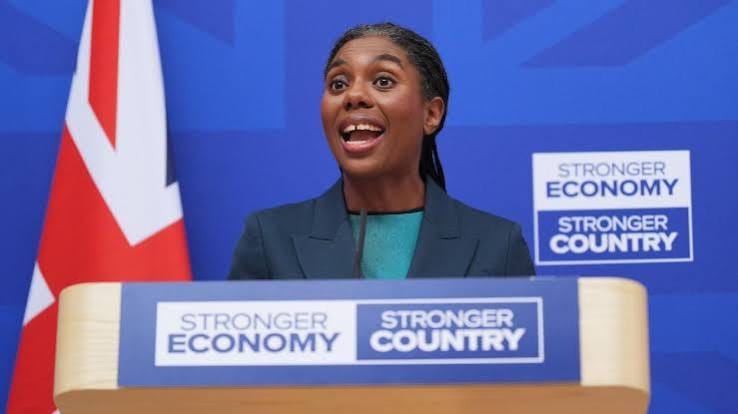
I quite like Kemi Badenoch- there I said it. I suspect she doesn’t much like me. She has repeatedly declined to appear on my Sunday LBC political show. She’s a self-described ideological warrior who seems most to enjoy talking to fellow-travellers. That is most unlike the avatar of Margaret Thatcher that most Conservatives strain every cell for her to be. Nonetheless, she has her qualities: I think she’s a politician who is interested in ideas, talks in broad concepts and who has shown flashes of genuine political bravery.
But her frailties are clear: she thinks speaking as if you’re tweeting is a good way of doing politics: she seems to think the route back to No 10 runs through the replies section, rather than the art of genuine persuasion. She thinks being offensive is an end in itself. In this sense, she is comprehensively a politician of the 2020s, schooled in the dictums of online political life.
In addition, it is often said that she’s not afraid to be disliked. But how would she know? For she exists in the sweetest spot of the Westminster unreality machine, the darling of the conservative papers. As one Reform source observed to me this week, she hasn’t had a negative column or piece written about her in the last year from her own side, despite her fair share of clangers, gaffes (which of course she doesn’t make) and misjudgments. There is not a political figure in Britain who has enjoyed a better press, on the basis of such scant success. Talk of “Kemistry” and the “Badenoch bounce” is everywhere.
The only problem is that neither exists beyond SW1. Consider that the Conservative Party is currently polling lower than they did in the 2024 general election. That performance- at 24%- was itself easily the Tories’ worst result in two centuries’ worth of elections. With the exception of the sui generis Aberdeen South, the Tories have gone backwards in every by-election, local and devolved election since. In Scotland, they became the fifth party at Holyrood. In Makerfield, a seat they were second in not so-long ago, they even didn’t keep their deposit. The natural party of government had to sit with the barely-rans, alongside the standing at the back looking stupid parties, the third party of the right, behind Restore, a force that probably had their party conference this year in a beer cellar in Munich.
Yet, despite all of that, all that failure- there has been no autopsy, no self-reflection, no panic. Indeed, these low-expectations- that the main opposition party must constantly and naturally diminish- seems baked in- or worse, cognitively denied. On each and every occasion, after some electoral drubbing or another, I’ve interviewed a Shadow Cabinet politician who assures me, breezily, that the Conservative Party is recovering. You can only conclude they mean the way a body recovers in a river. In large parts of the country, admiring op-eds notwithstanding, the Conservatives have been replaced wholesale by Reform. Consequently, they have retreated to their basest instincts and deepest dugouts- a party of wealthy, affluent, southern England. When I ask when we might expect the Tory Party to start advancing in elections, something, anything to corroborate this idea of recovery, these shadow cabinet ministers react with an air of genuine confusion. In Kemi-land, it isn’t just Britain protected by an Iron Dome, it’s Tory psychology.
And this is where the good press starts to become self-defeating. It protects them too much. It is the same problem which led to Liz Truss. Because, as I say, there is nothing so powerful in British politics as the right wing unreality machine. It its own Faraway Tree, a place where anything is possible, where anything can be manifested, if you think it hard enough. It’s a place where Brexit will be cost free, where Ed Miliband is a Marxist, where Liz Truss was a serious political figure. The latter point is most salient: anyone, most of all anyone who’d met her, knew that the idea of Truss being capable of being prime minister was risible. She was a walking, talking embodiment of how unserious Britain had become. But her means of transcendence was through sycophantic coverage, what in another country we’d call propaganda, which made this bozo into Boudicca. We all paid a price for it.
Badenoch is a superior political figure to Truss. I happen to think there are circumstances in which she might make a good, powerful prime minister, though not with a politics I share. Being Leader of the Opposition is tough, especially after a shellacking, and I can’t see anyone else within the Tory Party who’d do a better job right now. But however much The Mail, The Sun and The Times might desperately wish it, they cannot summon a Tory recovery into being by the force of their own will. They’re just not that powerful any more, if they ever were. No matter how often they write that ‘Badenoch had had a good week’ – it is not a message you can direct-debit into people’s brains until they vote Conservative. Indeed, in the long run it is self-defeating, obscuring the lack of deep thinking which has barely begun in Tory circles.
Badenoch is keen to relititgate the 1980s, reliving the party’s bravest days. By contrast, the 2010s is barely spoken of, despite being their most recent period of government. The Tory Party, with its typical lack of self-reflection, barely seems to have thought about why they lost. They’ve not thought about their signature political contribution in this period, Brexit and what might have gone right and what might gone wrong and why much of their natural electorate loathe them for it. They think not at all about austerity, and the permanently enfeebling effect on the British state. They regard Truss herself as a bizarre accident, a pimple they popped, rather the culmination of a politics they had groomed. Insofar as they talk about their 2024 rejection at all, Badenoch seems to assign it only to an internecine battling, now exorcised with Braverman and Jenricks’ removal, and a lack of conviction in their own conservatism. They’re the dumped boyfriend of British politics, who thinks the problem was that he didn’t talk about himself enough.
Signs of acceptance would be genuine thinking about public services, an electoral strategy which analysed the state of the electorate as it is now, not wishing it were the one of 1979. They would be thinking hard about how to recreate their most successful coalition of recent memory: 2019. Instead they revert to blue in tooth and claw Thatcherism, a philosophy as outmoded today as Atllean socialism had become in 1979. The unduly positive coverage makes this problem worse, not better. That might be enough to solidify their second place, but no more.
The route back begins with a question more uncomfortable than whether the party was sufficiently conservative: what did its years in power give people reason to conserve? What worked, what failed, and why should anyone trust it to do better? Until it can answer that, demanding greater conviction is just a prescription for repeating the same mistakes more confidently. Badenoch’s admirers should want her to confront those questions. Instead, they keep assuring her that the recovery is underway. The irony is that they tell this self-described teller of hard truths exactly what she wishes to hear.