



Original Coverage & Source Attribution: finance.yahoo.com
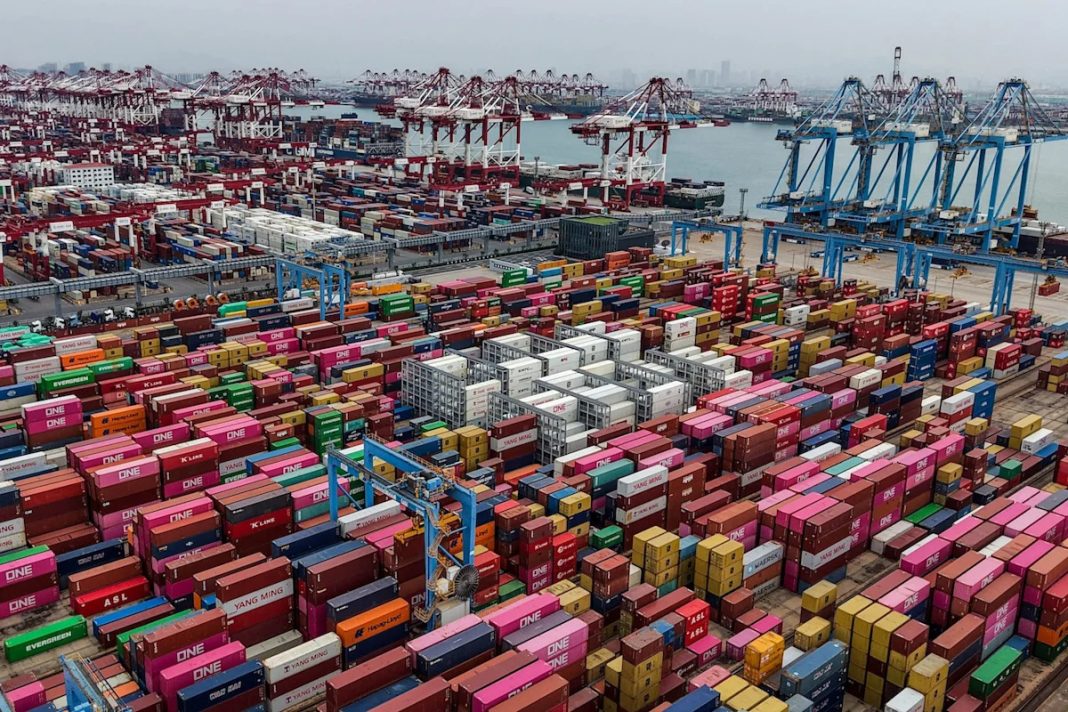
Asia’s container shipping network could take through next summer to work through its current congestion backlog as record volumes out of China continue to put pressure on ports that had dealt with typhoon-related disruption.
Container shipping research firm Sea-Intelligence projects a seven-to-10-month timeline for congestion to ease back to the relatively calm conditions of mid-2025. Even a return to end-of-2025 conditions could take six to eight months, pushing meaningful normalization beyond February’s Lunar New Year.
The estimate comes as Chinese ports are handling an influx of cargo. A record 7.3 million containers passed through Chinese terminals during the seven days through Sept. 20, up 9 percent from the same week last year, according to China‘s Ministry of Transport data analyzed by Bloomberg. Container volumes were up about 6 percent year over year during each of the first two weeks of September.
The figures followed an August where Chinese exports increased 25 percent from the year prior, while imports jumped 28.2 percent. Economists surveyed by Bloomberg this month raised their forecasts for China’s trade growth for the year, now expecting exports to grow 17 percent and imports to rise 22 percent.
The record week and strong projections compound a congestion problem that has already tied up an estimated 8.5 percent to nearly 11 percent of the global container fleet, or roughly 3 million to 3.8 million 20-foot equivalent units (TEUs), according to respective data from Linerlytica and Sea-Intelligence.
Freight forwarder Dimerco’s October Asia Pacific Freight Report said the Port of Shanghai was expected to remain severely congested into mid-to-late October, with berthing waits of more than five days and waiting times exceeding nine days at the port’s Waigaoqiao terminal. The backlogs cut Shanghai’s on-time performance down to 21 percent, while China’s second-busiest gateway, the Port of Ningbo, was at 34.6 percent.
Other major Chinese ports have felt the swell of containers, with Dimerco noting that ocean carriers have cut allocations and skipped calls at Qingdao to clear typhoon backlogs at southern ports.
On Aug. 26, Shenzen’s Yantian Terminals had to implement a 120 percent container receiving cap. Once a single voyage’s intake reaches 120 percent of the vessel’s baseline loading capacity, container receiving is suspended, and no new export loaded containers will be accepted into the port.
Story Continues
This has caused appointment slots to fill within seconds during peak periods, limiting empty-container releases and adding to equipment shortages, according to Dimerco.
The pressure at the ports is showing up in spot freight rates across China and its surrounding countries. Drewry’s Intra-Asia Container Index rose 6 percent from the week prior to $1,491 per 40-foot container on Sept. 24, marking the index’s fifth consecutive record high.
Rates for goods being shipped from Shanghai to Laem Chabang in Thailand accelerated 22 percent to $1,609 per box, while Shanghai-to-Jakarta shipments climbed 12 percent to $2,300 on average.
For shippers, Dimerco recommends booking intra-Asia ocean freight one-to-two weeks ahead of schedule and long-haul shipments two to three weeks ahead.
The recommendation comes as carriers have blanked just under 13 percent of planned Asia-to-U.S. and Asia-to-Europe capacity around China’s Golden Week from Oct. 1-7, according to Dimerco. The freight forwarder says cancellations have been announced on shorter notice than last year, raising the risk of space shortages if demand holds.
“Everyone expected October to mark the start of the slowdown, but the cargo hasn’t stopped and the overflow is still rolling forward,” Ted Chen, Dimerco’s executive vice president of global sales, said in the report. “With carriers blanking sailings at short notice, the real risk isn’t port congestion, it’s space disappearing before you’ve booked it.”
The risk is sharpened by the pace of Chinese cargo flows. Bloomberg reported the record week through Sept. 20 may have signaled an acceleration of shipments ahead of the long-awaited meeting between U.S. President Donald Trump and China’s President Xi Jinping. That summit resulted in the countries extending their yearlong trade truce from Nov. 10 to Jan. 10, 2027. With the extension, both the U.S. and China are planning to cut tariffs on $60 billion worth of goods.
Dimerco expects the elevated flow to continue into the fourth quarter, with China-to-U.S. shipments that had been held back due to the prior tariff uncertainty released just as the normal fourth quarter peak builds.
“Bookings look quiet right now, but that’s the calm before the door opens,” Kathy Liu, Dimerco’s vice president of air freight, said. “Once held-back China-U.S. cargo releases and ocean congestion pushes shippers into air, the space will face some constraints.”
Best of WWD