Original Coverage & Source Attribution: www.jns.org
(Oct. 16, 2026 / JNS)
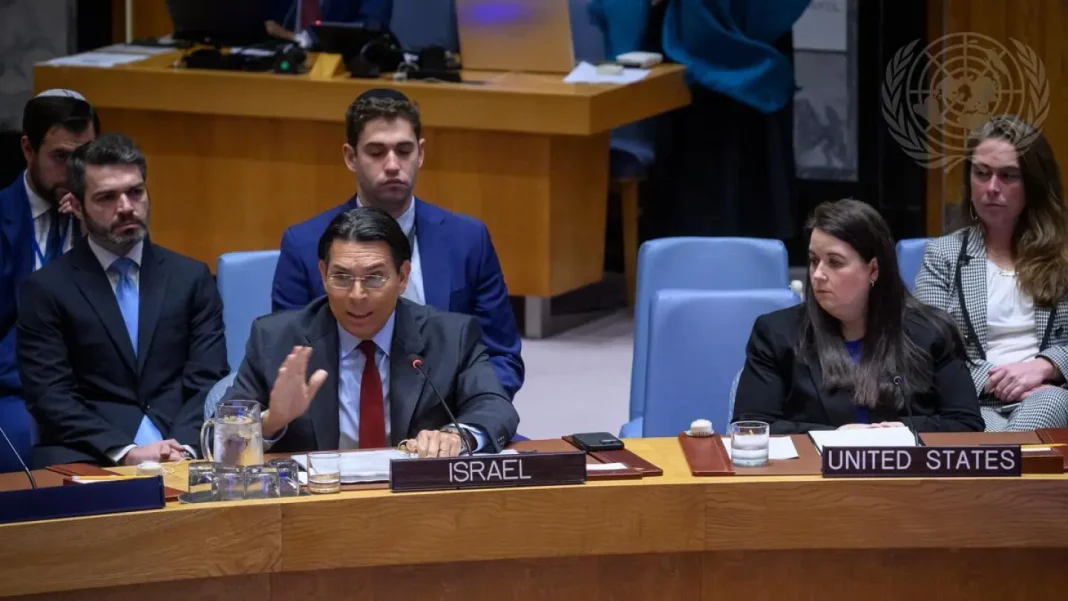
Iran and Hezbollah are trying to interfere with Israel’s upcoming elections, slated for Oct. 27, Danny Danon, Israeli ambassador to the United Nations, told the U.N. Security Council on Thursday.
“It doesn’t matter if it’s a provocative, ballistic missile exercise, a cyber attack or a disinformation campaign. We are issuing a clear warning,” the envoy told the council. “Anyone who attempts to pose a threat or attack Israel will face devastating consequences.”
Danon spoke during the council’s quarterly open debate on the Palestinian-Israeli conflict, held shortly after the third anniversary of Oct. 7. He said that he had repeatedly presented the council with facts and figures documenting the damage inflicted that day.
“We wanted every member to understand what Israel experienced. We hoped this council would finally address this vicious terrorist entity and designate Hamas as a terrorist organization,” Danon said.
“Clearly, nothing happened. Three years later, Hamas is actively terrorizing the people of Gaza,” he said. “Its arms and tunnels are still in use. The ideology behind Oct. 7 remains alive.”
The Israeli envoy also invoked U.N. Security Council Resolution 2803, adopted in November 2025, which endorsed U.S. President Donald Trump’s 20-point plan to end the Gaza conflict and welcomed the creation of the Board of Peace to oversee the transitional government and recovery efforts in Gaza.
“Maybe you forgot what you voted on. I will remind you,” Danon said. “Point number one—number one—of the 20-point plan says that ‘Gaza will be a deradicalized, terror-free zone that does not pose a threat to its neighbors.’”
He said that Israel takes concerns about Gaza’s humanitarian situation seriously and that it has met with the relevant U.N. official to seek solutions. He also said that addressing those concerns without confronting Hamas would not resolve anything.
“Let’s be clear,” Danon said. “If we keep discussing these concerns while ignoring the main issue, we will keep coming back here, talking in circles, and we won’t go anywhere.”
The Israeli envoy said that there needs to be action against the terrorist group.
Ahmet Yildiz, Turkish ambassador to the global body, spoke on behalf of the Organization of Islamic Cooperation. He called for international sanctions against Israel over its support of expanding Jewish communities in Judea and Samaria.
Yildiz urged member states and other organizations to take “all necessary political, diplomatic, legal and economic measures to halt and dismantle the Israeli colonial settlement system.”
Sarah MacIntosh, the British ambassador to the United Nations, also condemned the Jewish state’s planned construction on the outskirts of Jerusalem and said that the British government is “appalled by the E1 development.”
Critics warn that the project could sever territorial contiguity between Palestinian communities in Judea and Samaria.
London recently moved to tighten economic measures targeting Israeli “settlements,” banning trade with Jewish communities in Judea and Samaria and eastern Jerusalem.
Israel responded by downgrading the British consulate in Jerusalem to a smaller diplomatic mission.
France also criticized the E1 plans and decried the Palestinian Authority for another postponement in a series of election delays. Ramallah has not held a presidential election since 2005 or a legislative election since 2006.
Turkey has faced criticism from Israel over its ties to Hamas and the presence of Hamas officials on Turkish soil.
Jennifer Locetta, deputy U.S. ambassador to the United Nations, said that lasting peace depends on Hamas decommissioning its weapons, including depots and terror tunnels.
“Nothing will be taken on trust,” Locetta said.
She urged the Palestinian Authority to end policies supporting terror and its efforts to secure Palestinian statehood through unilateral recognition.
The authority’s future role in Palestinian governance “depends on actions and results, not just claims,” she said.