Original Coverage & Source Attribution: www.firstpost.com
A cyberattack that disrupted refrigeration systems at hundreds of French supermarkets has highlighted a growing weakness in connected devices. As household appliances become increasingly dependent on internet access and remote controls, security experts warn that weak passwords, outdated software and exposed networks can turn everyday gadgets into potential entry points for cybercriminals.
Your refrigerator is supposed to keep food cold, not become a target for cybercriminals. But as everyday equipment gains internet connectivity, the systems controlling appliances can also become vulnerable to attacks, sometimes with consequences that extend well beyond stolen data.
A recent cyberattack on supermarkets in France illustrates the risks. Hundreds of stores belonging to Intermarché, its Netto discount chain and other retailers reportedly experienced disruptions after hackers interfered with refrigeration controls. According to reports by AFP, the incident affected nearly 300 Intermarché and Netto outlets, more than 100 Cooperative U stores and several E. Leclerc branches, including locations across Paris.
Les Mousquetaires, the group that owns Intermarché, said refrigeration units at around 150 of its stores had been heated to 50°C for six hours overnight. The affected food was discarded to avoid potential health risks, the company said.
France’s National Cybersecurity Agency (ANSSI) subsequently identified a vulnerability in software made by Danish company Danfoss, which was used to manage the refrigeration equipment. The incident highlights how a weakness in a system designed to regulate temperature can disrupt operations on a much larger scale.
It also raises a question that is increasingly relevant to households: if hackers can interfere with supermarket refrigeration, how difficult would it be to compromise a smart fridge, security camera or other connected appliance at home?
How can hackers get into home appliances?
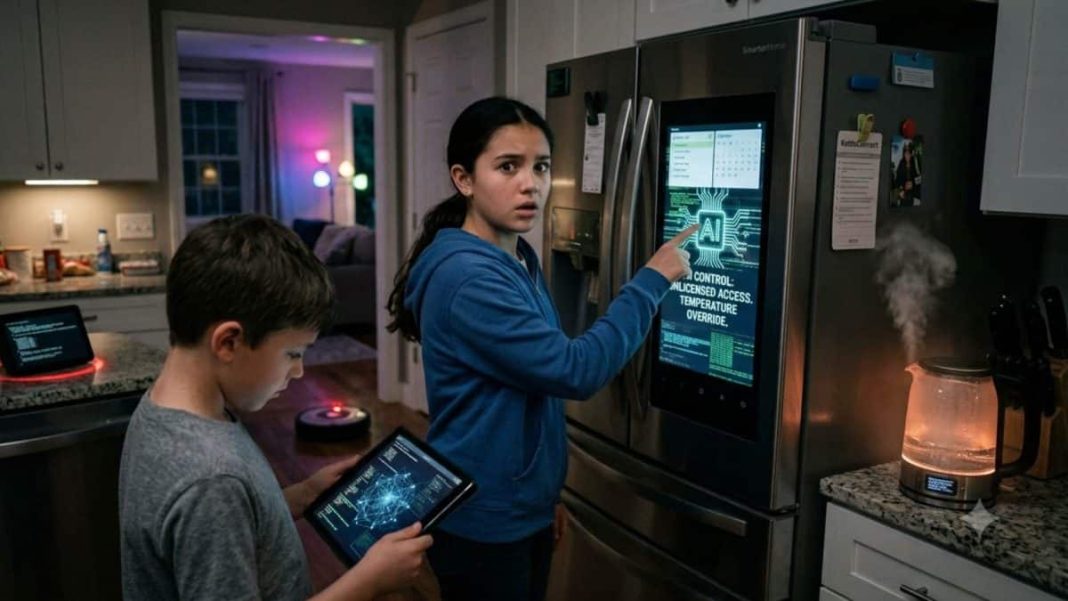
The risk is not limited to refrigerators. Internet-connected cameras, video doorbells, smart televisions, speakers, air conditioners, washing machines and even robot vacuum cleaners can present opportunities for attackers if their security is inadequate.
Anuj Magazine, co-founder and chief technology officer at AI&Beyond, says the important distinction is whether a device connects to the internet and how easily outsiders can reach it.
“Every smart appliance is a small computer with a job,” Magazine says, describing how devices that appear to perform simple household tasks can also have software vulnerabilities.
A conventional appliance without network connectivity is generally not exposed to remote hacking in the same way. However, adding Wi-Fi, an app or a cloud-based control service creates another route through which a device could potentially be accessed.
“The danger depends on several factors, including whether the device is accessible from outside the home, whether it uses secure passwords and whether its manufacturer continues to provide software updates,” he said.
Routers deserve particular attention because they connect multiple devices to the same network. A compromised router or poorly secured camera could provide an attacker with an entry point to other connected equipment.
Robot vacuums can raise additional privacy concerns because some models use cameras, sensors or mapping technology to navigate homes. Smart televisions and speakers may also collect information through their connected features, although the precise risks depend on the product and its configuration.
Kumar Rajagopalan, vice-president of strategic initiatives and country head for India at Dexian, says weak security settings, outdated software and poorly protected wireless networks can leave connected appliances exposed.
That does not mean every smart appliance is an easy target, or that hackers routinely break into individual households. Attackers may instead search for large numbers of vulnerable devices, making poorly secured equipment attractive even when its owner is not personally targeted.
How does it work?
In many cases, cybercriminals do not need to devise a separate attack for every appliance. They can search the internet for devices with known security weaknesses and attempt to exploit whatever they find.
Magazine describes the process in three stages: identifying exposed equipment, gaining access through a weakness and then using that access to achieve a particular objective.
The initial entry point might be a factory-set password that the owner never changed, an unpatched software flaw or a control panel that has been left accessible from the public internet.
Once inside, an attacker may alter settings, collect information, spy on users or use the compromised device as part of a wider network of hijacked machines. The consequences depend on the equipment involved and the level of access obtained.
The French supermarket incident demonstrates why the potential impact matters. Refrigeration controls do not need to contain valuable personal information to cause serious damage. Changing an operating temperature can be enough to threaten food safety and force a retailer to discard stock.
The same principle applies elsewhere: a compromised camera could expose private footage, while interference with a connected heating or cooling system could disrupt its operation.
There is also a difference between demonstrating that a device can be hacked and proving that it is being actively targeted. In 2015, researchers at a hacking conference in Las Vegas demonstrated a vulnerability involving a Samsung smart refrigerator that allowed them to intercept some internet traffic passing through the device. The demonstration showed a possible weakness, rather than evidence that smart fridges are routinely compromised.
For households, the broader concern is that devices are often installed and then forgotten. Unlike smartphones and computers, appliances may receive less attention when it comes to passwords, security settings and software maintenance.
How to stay safe?
Protecting a connected home does not necessarily require advanced technical knowledge. The first step is to change default passwords, use a different strong password for each device and enable multi-factor authentication wherever it is available.
Owners should also install firmware and software updates promptly. If a manufacturer stops supporting a device with security updates, replacing it may be safer than continuing to use outdated equipment.
Magazine recommends limiting the number of devices connected to the internet and disabling remote access when it is unnecessary. A smart appliance that does not need to be controlled from outside the home may not need that feature enabled.
Where the router supports it, placing smart appliances on a separate guest or device network can also help isolate them from computers and phones containing sensitive information. Router administration settings should be secured, and owners should check which devices are connected to their network.
Businesses face similar challenges, but with potentially greater consequences. Magazine says equipment control panels should not be exposed directly to the internet. Access should instead be restricted through appropriate security measures, with systems monitored and updated regularly.
Ultimately, internet connectivity brings convenience, but it also creates responsibilities that can be easy to overlook. A refrigerator may still perform the same basic function it did decades ago, yet the software controlling it can introduce risks that a purely mechanical appliance never faced.
The lesson from France is not that consumers should abandon smart devices. It is that security needs to be considered alongside convenience, from the moment an appliance is connected to the network to the day it is replaced.