Original Coverage & Source Attribution: en.sedaily.com
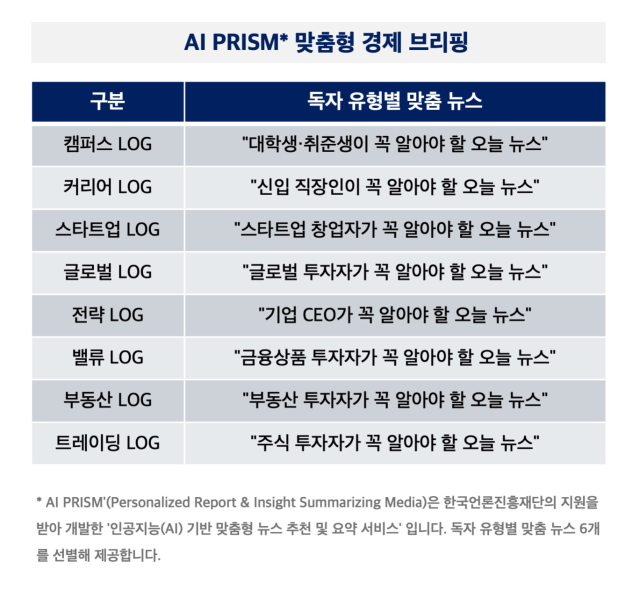
▲ AI PRISM* Personalized Economic Briefing
* Editor’s note: AI PRISM (Personalized Report & Insight Summarizing Media) is an artificial intelligence-based personalized news recommendation and summary service developed with support from the Korea Press Foundation. It selects and provides six tailored news items for each reader type.
■ Moving Off SaaS: As AI capabilities improve rapidly, a growing number of startups are building their own business programs — accounting and human resources enterprise resource planning (ERP) systems and electronic approval tools — instead of subscribing to software-as-a-service (SaaS) products. With vibe coding, in which AI writes code from natural-language instructions, now combined with reverse engineering that analyzes the structure of existing software to rebuild the same functions, some observers say the software market’s reliance on subscription fees could be upended.
■ Technology Export Results: Alteogen (196170) surpassed 100 billion won in quarterly revenue for the first time since its founding, driven by expanding sales of the subcutaneous (SC) formulation of Keytruda and platform technology exports. Its cumulative results through the third quarter alone exceeded both its full-year revenue and operating profit from last year, with the commercialization of its Hybrozyme platform now showing up in the numbers.
■ AI Infrastructure Expansion: Korea’s first AI humanoid data factory has opened, and the government is reviewing plans to establish common standards for AI- and robot-based food manufacturing processes and link them to Korean Industrial Standards (KS). Meanwhile, Anthropic disclosed AI computing contracts worth $895.4 billion, saying it would diversify its chip and cloud suppliers and increase direct procurement through dedicated data centers.
[News of Interest to Startup Founders]
1. “Build It Ourselves Instead of Subscribing”: Startups Cut SaaS Costs
– Key points: As frontier AI models sharply shorten development timelines, more startups are building their own ERP and groupware systems. One startup dropped a large-company collaboration platform that cost about 12 million won a year in subscription fees — while using only its electronic approval and expense settlement functions — and rolled out an in-house program company-wide, consolidating performance reviews and work updates in one place. A second startup is developing a program with ERP functions, aiming to gradually cut multiple subscriptions that total about 5 million won a month. Programs modeled on Adobe Photoshop and Illustrator and Microsoft Word, Excel and PowerPoint have been posted free of charge on GitHub. One venture capital industry official predicted that “only SaaS products with solid internal and external ecosystems, like Slack, will survive.”
– Key points: Alteogen’s third-quarter revenue on a consolidated basis came to 119.8 billion won, up 144.4% from a year earlier, with operating profit rising 195.8% to 78.9 billion won, according to preliminary figures. Cumulative third-quarter sales of Keytruda SC, marketed by partner MSD, reached $1.42 billion (about 1.9 trillion won), expanding sales milestone payments, and two more licensing agreements were added for the Hybrozyme platform (ALT-B4). The company signed a deal worth up to $365 million (about 490 billion won) with an undisclosed global partner in August and another worth up to $3.223 billion (about 4.3253 trillion won) with Novartis in September. CEO Jeon Tae-yeon said the company would broaden its medium- to long-term growth drivers by securing in-house production capacity, developing next-generation platforms and new drugs, and actively considering external technology acquisitions.
3. Government Expands SNS Marketing Support for Small Business Owners From 750 to 1,200
– Key points: The Ministry of SMEs and Startups and the Korea SMEs and Startups Distribution Center will run a social media marketing support program for 1,200 small business owners through the end of the year. The scale of support is 60% larger than the 750 businesses covered last year, and the program centers on experts in each field designing and executing targeted advertising tailored to each product. Advertising was concentrated on Meta’s Instagram and Facebook, preferred by more than 90% of participating small business owners last year, and the program proceeds in stages: diagnosis and consulting, targeted ad placement, and performance analysis and follow-up management. Coffee bean brand Beompyo Coffee Bean Factory drew 2,659 customers to its NAVER Smart Store through the program, recording 25.94 million won in payments.
[Reference News for Startup Founders]
4. Teaching Humanoids How to Work: Korea’s First Data Factory Opens
– Key points: The Ministry of Science and ICT held an opening ceremony for an AI humanoid data factory built jointly by the Korea Institute of Machinery and Materials and the Electronics and Telecommunications Research Institute (ETRI) at the machinery institute’s Daejeon headquarters. The facility collects and trains on robot movement and task data, and marks the first time a data production facility dedicated to bipedal humanoids has been established in Korea. Separately, according to market research firm Interact Analysis, at least 90 data collection and training centers for humanoids were in operation or planned for construction in China as of the end of April, and the Shanghai city government said late last month that it had gathered more than 50,000 hours of multimodal data at a training site in the Pudong New Area. The machinery institute currently operates 12 humanoids, and the government plans to open the facility in phases from the end of next year for joint use by industry, academia and research institutes.
– Key points: Anthropic, which is going public this month, said in an amended registration statement filed with the U.S. Securities and Exchange Commission that its total commitments to purchase and lease AI infrastructure stood at $895.4 billion (about 1,200 trillion won) as of Sept. 30. The largest single contract is a five-year equipment finance lease with Broadcom worth $161.2 billion, followed by Google Cloud at $121.3 billion, SpaceX AI at up to $120.5 billion and Amazon Web Services (AWS) at $110 billion. The suppliers are also investors: undrawn convertible bond limits with Broadcom, Google and Amazon total $77 billion. Third-quarter revenue was $16.962 billion (about 22.8 trillion won), up 46.7% from the previous quarter, but the company posted an operating loss of $567 million. According to The Wall Street Journal, some institutional investors have argued the IPO valuation should be lowered to between $1.5 trillion and $1.6 trillion.
6. AI and Robots Enter Food Plants: Government to Set Technical Standards
– Key points: The Ministry of Agriculture, Food and Rural Affairs is pursuing the enactment and revision of Korean Industrial Standards (KS) for processed foods with the Korea Food Research Institute, and is reviewing plans to identify common standards for AI- and robot-based food manufacturing processes and link them to international standards. The core work involves aligning information exchange methods between equipment, data formats and performance evaluation methods, with the aim of improving compatibility among different production facilities. Food manufacturing has been seen as difficult to automate because the size and viscosity of raw materials are not uniform, but U.S.-based Chef Robotics has surpassed 100 million cumulative servings of ingredients processed, and the De Marchi Group, which adopted Tomra Food equipment, announced that productivity rose 30%. The ministry will hold the 2026 Global Food Tech Technology Standardization Symposium at COEX in Seoul on the 6th to discuss standardization strategies.