Original Coverage & Source Attribution: www.thedrive.com
The Drive your inbox. Every weekday
Our newsletters take you inside the business and culture of cars with breaking industry news, spy photos, and exclusive reporting.
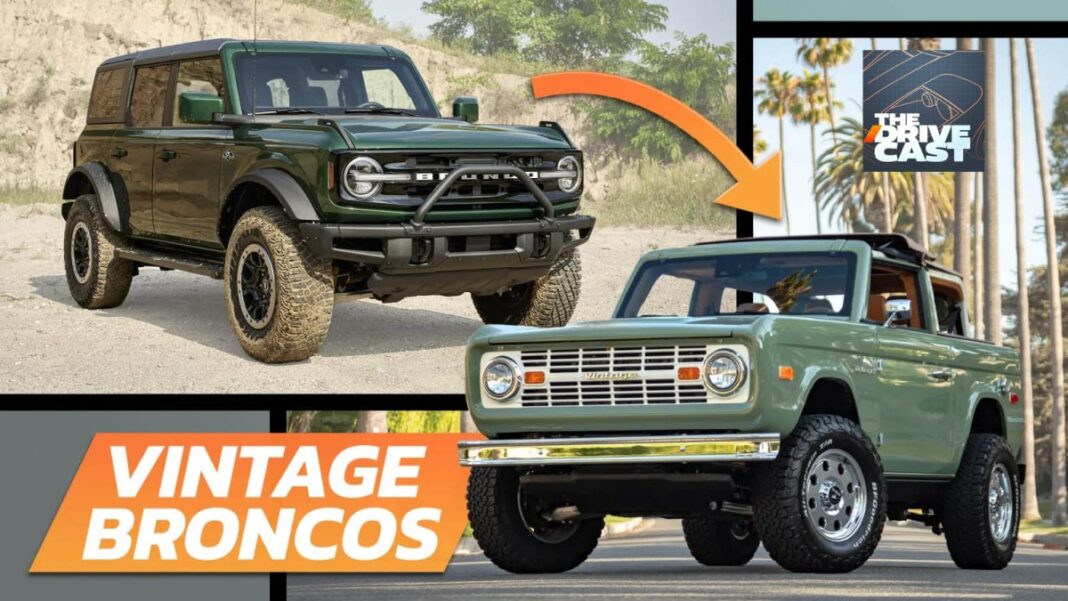
The business of high-end car restorations is extremely competitive, and business is booming. But what started out as turning 1960s and ’70s Ford Broncos into status symbols for celebrities has evolved into a completely new concept of reverse restomods. Why? Because it turns out celebrities don’t actually want an old vehicle experience, from the smell, functionality, and reliability, they just want the look.
On the latest episode of The Drivecast, Chau Nguyen, who is the founder and CEO of Vintage Modern, sat down exclusively with The Drive and explained how, and why, it’s making new vehicles look and feel old. Turns out, safety really, really matters to wealthy buyers.
While it sounds kind of elitist, I know, wealthy celebrities have a lot to lose if they are injured, or worse, in a car crash. And frankly so does Nguyen, who would be the man responsible if something bad, or worse, were to happen to someone in one of his company’s vehicles. He feels that responsibility. He says one of the big ah-ha moments for him was delivering one of his traditional restorations to LeBron James, and then panicking about what would happen if the most famous basketball player in the world got hurt in his truck.
Nguyen has managed to spot and tap into an unmet need in an oversaturated market by going against traditional logic. It’s the only company to turn the reverse-restomod concept into a real business making FMVSS-certified vehicles that actually get crash tested.
Having experience in both traditional builds and these remasters—my word, not his—gives Nguyen unique insight into how the restoration industry has evolved over the last ten years. Also, something we hear all the time is that people want automakers to do exactly what he’s doing—make new cars that look like old cars again. But how has he actually pulled it off?
Today, Editor-In-Chief Kyle Cheromcha and Director of Content and Product Joel Feder had Nguyen break down the future of restomods, why a simple body swap isn’t so simple, and how Vintage Modern turned viral attention into a sustainable business.
First time? The Drivecast is The Drive‘s weekly podcast that takes you behind-the-scenes on the largest controversies, stories, and characters shaping the automotive industry along with the way our roads look today. Powered by The Drive‘s inside access, original reporting, exclusives, and insights, The Drivecast aims to make everyone an insider.
Listen to The Drivecast via Spotify, Apple Podcasts, or Amazon Music. Love it? Like it? Want to help? Leave a five-star review on your platform of choice to help get The Drivecast
Full Transcript
Joel: So Kyle, your Blazer, which is becoming infamous on this podcast between emissions testing and all of the laws we cover. I’m curious, have you ever considered just resto modding is so we can alleviate these issues we talk about with the podcast in your car?
Kyle: It’s that consequences of my actions, here they are, kind of deal. When I first got it, I was obsessed with the idea of I want this thing to be original. I want this thing to be as perfect as it was when it rolled off the factory floor in 1988. The reality of that’s much more difficult to achieve, especially with my budget. And there have been multiple times in the last year especially after the smog disaster that I’ve though, why didn’t I just put an LS engine in this? Why didn’t I just make this a little easier to live with? But it’s the bet I made. But on that topic, we actually have a guest today who is the perfect guy to talk about this whole business of restomods, and that’s Chau Nguyen, who is the founder and CEO of Vintage Modern, which is not, I am told, a traditional restomod company.
You guys don’t even use the word restomod. Instead, your website, your materials calls what you build, “The world’s first fully modernized classic car.” So for those who haven’t heard of it before, can you explain what exactly that means?
Chau: Yeah, definitely. First of all, thanks for having me. And yeah, what it means is we’re all too spoiled today by modern day reliability, engineering and technology to go back into time. And so the journey that I went through was I bought a series of old classic trucks, old Bronco, FJ40 Land Cruiser, old Mustang, H1 Hummer, and they all had one thing in common. They all looked cool. And the other thing they all had in common was they were all very problematic. And so instead of trying to restore or build a restomod, for the person who just wants a classic looking car, but no compromise on everything else, we built the world’s finest, fully modernized, classic inspired luxury car and it gives you the best both worlds.
Joel: By the way, I love how you phrased that. I just got to say we’re all so spoiled because people all the time complain, “Oh, things were so much easier back when I had the carburetors, I can just tinker and whatever, whatever.” And I’m like, because I live in Minnesota, by the way, in the winter, your car didn’t start. Your diesel truck didn’t start. Now you can have a Super Duty with 10 billion pound feet of torque and you push the button when it’s subzero or negative 40 out and it starts in literally two seconds. That’s crazy. And so we are all very spoiled in this era compared to a different era before us.
Chau: Yeah, definitely. And I wouldn’t have known that unless I went through it myself. And so if you’ve never had a classic car before, you have this idea in your head that it’s just going to be so cool and nostalgic, and then you actually have one and the reality makes it very obvious why the market is moving towards more modern. So I’ve been through that pain and been stranded on the side of the road many, many times, and that’s why I felt like I was compelled to do something about it.
Kyle: So just to clarify for everyone listening, what we’re talking about here, restomod traditionally is you take an old truck or an old vehicle and you pack it full of new engineering, new parts, new technology, and try to bring it up to modern day or close enough to modern day livability standards and reliability, which I know is a big part of your thinking too. What you guys do is you take new trucks and make them look old with a completely new body, completely new interior. We call it reverse restomod. I don’t know how that term flies with you guys, but it is a very unique thing. It’s essentially body swapping a vehicle and that brings on its own set of challenges, I assume.
Chau: Definitely. And it was out of necessity too, because the story is that I bought an old Bronco, looked really great from 10 feet away, major problems in steering, braking, leaking, and just rode really harsh. My wife, she did not like me driving our young kids at the time around in an old car with no safety features. And I was always calling her saying, “Hey, you got to come get us because we’re on the side of the road.” But the number one thing that drove all this was that she did not like the way it made her hair smell and her clothes smell. It smelled like gas. And so she’s like, “You got to get rid of this thing.” And so the journey began, which was why can’t it just look classic, but operate like a modern car? And if it could, I would pick a classic looking car over a modern car.
I just think they look way better any day of the week. And so it went from this journey of fixing my old Bronco to falling into restoration, quickly realizing that we’re just taking it back 50 years and that today’s buyer’s expecting more. Then decided let’s go to restomod. As you said, Kyle, modern restoration modified restoration made it more modern, but not quite a modern car. And because we’re all used to getting in the car, hit the button, it starts and go, and you get there safe and you get there reliably, it was very clear that the clients that we were catering to, which is higher in the market, they wanted a modern vehicle that looked classic and they also wanted safety features because they have kids and family and half our customers are female moms with kids. They actually want to drive the car, that they asked us for two things that a restomod couldn’t do.
They wanted it to drive like their modern car, G-Wagon, Range Rover, what have you, and they wanted safety features. And so when we hit that inflection point, it became kind of obvious we have kind of a fork in the road. Do we tell our customers, no, you can’t, it’s the best it can be, or do we come up with a solution? And it occurred to me that what we should do is the opposite of everybody else, because if you really want a modern driving car and you really want modern safety features like airbags and crumple zones and all the things that you get in your modern car, and you’re not a diehard collector, numbers matching, all original, do it yourself kind of person, then all you actually wanted was a classic inspired vehicle. And so I had the idea that instead of attempting to make the classic cars more modern, we take that modern car and we turn into a classic inspired luxury car.
And that concept went from an idea in my head to prototype to production and we’re about to ship build number 500 on that chassis and it has opened up a whole new category. So not a classic car or a restoration or a restomod, but a classic inspired luxury vehicle.
Joel: I want to jump in here because my wife tells me all the time I’m too deep in the world and you don’t know reality anymore, Joel, because you’re just living in this bubble, which probably, possibly, maybe. She doesn’t listen to this, so whatever. But the general consumer, I’ve heard countless times from people, new cars don’t look like old cars. And you’re right, but new cars don’t look old cars because we have regulations around safety and crash and roof crush and front pedestrian standards and people don’t die like they used to. That’s just the bottom line. People don’t die like they used to in so many levels, but in cars. So you’re taking these modern chassis, but then you’re making them the thing you see, the skin of the metal skin, look old. But one of those things that is derived by those safety initiatives is the proportions of the car, whether it’s the roof height, the height of the hood, the way the fenders curve, that all has to do with structure and how it hits somebody and then bends and crumples around both the people that you’re hitting and/or the people inside.
How do you take a new chassis, but make the car look old, but still be modern safety? Does that make sense?
Chau: Absolutely. Great, great question too. So the way you do that is you build an amazing team and we brought in engineers from automotive that came from a lot of the big OEMs and we got together and we’re like, “There is a way to do this the right way.” And so we actually went through FMVSS compliance, that’s Federal Motor Vehicle Safety Standards, to ensure that all of the work that we did to the vehicle, it would still pass the FMVSS compliance, including doing physical crash tests with instrumented dummies because no one had really ever done what we did to this level, meaning that we went out and stamped brand new steel body panels and we took some design liberties. And also the modern car stay bigger, wider, and longer for a reason. They’re safer, they drive better. So your center of gravity, the handling of geometry is different than it was 50 years ago.
If you look at an old Porsche compared to a new one, you’ll see it’s just bigger today for a reason. And so we carefully never modified the body in white, which is really where the safety structure is. And then the body panels, the outside, even though they’re brand new American made steel, we crashed it front, side, rear and with the crash test dummies by the same company or companies that do the big compliance testing for the OEMs and it passed. And some of the tests were actually better than OEM. So the answer is you have to do it very carefully. You have to be very intentional about it. You have to have a great team, and then you have to go through all the compliance testing, which no company I know of at our size or stage had ever physically crash tested a car. They’ll just modify them and stick them out there.
We actually went through all of that. And so inside the door jam of every vehicle we build, there’s a FMVSS compliance label. So we went all the way on this one.
Joel: I do want to note for everyone listening that that cost a fortune.
Chau: Yeah, it did. It cost a lot. And you can imagine crashing one of our cars, which is not inexpensive, was gut wrenching, but we knew that it was an important thing to do. And we also knew with the brand blowing up the way it did, and then the customer shifting from just guys who always dreamed of an old car to now families and people with kids who want to actually drive them every day on the freeway that we had to. And I’m glad we did because it was absolutely worth it. And it’s a signal to the world that we’re not just doing some things here in a shop somewhere. We’re a serious car company, and so compliance is a big, big deal. And I think that’s really the only choice if you’re going to build a company in this caliber. And we knew that if we didn’t go all the way, then we were just throwing parts on a car.
So it gives us and our clients a lot of peace of mind.
Kyle: I got to ask, do you got that test on video and can we see it? Because I’m really fascinated by that.
Chau: It is fascinating. And we post it often in our content on social media. It is amazing how violent a crash is even at 25 miles per hour. You’d be very surprised. Watching the dummies kind of hit the airbag and all that stuff, it’s pretty fascinating and we learned a lot in doing it too. So yeah, if you go in our content, you’ll see us share that crash test publicly with people.
Joel: It is extremely violent. You feel it and you’re outside the room that it’s happening in a viewing area and you feel it in the floor. Also, a real crash is really violent too. I’ve been in a few of those. Not recently, Kyle. Don’t worry. I’m just saying that it is a violent thing.
Kyle: Yeah. The safety of restomods is something, traditional restomods, that’s a topic we’ll definitely come back to because that I think is a big part of what the market is grappling with right now. But I’m also curious, this is a pretty big pivot to go from restoring old Broncos or old trucks to then making your own version of one essentially. How did the business have to change structurally and functionally when you went from A to B there, which was only a few years ago at this point?
Chau: Yeah, a lot’s happened in a few years. So I think in typical restoration, you have very skilled people who are artists and they can do things by memory and feel and they’ve got experience and ability, but a lot of it’s like verbal or sorry, memory-based and visual based. And so when we made the leap from restoration to restomod, we actually moved into a factory and we built an assembly line and then we built standard operating procedures, SOPs for every single step, work instructions, torque spec for every nut and bolt, millimeters for every line and gap. So we were already building this muscle memory of building like an OEM. And the reason for that was the demand side, which was fueled by our social media, which is really, really big. We have about five million followers across all our socials. It was driving the demand for, okay, people want this product.
They are jonesing for a classic-inspired vehicle, but modern everything else. And they didn’t want problems. So restomod made a lot of sense. And so we were building restomods and stood up the factory and the business got really big fast where I think we gained a million followers in just a couple years. And what happened was feedback from our customers was very clear. They were like, “Hey, we love the brand, the fit and finish and the quality, but can you make it drive better?” And they’re asking us to make a short wheelbase narrow track with solid axle vehicle drive better. And so we did everything we could, but then you hit a limit because you can only do so much. And back to the type of customers we were getting, nevermind celebrities and billionaires and athletes just had families who were like, “Hey, I’ve got an eight-year-old and a five-year-old.
Would you drive it every day on the freeway?” And we’re like, “It’s probably more of a cruising type of car, and we want to be honest with that.” And so here’s what happened. The business started getting really big and one delivery in particular changed my outlook on the future, which was LeBron James. And we got LeBron James as a client, super excited. I’m a big LeBron fan. I go to his house in Akron and I deliver him the car. And I said to LeBron, because he was all excited, he’s a huge car guy geeking out over all the features. I said, “Listen, you’ve got to be really careful here. This is a beautiful car. It looks brand new. The parts are brand new, but unlike your other cars, there’s no antilock brakes, there’s no traction control, there’s no crumple zones or airbags. And so when you drive it, just promise me you’re going to be very thoughtful because it can be easy to forget that.” And I would tell it to any customer, but I though to myself, “Man, the responsibility building cars for people that actually going to drive them on the freeway with their family, it’s a big deal.” And that LeBron one had me nervous because I thought to myself, “What are we doing here with the future of the company?
If we want to build a good company, we keep building super high quality restomods, but if we want to build a great company, we really need to change a product to one where at the end of the delivery, you don’t have to tell a customer, be careful on the freeway with your kids if it rains on the freeway.” And all of a sudden the use cases go down. Meanwhile, the price is really high. So what happens when your expectations of a restomod, which is going to usually be like $200,000, $300,000 and above, are here, but the vehicle can only deliver there. That was a big catalyst. And I think just seeing the shift from primarily men to women, I though about my own wife, my wife and the kids, anytime she’d drive it, I’d just be like, “Hey, just be careful.” That always bothered me because I saw where this was going from a brand following perspective.
People want this concept, but we were giving them almost all of it. And so I think that was a big, big kind of inflection point. And the path we chose was let’s give them everything with no compromises. So it was a huge undertaking, but we knew that if we wanted the customers to love the product, not like it, we had to do it.
Joel: Look, I’m a dad. I got two kids. My viewpoint on a lot of things, whether I’m on a racetrack or a back road or whatever, it did change once I became a dad. Suddenly I have something to live for much more beyond my wife. I’m responsible for these little creatures that aren’t so little anymore. And when they were born, I had an E34 M5. I used to be cool by the way. And I put them in this car and I was very keenly aware. I mean, yeah, it was a very safe car in 1991, but this was not a modern car. This was not a safe car by today’s standards. And you crash against a modern car, that thing is going to crumple like a Coke can and it ain’t going to be in the right ways. And that car is long gone, sadly, not as cool as it used to be.
But we do have a 1990 300ZX in my garage, door mounted seat belts and no airbags. It’s 1990, so it’s pre-airbag car. And I’m keenly aware that when I’m driving with my kids in the car, which isn’t often, it is a toy, you’re going to die in that car. If you get in a car accident, it is not a safe car, right? There’s a reason that seatbelts aren’t on doors anymore. I am curious about your comments about safety and particularly demographics, men versus women buying your products. Are you finding that there are more women interested in your guys’ cars to buy than men or is it a split thing? I am curious about the demo split.
Chau: Yeah. So early on, especially in restoration, it was that guy who grew up with his dad or uncle or grandpa wrenching in the garage. And so they’re like, “Hey, I grew up driving a Bronco, so now I want a Bronco.” And you’ve got a lot of that happening. And then over the years as we moved to restomod and people’s perception of a restomod was more modern, modern restoration. So they thought, “Okay, well, I won’t have old car problems and it’ll be more modern.” And so I think in general, restomod opened up the TAM, the total addressable market of people willing to buy a vehicle in that class. But for us in particular, it’s kind of crazy. We built a pink Bronco that went viral globally, and you can make this stuff up pretty much almost overnight after that virality of our pink truck went everywhere, TikTok, Facebook, Instagram, YouTube, men were calling up and instead of just saying, “Hey, I want a truck from you,” they’re calling up saying, “Hey, my wife wants one.” Because when you see a pink car, you’re like, “Oh shoot, I guess I want one of those.” And so the demographic shift shifted all the way to today, 60 / 40 women.
And as that happened, I just got more and more nervous and conscious of the fact that, okay, well, we got to do something here. And so that was also catalyst, which is if your demographics change and your client plans on driving their kids to school on the freeway in the car, and they imagine that they’re going to be able to do that and they can, but it’s just risky. And it was tough because when I saw that, I thought to myself, I know where this is going. And regardless of women, kids, men, doesn’t matter. Can you really build a true legitimate car company if you don’t have safety features, if you can’t pass emissions, if you’re missing the things that are found in a modern car, and then the price point’s high, so people’s expectations are high. So you kind of have all those factors going.
And by the way, I skipped this part, but at that point in my life, I had already owned 50 cars since I was 21 years old, so I knew what our clients wanted. I had already owned Ferraris, Lamborghinis, Bentleys, Rolls-Royces, Aston Martins. I knew what a luxury high-end buyer wanted. They wanted zero compromises. And as a sales guy, you always hate having to justify or be like, “Oh, well, no, it doesn’t have airbags. It doesn’t have safety features.” And we lost a lot of deals to that where people were on the brink, they’re like, “You know what? I’m just going to get a Urus instead or I’m going to go get a G Wagon instead.” So it was almost a necessity because of the clientele that we had. I do think that the lower the price point, the more traditional buyer you’re going to get where it’s like, “Hey, it looks $20,000 car, so we get it.
It’s going to break down, it’s going to leak, don’t have safety features, no big deal.” But at 250,000 plus, people have expectations.
Kyle: That is very interesting because I think the first reaction to when you unveiled this new design, I’m going to call it a remaster. Is that okay? The remaster? When this was fully rolled out in 2024, and again, took the Internet by storm, most people, when they see it, if they’re thinking about value, they’re comparing it to, well, if you spend 250 grand on restoring a Bronco or an FJ or whatever, you’re going to end up with a really, really nice truck. So why would I get this? I don’t care about safety. But it sounds like what you’re saying is that from your experience, the buyers, people are not cross-shopping, do I get a traditional restoration or do I get this? It’s people are cross-shopping it with new cars and deciding I want to get this instead of dropping a quarter of a million dollars on an Urus.
Chau: Yeah, definitely. I mean, you definitely have people that are cross-shopping, but I think what it comes down to today is let’s say you’re going to go shopping today for a new car for yourself, for your family, for your kids. There’s no way you would consider a car that’s new, that doesn’t have airbags and crumple zones, has no crash tested, right? You imagine walking into a Land Rover dealership looking at Range Rover and being like, give me the ones without airbags. It’s not going to happen. So I think it’s just the conditioning of the market today. And the farther back you go, the less I think people were conditioned where, oh no, I have to have airbags, but it’s 2026. So I believe that the demand and the direction the market is going is only going to become more and more modern because that’s what we’re used to.
And restomod kind of signaled that, right? Back before restomod, it was sacrilegious to put in a new motor into a restoration. It was all about the numbers matching, all original, all that kind of thing. I think the audience has changed. I think that the further in a time we get, the more that’s going to be a requirement. And quite frankly, if you’ve ever driven a restoration, you’ll know very quickly why the advancements in technology and engineering happened, right? It was just a necessity. So we’ve come such a long way in 50 years that I’ve been on many, many restoration classic car restomod test drives, and you can just tell the second they grab that steering wheel and they’ve got that play and the different braking, you hear sounds like, whoa, or oh. And that was always hard for me because that was our product and we worked really, really hard to make it as modern as possible, but you just couldn’t get it there.
And I think the higher the price point, the harder it’s going to be to convince those customers that they’d be willing to make those concessions.
Kyle: I’m very familiar with the boat tiller sensation going down the highway in my Blazer. Just real quick, and then I’ll let Joel jump back in. You mentioned the total addressable market earlier. The restomod market in general, it really exploded in the last 10 years, but it does feel to me in my position here that it’s kind of oversaturated at this point, especially the classic SUV space. I mean, we get so many pitches from new shops or startups hawking some remade Defender or G Wagon these days, and it all kind of just feels the same after a certain point. So you’re an experienced CEO. You founded and exited multiple tech startups over the last 15 years. Did you see that as something that’s on the horizon as well is that what we’re doing with restomod, we’re going to run out of buyers at some point. We need to go find the next level.
Chau: Yeah, that’s interesting. I think about it way less than I used to because the restomod business taught us how to build cars and it allowed us to evolve from restoration to restomod. The market we focus on really is a fully certified vehicle at this price point. So you can think of the cars you can buy at this price point. So that’s, as you mentioned, Lamborghini Urus, the Bentley Bentayga, G Wagon, Rolls-Royce, Cullinan. That is a market we focus on because our clients, those are the cars that they drive. As far as restomods goes, I think that a lot of the companies will learn what we learned because we built 200 restomods. So we reach some meaningful scale for a restomod company at the time. And I think that they’re going to find that you’re kind of living in this in between category because you’re not fully modern car.
They don’t pass emissions. And then some of them have titling issues due to certain states because they’re very, very finicky about that kind of thing, depending on where you live. I also think too, clients will believe that the restomod, in our case too, will perform better than what’s in their head, just like a classic car would perform better than what’s in their head. So I think restoniod will be a category that lives for a long time. I think that for the high, high end of the market, they’re going to demand more. And I think what we started this category, I think it’s going to grow because it just makes sense. And I don’t know about you guys, but I like to drive my cars and the more money I spend, I definitely want to drive it. And if I don’t feel like I can drive it, I can’t justify the purchase.
So I think if you are a person that wants to drive the car, not just display it or look at it, then you’re eventually going to want more. And I think that this category modern vehicle that looks classic, I think it’s going to be really, really big.
Joel: It’s interesting. If you look at the market, This is going to be a big price spectrum shift, just so you know, a span. But we’ve got everyone from, I’m just going to name some names, Singer and Workshop 5001, which is a guy that split it off from Singer. We’ve got you guys. We have a bunch of companies that are doing true restomods, like what you talked about earlier where it’s the old car, but it’s new off the show floor. And you can spend anywhere from, I’m going to call it 100,000 on the very, very low end all the way to well over a million, well over a million on some of this stuff. And everyone, there’s splinter cells. It’s almost like these finely cut sections of you’ve got the car that’s the original car that just looks like it’s been completely redone from the factory.
And then you’ve got the guys that are taking the old cars, but they’re upgrading them with modern suspension, upgrading them, but they’re still the old car originally. And you have a brand new engine, you have KW coil overs, and you’ve got Wilwood brakes and all these other crazy things and ITBs. And then all the way to the spectrum of completely bespoke cars that just look like the old cars. And then you have you guys who are, it’s a modern car, but it looks like the old car. And it’s very fine slices. And a lot of these guys own cars from all these different sectors because they have the means to do it. It’s fascinating to hear you talk about how these guys are crush shopping new cars. I don’t think I’ve ever heard a singer workshop or any of these guys talk about like, “Well, we’re being cross shopped with a G wagon. We’re being cross shop against a new 911 GT3 RS.” Because the guy that wants a Singer, he probably owns a 911 GT3RS, let’s be honest, but those are not comparable experiences. They’re not cross shoppable cars. They’re not the same. A vintage Bronco, but modernized like what you’re offering is not the same experience as a G Wagon in the sense that the new G Wagons are not the old G Wagons. They’re wider, they’re less tippy. They have completely integrated electronics and stability control systems and all these crazy things. It’s just a fascinating segment that’s really risen out of nothing in the last decade. There wasn’t even a question in there. It’s just context of the whole thing’s just fascinating to me.
Chau: Yeah, definitely. I can comment on that too. I think before there wasn’t an option, you either chose a new modern luxury high-end SUV, G-Wagon, Urus, Cullinan, Bentayga, whatever, or you chose a restomod or you chose a restoration. And what we’ve essentially done by giving them both is it is an alternative to a Urus or a G Wagon. And now comes in the exclusivity, having something rare, different, and unique. Because even the G Wagon, and I’m a huge G Wagon guy, I’ve had 11 G Wagons, so I’m a big fan. They make 50,000 G Wagons per year. And in certain pockets of the world, Miami, LA, and for certain pockets of certain cities, you pull up somewhere and you’re going to see a bunch of G Wagons and you’re going to see a bunch of Range Rovers. And at this price point, people really value exclusivity.
They want something no one else has and they don’t want to pull up to the kids’ carpool at private school or their country club and see five other black G Wagons. And before you’d have to say, “Well, I could get a restomod, but I couldn’t drive it like my modern car. I’m not going to drive in the rain and I just got to be careful about kids and safety and wife and all those things.” And what we’ve done is by taking those butts away and those compromises, it really truly is an alternative to those vehicles. And that’s why that classification mattered to us because we knew that that market was way, way bigger than a restoration or restomod market. And if you calculate the number of cars that are built over $200,000, it’s huge. It’s like over 150,000 vehicles per year and growing very, very rapidly.
And so I think that for our customers, they also have a G Wagon, they also have a Range Rover and whatever else is in the garage. But when they drive our modern classic truck, they’re really getting the best of both worlds. And the third one is no one’s got one. So they pull up somewhere and everybody’s like, “Wow, I’ve never seen that before.” And it’s just a very different aura. When you drive a classic car or restoration or restomod or our classic-inspired vehicle, driving something classic, people look at it differently. It’s not a yellow Lamborghini that’s like, “Hey, look at me.” You have great taste. It’s like you couldn’t get that without the compromises until the category is created, which is why I believe the category is going to be very, very big.
Kyle: Can I ask you though, you just said the classic just hits different. You see one on the road, you’re like, oh, that’s cool. Then you assume the person driving it is cool. What have you made of the reaction among some camps to your product that it’s like, oh, this is just vibes. This is not actually a classic truck. This is just pretending and therefore I don’t like it. Obviously most of those people are not in the market for one, so who cares? But I’m just curious how you personally have felt about those critiques and if you have developed strategies to sort of counteract that line of questioning from potential buyers.
Chau: Yeah. Well, you actually said it first, Kyle, so I’ll just repeat it, which is typically people that feel that way, they’re not a buyer of the product. Let’s just go into it. If you can afford this car, it’s not an inexpensive car, you’ve got a lot to lose. And you can say, “Hey, I’m going to buy a pure, real, true classic and I’m going to die like a real man.” But I’m pretty sure your wife and your kids have a different opinion about that. And so typically those comments are in the comment section of the internet.
Kyle: We’re familiar.
Chau: Yeah. Yeah, I’m sure. And kidding aside, I think there’s something for everybody. I have a lot of respect for people who can do it themselves. If you can wrench on your truck, your car in your garage, then you are an outlier today especially. And I have a lot of respect for that because we have a lot of craftsmen and women that work for us and it’s not an easy skill to come across. And I think what happens is you look at the market down here in the middle, higher and higher, we listened really carefully to our customers. We didn’t listen to everybody and we knew what they wanted because they told us and I knew what they wanted because I was a buyer too and my wife and my kids. And so because I also grew up in a time where I’m used to things working, we’re used to modern conveniences, we’re used to technology, so nevermind safety features.
Just having Apple CarPlay and the technology that a modern car has, it’s hard to give up. So I was really building the car I wanted for myself, for my family, for my kids. And ultimately something that I knew that when that client received our vehicle, that we were going to be extremely confident when they drove off and we didn’t have to worry. So I don’t think there’s any right or wrong here and I think there’s different kind of categories. And if you’re an all original numbers matching purists that you want to do it yourself, then we’re probably not your builder. But if you just want a classic look, you want no problems, you’re used to the best and you want safety features, then there’s really only one choice. And it was a big bet because people had done it before on a one-off basis or a smaller scale.
We bet the farm on it because we knew that that was what our customers wanted.
Kyle: Right.
Chau: Yeah.
Kyle: You were essentially creating a market because there have been individual projects, some amateur, some done by a professional shop to sort of body swap like this, but no one else has gone about trying to make it a real sustainable business. So I want to talk about the product for a second. And I am saying product because I know you can’t call it a Bronco for legal reasons and I know you can’t talk about those legal reasons. So just to catch everyone up who’s listening, if you’re not aware, your company was sued by Ford in 2024 over using the Bronco name. Now the company’s called Vintage Modern, not Vintage Bronco. And the vehicle is the modern classic truck, which I’m sure was annoying, but also probably good for sales. So I was hoping you can take me through the actual development of this vehicle. You had this idea, what if we had a new truck that looked old?
But then to make it an actual product, we touched on the crash testing a little bit and the restructuring of the company, but just how did it actually get to a finished product?
Joel: How’d you make your car?
Kyle: How did you make your car? How do you make cars? Tell us.
Chau: Yeah, it’s kind of crazy. So the straw that broke the camel’s back was feedback from Ryan Reynolds. So we get Ryan Reynolds as a client. Long story short, go to his house, he drives the restomod, super excited, fit and finish, outside exterior, loves it. I’m sitting in the back with my son. He’s sitting in the front seat driving with Blake Lively, his wife, and he had the reaction that you have when you drive a classic car. He was like, “Oh, hey.” And it was very clear that the car wasn’t for him. I would say for your typical modern car buyer who’s used to modern cars, you don’t even have to have nice fancy luxury cars. You have a modern car, you’re going to notice a big difference. And for him, it was too big of a gap. And so we ended up resolving that, gave his money back because it just wasn’t for him.
He didn’t feel confident. And so I lost a lot of sleep over that deal because I thought to myself, “Wow, what kind of company are we if we can pull in clients like Super VIP A-Lister, but then let them down on the actual product?” And I’m a product guy and I’m a car guy, and I’m also just super objective and very unbiased about my own opinion. And so I knew he wasn’t the only one. When people tell you that, you have two choices, you listen to it or you don’t listen to it. I listened to it. And I took it hard because I was embarrassed too because my son was there too and he was only 14 at the time and I’m his dad, I’m his hero. And he was watching me. He was like, “Well, what are you going to do about it, dad? Are you just going to be brushing on the rug and be like, Hey, it is what it is,” and it’s just not my nature. And so I go back to Atlanta and I call up Bob Nardelli. So Bob Nardelli is a former CEO of Chrysler and Home Depot. My friend met him at dinner one night and told him about what we’re doing and he came in for a tour and he looked around and he was like, wow, you’re onto something big here. So he becomes an advisor, which is huge advantage because now I’ve got a Rolodex like no other. And I called Bob one day, I’ll never forget the phone call because it was the next day, literally the very next day. I said, Bob, we got to change the product.” And he’s like, “Wow, you just spent two years perfecting it, working out the kinks, you’re building rest mods.” I was like, “Yeah, but I think that the customers, they think that they want a classic car. They don’t want a classic car. We should do the opposite.” So I had this idea and I asked him for every contact he had, engineers, chief engineering officer, he had all kinds of contacts. And I talked to all of them and it was very clear, well, you want a longer wheelbase and you want a wide track width, and unless you’re going to go hardcore off-roading, you want independent front suspension too. Three things that the restomod didn’t have and classic cars don’t have. And so I started looking at chassis and I interviewed chassis companies and I thought even if we did make it drive better, there’s no safety features. So you solve one of the two big problems. And I though, wow, if we’re going to go through all this trouble, cost time and only incrementally make it better, then we still fall short. And so then I looked up the wheelbase and length of a modern Ford Bronco and I said to myself, “This is the direction to go, longer wheelbase, wider track with independent front suspension and modern safety features and pass emissions.” And so it really went from this search based on client feedback to make it better to thinking I had a solution and deciding that wasn’t good enough to deciding, you know what? We’re going to build a modern car chassis.
And when I told everybody, everybody’s like, “You’re crazy.” But I think it takes a different perspective. You have to think really outside the box. And we were driven by two things, make it drive better and modern safety features. So it’s very obvious that unless we’re to go raise a billion dollars and go spend 10 years developing something brand new from the ground up, we already had a great platform. So we took that platform and we did a bunch of testing and R&D and design and we created classic inspired body panels that were bigger, wider, and longer to fit a modern car chassis. We went to Detroit. We didn’t go overseas to China or Taiwan where it’s cheaper and we didn’t use a composite or fiberglass. We went with steel, American-made steel. And all the companies I remember when we were getting close in Detroit were like, “You’re crazy.” But I was like, “But this is a maniacal focus we had.
We’re going to make that car drive like a modern car and we’re going to make it safe.” So we stamped brand new body panels, built a prototype, did a ton of testing and found a really great compliance company that was really excited about the project because they’re used to crashing very kind of boring, big OEM giant company cars. And they’re like, “This is really cool. We love this concept.” So they crash tested it and then we had a FMVSS compliant vehicle that had all the airbags. And when we delivered it, it was like this feeling of relief because we knew that that customer literally had the absolute best of both worlds if modern safety, driving, luxury, reliability, comfort was a high priority for you. And so amazing team behind the scenes, small team, short timeframe, no outside capital. They just executed relentlessly.
Joel: So I’m watching the clock. I want to reset for your time and hang on, we can sit here and talk about this all day. Kyle and I do sit here and talk about cars all day, just so you know. That’s literally our job. So I want to do a rapid fire round because I don’t want to leave stuff on the table. So I’m going to combine a couple of my questions for you and just have you rapid fire a question. So what’s the hardest part of all this? And don’t just say crash testing, that’s an easy out. I want to know the whole, what was the hardest part of all of this? Maybe it was crash testing. Where are you sourcing the new Broncos and the parts you need and who’s making all this stuff? And more importantly, have you made a manual transmission model?
Are you worried about future powertrains as Ford phases out this turbo six and it leans on this turbo four and et cetera, et cetera? I know that was a bunch of questions at once, but I’m just trying to… I want to make sure we try and get a bunch of stuff.
Chau: Yeah, definitely. Yes, we build manual transmissions and we love doing them. They’re very fun. The customers that get them love them, but as you can imagine, 95 plus percent are automatic, but we do offer it. The hardest part, man, all of it was hard. People, process, parts. That’s what it takes to build a car. Every bit of it is hard and we’re handcrafted. It’s a 900-hour build per vehicle. And so nailing people processing parts simultaneously is very, very difficult. I think doing it right is the hardest part. Anyone can do it. And we’re super, super conscious about our clients’ happiness. So if they don’t love it, we’re unhappy. And so to do it in a way where we could deliver it on time and meet and exceed their expectations from a quality and service perspective, I think we’re punching well above our weight for the company size that we are.
We’re not a big giant OEM, nor are we massively funded by VC capital. I think that it was an execution play. We had to execute and execute and execute, and we built an exceptional team today. Today we have 170 people, and at the time that we started the factory, we had 12. So a lot of juggling, and if I have gray hair, my head is pretty much from doing this over the last few years. None of it’s easy. But I can tell you the one thing that’s really important is that I’m a car fanatic. I love cars. I’ve loved cars since I was a kid. I did this for free my whole life. When you have passion for it and then you go find other people that have passion, it’s huge, huge unfair advantage and a multiplier effect. So the way we did it was we just fought through all the problems and we just made it as perfect as it could be, as fast as it could be.
And that was a testament to the team, amazing team behind the scenes.
Kyle: I’m going to disrupt the lightning round for a second. Just engineering-wise, in a single build, what is the biggest challenge in re-bodying a modern car? My guess would be all the sensors because they need to work either through or pass through these new steel bodies and a car will freak out if you have one thing out of place these days. So what is the biggest challenge of re-engineering one like this?
Chau: I would say that was not as hard as you would imagine. Now, we haven’t done a Tesla. I would think that would be way harder. A lot of electronics there. The fit and finish, getting the gaps to perfectly align and getting it to attach properly to a OEM chassis and doing it in a way that is going to yield a quality product that people expect this price point, that’s the hard part. And then finding great vendors too, because to find a vendor that could do it is not hard to do, but to find a vendor that could do it on time and produce quality at a price you could afford, and we’re dependent on our supply chain. So I would say the iterative process to go from concept to prototype to production and then constantly improve, you’re never really done. It’s not like you just hit print and then here they come.
You’re constantly making it better and better and better. We have this kind of mindset of continuous improvement because I came from software, building mobile apps, you’re always revising and iterating. I would say lines, gaps and getting it all to bolt up perfectly to when you look at it, people tell us it looks equal to or better than anything in their garage. That was hard.
Kyle: That answer kind of made me nostalgic for the days of Tesla panel gap coverage, which –
Joel: Do you guys still remember the model three at the LA Auto Show and I could see the primer on the trunk lid because the paint was so thin back in my day.
Kyle: Building cars is hard. There’s a very interesting, almost conceptual tension at the heart of this business though that I’m curious for your thoughts on. New cars are not built like old cars. They are safer, more reliable to your points, but they are not made to last in the same way that a Bronco from the 1970s was. And you could argue about construction techniques, but just material wise even. I mean complexity, there’s just less to break. The durability is kind of inherent for an older vehicle. I think it’s one thing to charge a lot of money for a really true nut and bolt restoration because you can then say, “Well, this will last you another hundred years.This thing is good to go.” But that’s not the case for your products and that’s not because of anything you are doing, it’s because of what you have to work with these days.
So how do you think about that tension between this is something that has a sort of defined lifespan at the heart of it that you can’t really control? I know you offer a warranty, but beyond that.
Chau: Well, I would say there’s two ways to respond to that. There are definitely certain parts of classic cars and the way they were built that are bulletproof, the days of really heavy steel, but even then I’d say a lot of those rust a lot and cars notoriously from the ’60s, ’70s, ’80s, those gaps and doors were probably worse than what even Tesla experienced when they first came out. That’s an interesting one. I would say that the misnomer or the misconception that they don’t build them like they used to, I would challenge that. And I think that with the exception of certain quality materials that today the big giant OEMs that are publicly traded that are super, super tight on margin and EBITDA and every penny matters, I think that’s where you’re correct where they’re going to have skimped on certain things because the numbers don’t make sense.
So things might be more plastic or whatever. But I don’t know, and a Rolls-Royce Cullinan is pretty nice inside, so those materials are very, very, very expensive.
Joel: Jerry Perez is going to be so happy you said that. He’s our deputy editor.That’s his favorite part of this podcast episode, I guarantee it.
Chau: There you go. There you go. But I think going back to they don’t build like they used to, is that there is a misconception that the cars are more reliable then and safer because they’re sturdier. But one of the things you guys mentioned is that if you were to crash a modern car into a classic car restoration restomod, the result would not even be close. And people think, shoot, the new cars today, they crumple up like plastic. Well, they’re supposed to crumple around you so you don’t crumple. And it’s all about weight and energy management. And I think that’s kind of the thing that people have in their minds is that, oh shoot, well, the cars, they just kind of look like an accordion. You want that to happen around you so that doesn’t happen inside the cabin. So I think yes, certain materials today I think the big manufacturers skip out on, but I would absolutely choose the reliability and for sure the safety of a modern vehicle over a classic any day of the week.
It’s not even close.
Joel: So we’re butting against time, but I do have one more question I have to ask. What’s next? As you look at the landscape and decide what you guys are going to do next, how you differ from traditional restoration shops, how you’re deciding which vehicles to tackle, customer segments to tackle, these very interesting statistic events for buyer demo, male versus female and all that, what’s next?
Chau: Well, we have a new model coming out that we’re going to announce, I guess, in this quarter.
Kyle: Feel free to announce it right here.
Joel: Yeah, feel free. No time like the present.
Chau: Yeah. We’ll do a follow-up session. Once that happens, I’d love to show it to you guys. When we turn the cameras off, I’ll even give you a little sneak peek. I’m just chasing my dream and I started off as a kid who had no money that dreamed of cars with car posters on his wall. And so the next models, plural, are just the cars I always wanted that I just couldn’t deal with the leaks and squeaks and rattles and breakdowns. And so I’m really remastering, Kyle, your word, the cars I always wanted and in doing so, allowing people to get their dream car that they always wanted, but they were hesitant. And so I think that there’s a long runway there and I think that the category, we were the first mover at this stage or size and scale. We won’t be the last company.
So you’re going to see a whole bunch of them, which is great for everybody because now you can have that old whatever fill in the blank you always wanted. And I think it’s going to be a really, really interesting journey. But yeah, the next one’s going to come out. I will tell you this much. Fast sports car, muscle car without the problems. And I think it’s going to be really, really big.
Joel: I’m just going to say before you show us muscle cameras turn off and we’ll keep our mouth shut. I’m a big gun 60 seconds guy and based on my age, the remake, I’ll admit it. But I’ll tell you, if I was rich, there would be signs and her name would be Eleanor because I want one. Just saying.
Chau: Love it. That’s very cool.
Kyle: Well, we look forward to seeing how you chart a course forward for all of this. Chau Nguyen, thank you so much for your time. This was a great chat.
Joel: Thank you for coming.
Chau: Kyle, Joel, thanks for having me. Appreciate it.