Original Coverage & Source Attribution: www.eletimes.ai
From rule-based workflows to AI-generated content and autonomous decision-making, businesses are entering a new era of intelligent automation.
The Next Stage of Enterprise Automation
Artificial Intelligence Companies are reinventing how they use products, data, and the enterprise. Automation has been a real workload saver for businesses for years and has played a role by automating rule-based manual and rule-based workflows. Then Generative AI arrived with its game-changing capability of content generation- text, images, code, technical documentation. Now we have Agentic AI, which, in addition to generating content, can plan actions, leverage digital assistants, and complete multi-step workflows with very little human guidance.
These three types of technology, Agentic AI, Generative AI, and Traditional Automation, are important for any enterprise running pilots or already investing in digital transformation. They may seem similar but will likely solve different pain points and require different deployment strategies.
Computer scientist and Coursera founder Andrew Ng has said that it’s ‘the new electricity’ because, as widely touted as the technology is, AI is going to change everything, ‘not one thing at a time’. From helping (creating content) to doing (acting), AI and automation are leading a fourth industrial revolution in manufacturing, medicine, finance, security, and IT.
What Is Traditional Automation?
Traditional automation automates instructions, rules, scripts, and flows, automating work that repeats with little human intervention. Examples include: Robotic Process Automation (RPA), batch system jobs, manufacturing controllers, enterprise business rules-based software. These systems work effectively if you know the input conditions, the environment, and the desired output, and you know the relationship between all three. For example, a manufacturing system that controls the plant to follow a control algorithm; a monitoring and alarm system where the alarm sounds when the temperature rises above a specified level; or an ERP system that automatically creates an invoice when the order fulfils certain conditions.
The primary advantages of traditional automation include reliability, stability, speed, and cost-efficiency for repetitive predictable operations. However, conventional and rule-based automation can lack robustness when data is partial, when instructions need to change, or when an unanticipated situation isn’t covered by previous rules. This doesn’t render traditional automation inaccessible, though. There are still uses for conventional automation in situations requiring deterministic behaviour, accurate timing, and consistent reactions—safety-sensitive industrial machinery still needs designed controller hardware. There are still uses for conventional automation in situations where you need deterministic behaviour, accurate timing, and consistent reactions- safety-sensitive industrial machinery still needs designed controller hardware.
What Is Generative AI?
The outputs of generative AI models are created based on the data and format you input into the model. Copywriting, summarisation, coding, translation, and visual design are all use cases for Large Language Models (LLMs), image generation models, and multimodal AI. Unlike classic automation, which relies on structured data, generative AI understands natural language input and can be used by marketers for writing campaigns, software developers for code snippets and summarising technical documentation, and product teams to create ideas for new product designs.
Enterprises are applying Generative AI in their automation use cases. These use cases include customer service, managing the knowledge base, research, and software engineering. Generative AI is useful for providing employees easier ways to search extensive document repositories and to translate complex technical content into understandable content.
However, the technology is imperfect. Models may generate incorrect statements, invented references, or misinterpret instructions. Their results can require review by a human subject matter expert- particularly in technical, financial, legal, and safety- critical contexts. Moreover, generative AI doesn’t just generate content; it lacks the power or capability to actually perform the action. A model might prepare a maintenance report, but it can’t change an asset-management system or make an engineering assignment on its own.
What Is Agentic AI?
An agentic AI can goal-seek (when given instructions), reason out (by planning and executing steps to accomplish a goal), use tooling (e.g., APIs and tools), get feedback, and alter behaviour if the context changes. We see agentic AI as being powered by an LLM (or, in our focus case, a Generative AI) for reasoning and language tasks, while utilising APIs, enterprise data, memory, rules, etc. Agentic AI systems are taught by enterprise chat to explore how they can use generative models for input interpretation, problem solving, and action planning.
Think of a particular IT support function. A classic automation would trigger an alert whenever a server fails. A Generative AI assistant may review the alert and suggest a short list of the most probable root causes. An Agentic AI system that has been configured correctly would gather diagnostic information, review peer-approved troubleshooting instructions, recommend actions, and carry out peer-approved remediation.
Agentic capabilities also enable coordination of multi-agent AI. A retrieval agent might surface results, while one or more subsequent specialised agents carry out processing, and yet other sketches out an execution plan. Multi-agent support might facilitate a variety of advanced workflows, but supporting such collaboration introduces additional problems-especially in coordination, monitoring, permission, and accountability. Agentic skills do not mean that humans lose control.
Agentic AI vs Generative AI vs Traditional Automation: Understanding the Differences
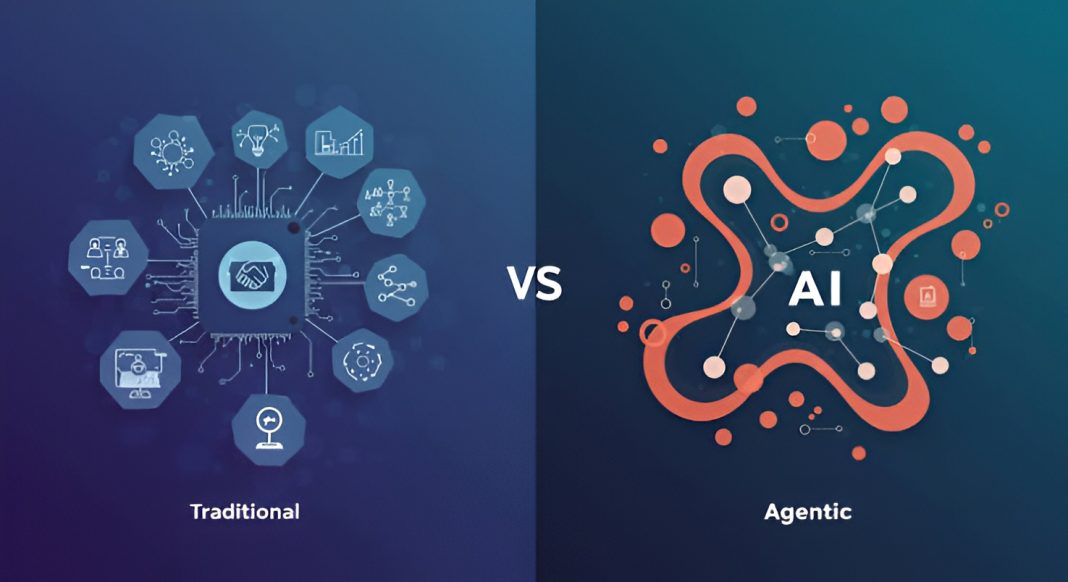
The biggest contrast between Agentic AI, Generative AI, and Traditional Automation is how each approaches a given task. The traditional Automation approach is to follow a set process. This is most effective for repetitive tasks where the data inputs and outputs are known—examples include AP automation, predefined reporting, and assembly line control.
Generative AI generates text or other output from a prompt. It is helpful for writing documents, summarising, generating code, and knowledge work. Agentic AI combines reasoning, planning, and use of tools to achieve a long-term goal via a series of steps. It can gather information, decide between alternatives, connect to multiple interacting applications, and determine when a goal has been reached.
For instance, with traditional automation, the ticket would be assigned based on parameters, and with Generative AI, it could be summarised and potentially even responded to. Generative AI could even be used by an agent to create a draft resolution. An Agentic AI could retrieve the customer order history, compare that to the refund policy, generate a suggested outcome, and activate a supported process step. And it’s not always a case of choosing just one: all three can be used together in the same automation.
Real-World Applications Across Industries
Manufacturing and Industrial Operations
At the manufacturing stage, Traditional Automation sets the pace for manufacturing, conveyor planning, and repetitive assembly. Generative AI may help engineers when they read logs, write manuals, or guide troubleshooting of failed equipment. Agentic AI can support authorised workflows: Collect sensor data, generate a service ticket, check availability of spare parts, and coordinate dispatching a technician. In the industrial use case, keep the AI agents as close as possible to the traditional control system: Request safety interlocks and high-impact actions only after engineering control approval has been obtained.
Healthcare and Financial Services
In healthcare, Generative AI in the healthcare could generate summarise of clinical documentation, and help with administrative correspondence. Agentic AI might lead scheduling, obtaining approved records, and similar tasks. Clinical decision-making would require appropriate professional governance.
In Financial Services, traditional automation handled transactional processing, whereas Generative AI can create summaries of financial documents and even assist with customer engagement. Agent AI can help with fraud investigation by gathering evidence and escalating concerns. Payments and changes to accounts should have controls and audit trails.
Cybersecurity and IT Operations
Typical security automation generates alerts by configured indicators. Agentic AI may help security analytics by summarising incidents, investigation reports and producing plain language explanations of technical results. Agentic AI for cyber security may gather approved data sources, prioritise alerts, collect evidence, and carry out approved actions.
However, with greater access comes greater risk. A badly trained agent could alter data, disclose sensitive details, or make a mistake and take the wrong action. This is why organisations need least-privilege access, observability into actions and decision points, and the ability to pause and revert those decisions.
Challenges and the Road Ahead
Digital automation processes are different. You are switching from high-volume test automation to a completely new process, and there are a few factors to consider before you decide. Data quality, integration cost, human resilience, security, and performance. Conventional automation is reliable but less flexible. Generative AI is flexible but unpredictable. Agentic AI is flexible but unpredictable. Agentic AI is more powerful operationally but comes with new, more complex risks, as the system can query applications.
Microsoft CEO Satya Nadella has been talking about an emerging agentic world- where AI agents operate in the jobs of humans, teams, and enterprises. This vision’s next step is to utilise enterprise systems to orchestrate work between teams and individuals and not simply in response to the work they submit. Pragmatic advice: automate the routine work that is deterministic; Generative AI for work that involves language and content generation; and Agentic AI for case orchestration that is multi-step, multi-function, multi-stakeholder, multi-outcome where the complexity merits more nuance. Minimise human oversight as the scale of potential consequences of an action increases.
Conclusion
Looking at Agentic AI vs Generative AI vs Traditional Automation, we see three flexible dimensions for enterprise tech: Traditional automation provides predictable execution, Generative AI allows machines to produce and consume new data, and Agentic AI gives machines the ability to orchestrate a series of actions to achieve an explicit goal.
Hence, for businesses, the goal shouldn’t be to replace each process with the latest AI, but rather to choose the right capability for each use case, artfully connect the systems, and retain the right level of human oversight. An enterprise that leverages both deterministic automation and Generative AI with well-governed AI agents will be more agile, productive, and responsible.