Original Coverage & Source Attribution: www.fool.com
On Nov. 16, 2022, Nvidia (NVDA -3.85%) reported results for the third quarter of fiscal 2023. It wasn’t a great report. The chip designer missed Wall Street’s average bottom-line target, even.
Revenue fell 17% year over year, and gaming sales were cut in half. New U.S. export rules blocked its top data center chips from China. Management took a $702 million inventory charge for products it no longer expected to sell in the Chinese market. If you skimmed the headlines that evening and went back to your couch, nobody could blame you.
Two weeks later, OpenAI released ChatGPT, and the tech world went bananas. Nvidia was already shipping chips to support the generative AI wonder. The stock was worth roughly $390 billion back then, and $5.5 trillion in October 2026. Things have changed, and November 2022 was a turning point.
So I went back and checked out that ho-hum earnings call. Hindsight is cheating, I know. It’s also a pretty good way to learn what an early signal might look like before it becomes obvious.
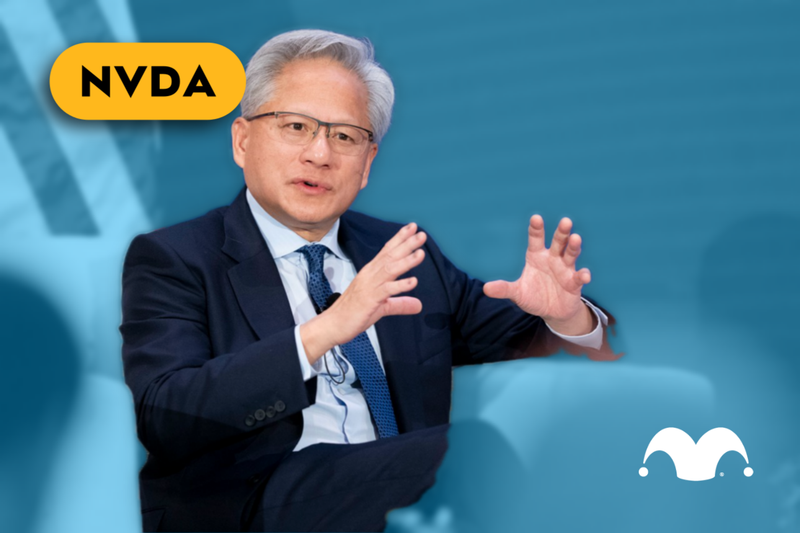
Nvidia CEO Jensen Huang. Image source: Nvidia.
The ghost in the gaming numbers
Nvidia still had a gamer’s reputation. The pandemic graphics card frenzy, further juiced by crypto miners, had ended with a whimper. Its ghost was haunting the sales channel in the form of unsold inventory and secondhand cards on eBay. When an analyst asked about leftover mining hardware, CEO Jensen Huang said he didn’t expect blockchain to be an important part of the business anymore.
In 2022, it sounded like Huang dodging an uncomfortable question in the middle of a crypto winter. He was absolutely right, though. Ethereum switched from GPU-based mining to a proof-of-stake system in September that year, and specialized processors were already orders of magnitude better for mining Bitcoin. Even if the AI boom hadn’t been around the corner, the crypto-mining surge was over.
Meanwhile, in the other corner of the income statement, data center revenue rose 31% to a record $3.8 billion. Gaming fell 51% to $1.6 billion. Just one year earlier, gaming had been the bigger segment. By this quarter, data center was about 2.4 times its size and made up nearly two-thirds of total revenue.
The new pillar of the business had been poured and set while most of the attention stayed on the gaming wreckage.
Nvidia named the trend before it had a mascot
What gets me is that management wasn’t hinting. CFO Colette Kress credited data center growth to workloads like “large language models, recommendation systems and generative AI.” Huang called it “the beginning of the era of generative AI.” The investor presentation flatly stated that LLMs “are widely viewed as the most important AI models today.”
Many investors still had to look up what LLM meant. This was before ChatGPT turned the acronym into casual dinner-table material.
The deck also had a chart about the computing power needed to train transformer-based AI models. It was growing about 275 times every two years, versus 8 times for everything else. Squint at that chart as a sales forecast for an AI chip company, and it starts to look exciting.
Then came the metaverse slide
The deck didn’t stop at LLMs. The very next slide pitched Nvidia’s Omniverse computing systems as a foundation for the metaverse. A later slide declared metaverse applications “the next wave.” The company’s $1 trillion market opportunity slide gave Omniverse software the same $150 billion estimate as AI enterprise software.
On paper, it was a coin flip. Facebook had renamed itself Meta Platforms (META -3.53%) about a year earlier. In an alternate universe, virtual reality worlds might have taken the spotlight that AI stole in 2022 and 2023.
To be fair to Nvidia, Omniverse was mostly aimed at industrial digital twins for factories and rail networks, not cartoon avatars, and the product is still around. It just isn’t what turned Nvidia into a $5.5 trillion company.
The unglamorous plumbing
Huang spent several answers on networking. He argued that high-performance interconnects pay for themselves in large AI data centers. The deck described the network and storage as part of “the computing fabric,” not separate add-ons. Microsoft (MSFT -1.90%) was about to launch an AI infrastructure platform, running entirely on Nvidia’s InfiniBand networking. That systems-level approach helps explain why Nvidia captured so much of the AI spending wave, not just the GPU slice.
Microsoft also happened to be OpenAI’s biggest backer. Nobody on the call connected those dots.

Today’s Change
(-3.85%) $-8.79
Current Price
$219.73
Key Data Points
Market Cap
Day’s Range
$219.64 – $226.00
52wk Range
$164.27 – $243.37
Volume
73.7M
Avg Vol
119M
Gross Margin
74.67%
Dividend Yield
0.23%
The H100 was already rolling
Nvidia started shipping its H100 data center GPU during the quarter. Huang said customers were “clamoring” for it. He expected large volumes by early 2023, a faster ramp than the prior generation. The slide deck said partners would roll out the first wave of H100 products and services in fiscal Q4. ChatGPT launched in that same quarter.
Timing like that is hard to plan. For investors, the signs were hiding in plain sight.
What I’d borrow from this call
None of this guaranteed what happened next. Nvidia guided for $6.0 billion in fourth-quarter revenue, barely above the third quarter. China export restrictions, inventory charges, and a gaming slump dominated the near-term picture.
Yet, data center revenue was growing while everything else shrank. Management was talking specifically about LLMs and generative AI. A new flagship chip was ramping into exactly those workloads.
Those three signals are worth watching for in any earnings call: which segment keeps growing through a downturn, and which topics management keeps returning to.